Can you please explain why you think
1. Gaddafi should remain in power even though he has ruled as dictator for 42 years
2. What options you suggest about achieving political justice in Libya in the face of Gaddafi's dictatorship?
If I am wrong that you want Gaddafi in power please forgive me and please explain what you would like.
I see that you have consistently addressed the Gaddafi issue in terms of your conception of African racial solidarity. How relevant is that sentiment or stance in the face of the realities of a struggle to decide whether Gaddafi stays or not,between rebel Libyans, Gaddafi and the Western allies of the rebels ?
Is the situation not too complex for racial solidarity as a valid respopnse to this crisis?
I am also curious about your understanding of the African character of Gaddafi and the cultural context in terms of which he operates. To what degree are Gaddafi and that context African and to what degree are they Arab? How do we define the distinction, if any?
In relation to this, what is the racial configuration of Libya and to what racial group within that pattern does Gaddafi belong to? What is the ethnicity of the king overthrown by Gaddafi?
Questions that might be relevant.
If you have addressed these issues earlier please direct me to the post when you did so.
Of course, the double dealing by the West described in the post you forwarded is valid but does it necessarily invalidate Western intervention in Libya in the face of the weakness of African and Arab governments, to whose constituency Libya belongs by geography and cultural ideology, weakness that were glaring as Gaddafi slaughtered protesters, while the West bidded its time waiting for the tide to turn before they acted?
Does a pragmatic interpretation of international politics not imply that while one recognises such contradictions, one appreciates the need to act with urgency even by compromised actors like the West?
thanks
toyin
--
United States of Africa 2017 Project Taskforce2011 July 12The Hon. Barack H. ObamaPresident of the United States of Americac/o Secretary of State Hillary ClintonWashingtonDear President Obama:This letter is to endorse today's Human Rights Watch report calling on you to investigate and prosecute former George W. Bush and other top officials of his administration for war crimes.We are deeply distressed by the fact that your administration continues to be the loudest in Third World countries in purported defense of human rights while you are protecting America's own war criminals from justice.You have lately pushed for and backed the International Criminal Court's warrant for the arrest of Col. Gaddafi, who you, President Sarkozy and Prime Minister Cameron are seeking to assassinate on the other hand. We would like to know why you so zealously want Gaddafi in the dock and not Bush, Richard Cheney and, among other American war criminals, Donald Rumsfeld.To the contrary, you have conveniently kept quiet regarding the recent United Nations dossier and many other reports accusing the American and European imperialist puppets in Benghazi of war crimes against the civilian population, including black immigrant workers from sub-Saharan Africa that they brand as mercenaries for Gaddafi.Whatever happened to the Barack Hussein Obama of 2008, who pledged to reform Washington? We genuinely want you to realize how the status quo has swallowed and changed you beyond redemption! What are you going to tell us next year when you come back to us for our votes?In short, Mr. President, investigate Bush and company for war crimes and get out of Libya now, not tomorrow. Stop the American arrogance and hypocrisy at home and abroad.Sincerely,Bosire MosiDirector of CommunicationsJULY 11, 2011
George Bush
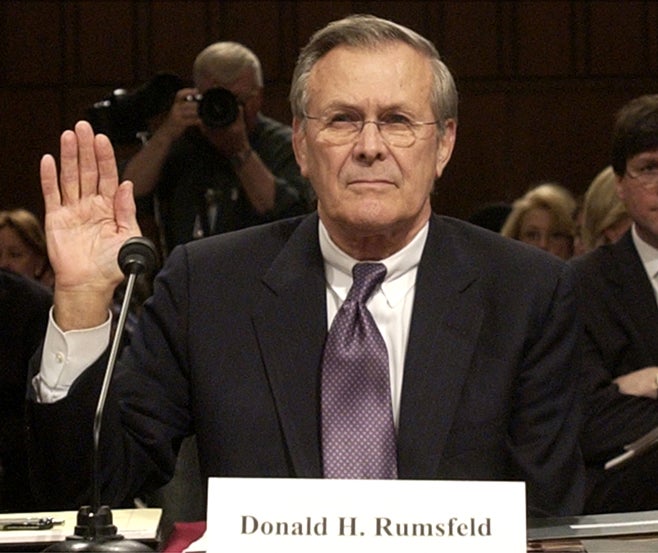
© 2004 AP ImagesDonald Rumsfeld
© 2004 AP ImagesDick Cheney
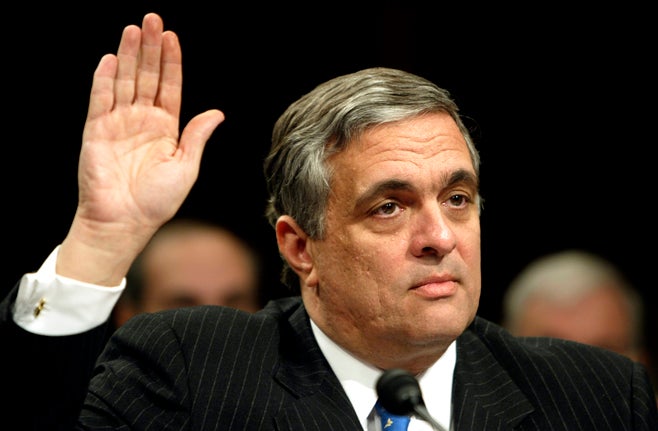
© 2006 AP ImagesGeorge Tenet
2004 Reuters
There's overwhelming evidence of torture by the Bush administration. The Obama administration has a legal obligation to investigate. Jessie Graham reports.
There are solid grounds to investigate Bush, Cheney, Rumsfeld, and Tenet for authorizing torture and war crimes. President Obama has treated torture as an unfortunate policy choice rather than a crime. His decision to end abusive interrogation practices will remain easily reversible unless the legal prohibition against torture is clearly reestablished.
Kenneth Roth, executive director(Washington, DC) - Overwhelming evidence of torture by the Bush administration obliges President Barack Obama to order a criminal investigation into allegations of detainee abuse authorized by former President George W. Bush and other senior officials, Human Rights Watch said in a report released today. The Obama administration has failed to meet US obligations under the Convention against Torture to investigate acts of torture and other ill-treatment of detainees, Human Rights Watch said.
The 107-page report, "Getting Away with Torture: The Bush Administration and Mistreatment of Detainees," presents substantial information warranting criminal investigations of Bush and senior administration officials, including former Vice President Dick Cheney, Defense Secretary Donald Rumsfeld, and CIA Director George Tenet, for ordering practices such as "waterboarding," the use of secret CIA prisons, and the transfer of detainees to countries where they were tortured. "There are solid grounds to investigate Bush, Cheney, Rumsfeld, and Tenet for authorizing torture and war crimes," said Kenneth Roth, executive director of Human Rights Watch. "President Obama has treated torture as an unfortunate policy choice rather than a crime. His decision to end abusive interrogation practices will remain easily reversible unless the legal prohibition against torture is clearly reestablished." If the US government does not pursue credible criminal investigations, other countries should prosecute US officials involved in crimes against detainees in accordance with international law, Human Rights Watch said. "The US has a legal obligation to investigate these crimes," Roth said. "If the US doesn't act on them, other countries should." In August 2009, US Attorney General Eric Holder appointed Assistant US Attorney John Durham to investigate detainee abuse but limited the probe to "unauthorized" acts. That meant the investigation could not cover acts of torture, such as waterboarding, and other ill-treatment authorized by Bush administration lawyers, even if the acts violated domestic and international law. On June 30, Holder accepted Durham's recommendation to carry out full investigations of two deaths in CIA custody, reportedly from Iraq and Afghanistan. Human Rights Watch said that the narrow scope of Durham's inquiry failed to address the systemic nature of the abuses."The US government's pattern of abuse across several countries did not result from the acts of individuals who broke the rules," Roth said. "It resulted from decisions made by senior US officials to bend, ignore, or cast the rules aside."
In citing the four top-level Bush administration officials, Human Rights Watch said that:
- President Bush publicly admitted that in two cases he approved the use of waterboarding, a form of mock execution involving near-drowning that the United States has long prosecuted as a type of torture. Bush also authorized the illegal CIA secret detention and renditions programs, under which detainees were held incommunicado and frequently transferred to countries such as Egypt and Syria where they were likely to be tortured;
- Vice President Cheney was the driving force behind the establishment of illegal detention and interrogation policies, chairing key meetings at which specific CIA operations were discussed, including the waterboarding of one detainee, Abu Zubaydah, in 2002;
- Defense Secretary Rumsfeld approved illegal interrogation methods and closely followed the interrogation of Mohamed al-Qahtani, who was subjected to a six-week regime of coercive interrogation at Guantanamo that cumulatively appears to have amounted to torture;
- CIA Director Tenet authorized and oversaw the CIA's use of waterboarding, stress positions, light and noise bombardment, sleep deprivation, and other abusive interrogation methods, as well as the CIA rendition program.
In media interviews, Bush has sought to justify his authorization of waterboarding on the ground that Justice Department lawyers said it was legal. While Bush should have recognized that waterboarding constituted torture without consulting a lawyer, there is also substantial information that senior administration officials, including Cheney, sought to influence the lawyers' judgment, Human Rights Watch said.
"Senior Bush officials shouldn't be able to shape and hand-pick legal advice and then hide behind it as if it were autonomously delivered," Roth said.
Human Rights Watch said the criminal investigation should include an examination of the preparation of the Justice Department memos that were used to justify the unlawful treatment of detainees.
Human Rights Watch also said that victims of torture should receive fair and adequate compensation as required by the Convention against Torture. Both the Bush and Obama administrations have successfully kept courts from considering the merits of torture allegations in civil lawsuits by making broad use of legal doctrines such as state secrets and official immunity.
An independent, nonpartisan commission, along the lines of the 9-11 Commission, should be established to examine the actions of the executive branch, the CIA, the military, and Congress, with regard to Bush administration policies and practices that led to detainee abuse, Human Rights Watch said. Such a commission should make recommendations to ensure that the systematic abuses of the Bush administration are not repeated.
In February 2011, Bush cancelled a trip to Switzerland, where alleged victims of torture had intended to file a criminal complaint against him. An investigation implicating US officials in torture is under way in Spain. Documents made public by Wikileaks revealed that US pressure on Spanish authorities to drop the case has continued under the Obama administration.
Human Rights Watch said that the US government's failure to investigate US officials for the torture and ill-treatment of detainees undermines US efforts to press for accountability for human rights violations abroad.
"The US is right to call for justice when serious international crimes are committed in places like Darfur, Libya, and Sri Lanka, but there should be no double standards," Roth said. "When the US government shields its own officials from investigation and prosecution, it makes it easier for others to dismiss global efforts to bring violators of serious crimes to justice."
You received this message because you are subscribed to the "USA-Africa Dialogue Series" moderated by Toyin Falola, University of Texas at Austin.
For current archives, visit http://groups.google.com/group/USAAfricaDialogue
For previous archives, visit http://www.utexas.edu/conferences/africa/ads/index.html
To post to this group, send an email to USAAfricaDialogue@googlegroups.com
To unsubscribe from this group, send an email to USAAfricaDialogue-
unsubscribe@googlegroups.com


--
You received this message because you are subscribed to the "USA-Africa Dialogue Series" moderated by Toyin Falola, University of Texas at Austin.
For current archives, visit http://groups.google.com/group/USAAfricaDialogue
For previous archives, visit http://www.utexas.edu/conferences/africa/ads/index.html
To post to this group, send an email to USAAfricaDialogue@googlegroups.com
To unsubscribe from this group, send an email to USAAfricaDialogue-
unsubscribe@googlegroups.com

No comments:
Post a Comment