--Why I Dedicated My Book on Elebuibon to Toyin Adepoju by Toyin Falola
Why I Dedicated My Book on Elebuibon to Toyin Adepoju
Toyin Falola
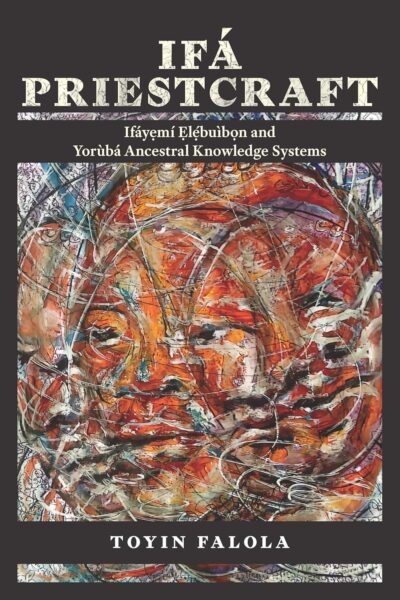
This month, I released a book on the Ifa guru, Araba Elebuibon, titled Ifa Priestcraft: Ifayemi Elebuibon and Yoruba Ancestral Knowledge. I dedicate this book to Toyin Adepoju, a leading Independent Scholar based in Lagos. I am proud to have dedicated the book to him, and I am eager to give my reasons.

Book dedications are always more than simple gestures. In essence, dedications are expressions of appreciation, admiration, respect, and remembrance. A dedication always has a history that goes much deeper than the actual text that appears on the pages of the book. In fact, there have been instances when dedications are not simply an expression of friendship, but rather an affirmation of shared visions, similar intellectual pursuits, and extraordinary commitment to the expansion of knowledge. This is the reason why I dedicated my book about Elebuibon to Oluwatoyin Vincent Adepoju.
Though this might seem like a small thing to many, this point is characteristic of a long-time engagement with a scholar whose life’s work revolves around showing unparalleled dedication to uncovering the epistemologies of Africa, Yoruba cosmology, and the intellectual traditions of Africa. While most scholars engage with superficial descriptions of what goes on in Africa, Adepoju is one of a breed of scholars who believes that the intellectual tradition of Africa requires an analysis from an all-inclusive, nuanced, and global perspective. While some scholars can only engage with the text through reading it, some engage with the text beyond the text by challenging the text, arguing against it, and releasing its latent potentials. Adepoju falls within the category of scholars who challenge the text. He never engages with scholarship as mere literary works or as history. Rather, he engages with scholarship as the living repository of human thought processes. This is clear in his intense engagement with my body of work on Yoruba studies, African knowledge, and intellectual history.
It must be noted that he has become one of the leading critics of my creations in the past couple of years. He has provided a highly intelligent and thought-provoking criticism of my works through the USA-Africa Dialogue and Toyin Falola Network, as well as many other means that really touched me with his intellectualism and his philosophy on my work. But it must also be remembered that there are other reasons why he stands out among others. As opposed to the mere flattery that other people can give, it is the intellectual curiosity that Adepoju has cultivated as a critic and as a researcher, going beyond simple admiration into more complex areas of hidden meanings and what could happen in the future of Africa. Therefore, the dedication in this particular book is very fitting indeed. This is so not only because my book on Elebuibon is a product of my intellectual curiosity about indigenous African knowledge systems but also because it is a critique of things that pertain to the African cosmos.
This is exactly the type of intellectual terrain that Adepoju has continually traversed with incredible tenacity. Throughout his research, he always focuses on one issue: that African intellectual heritage must be rescued from being understood through reductionist perspectives. He recognizes that Africa's civilizations cannot be involved in global dialogue without first reconnecting with their roots intellectually. In this sense, his intellectual project has much affinity with the philosophical impetus for my study of Elebuibon. There is yet another remarkable attribute of Adepoju’s literature that is his appreciation of the importance of studying African philosophical thought from both indigenous and global perspectives. His work on the philosophy of the Yoruba people is not carried out from an ethnological or romantic perspective. He sees it as a living intellectual system that can contribute to human discussions on spirituality, morality, creation, and existence. These ideas harmonize quite well with my own philosophical approach toward writing about Elebuibon.
For too long, African traditional knowledge systems have been misrepresented in Western paradigms that have viewed them as vestiges of so-called primitive peoples unable to philosophize. Such biases have informed institutions of academia as well as public discourse and even the African people themselves. Nonetheless, scholars like Adepoju continue to reject such biases by revealing the philosophical profundities contained in African worldviews. Adepoju was especially interested in the analyses I conducted regarding my own writing on African Ancestral Studies. This is because he realized that my project on ancestral systems was not one of going back to the past to revive the old ways, but to consider how traditional epistemology could encounter modernity without compromising its philosophy. He comprehended that traditional systems like Ifá were alive and able to adapt to changing times and geographies.
The importance of this stems from the fact that one of the most unfortunate characteristics of colonial modernity has been the systematic destruction of African epistemology. Generations of Africans have been raised to have doubts about the genuineness of their epistemological inheritance of theirs and embrace the foreign paradigms. The consequence has been that African epistemologies have become the butt of mockery rather than the subject of serious inquiry. Nevertheless, custodians such as Araba Elebuibon have preserved African epistemologies over generations through dedication and commitment. When it comes to honouring the person to whom this book ought to be dedicated, I thought of Adepoju instantly owing to the similarity of his scholarly endeavour to mine in terms of restoring African epistemology. Moreover, Adepoju’s scholarship carries inherent interdisciplinarity, which resonates with me as a methodology. Even though modern-day academia tends to compartmentalize knowledge, historians are supposed to be within the realm of history, literary scholars within literature, philosophers within philosophy, and anthropologists within anthropology. Nevertheless, reality within Africa does not respect these boundaries.

The civilizations of Africa have been characterized by interrelated systems of knowledge, in which spirituality, politics, ethics, aesthetics, ecology, and communal existence interact constantly. The intellectual capabilities of Adepoju encompass the understanding of this intricacy.
The notion that scholarship needs to break out of strict academic silos has been central to my intellectual journey. Knowledge thrives on dialogue between different disciplines. In many African societies, wisdom could never have been compartmentalized. The diviner, historian, healer, philosopher, artist, and moralist would all occupy overlapping areas in society. Elebuibon is a perfect manifestation of such an intellectual world. While treating Ifá strictly as religion would be inadequate, it also means philosophy, ethics, history, poetic art, hermeneutics, sociology, and cosmology. Such a scholar as Adepoju would undoubtedly be able to appreciate all of these elements without being trapped in academic reductionism.

Another factor I considered for my dedication to him is his profound understanding of symbolism and metaphysical imagination. While intellectual pursuit in the modern world tends to privilege empirical thinking over symbolic reasoning, the latter is dismissed as either irrational or trivial. The African people have long known that symbolism is one of the most important ways by which a community expresses its values, fears, hopes, and philosophy. The discussion of Adepoju on the "Tree of Knowledge" and other symbolic interpretations of the African intellectual tradition illustrates his perception of the deeper meanings contained within cultures. This kind of perception is crucial for someone wishing to engage in dialogue with Ifá and similar knowledge systems. In fact, one of the problems regarding the indigenous epistemology of Africa is that people who are from an outside perspective and who do not understand the symbols used in it tend to take it literally. It leads to misunderstanding and misinterpretation. Something that Adepoju never does. He gives philosophical epistemology of Africa the respect it deserves.
Intellectual generations always have some duties left behind by their predecessors. Intellectual property is preserved when individuals choose to preserve, evaluate, criticize, and evolve their intellectual heritage. However, in many African communities currently, there exists an alarming dissociation of the younger generations from their native modes of thought. Globalization has made the world much more connected and exposed them to the influence of foreign civilizations while rendering indigenous intellectual practices foreign. Adepoju's literary creations demonstrate one way this challenge could be addressed. These literary pieces prove that there is no need for people to discard modernity and global intellectual interactions simply because they study their indigenous practices. Rather, they demonstrate that indigenous practices could contribute to the debate in the global arena without losing their uniqueness.

I hope that younger scholars will go on to engage with African epistemologies seriously without feeling embarrassed by them. I hope that the weight of cultural forgetfulness will not erase intellectual legacies carried over millennia of historical oppression and that African philosophy will come to take up the places that have been denied to it for too long. Writing my book on Elebuibon became one way of engaging in these larger discussions. I wished to question our preconceived ideas about what counts as legitimate knowledge. I wished to prompt people to engage with local epistemologies not out of fear and prejudice but with intellectual rigor. More than anything else, I wished to capture the story of someone who embodies the strength of African intellectual legacies.
This dedication to Toyin Adepoju is justified by the fact that his research resonates in this same vein. Another factor justifying this dedication is one of intellectual courage. Courage is required to commit to studying African metaphysical systems amidst the lingering colonial bias in academia. Topics related to indigenous religion can invite misunderstanding and hostility. However, Adepoju has always been willing to explore these themes, acknowledging their importance in African intellectual tradition. It is important to recognize such boldness. In several respects, it is also an homage to intellectual tenacity, the determination to explore tough issues despite the disapproval of prevailing structures. Intellectual tenacity has been present in Elebuibon’s efforts to preserve Ifá culture and Adepoju’s intellectual inquiry into African cosmology. One must also consider the value of interpretation within the field of intellectual endeavour. Ideas will not endure simply because they have been recorded on paper. They will endure because critics and readers constantly interpret them throughout generations. The numerous encounters that Adepoju has with my work made me realize this fact repeatedly.
Adepoju is not a mere summary writer; he goes deep into texts in a philosophical sense, forging links between texts that the writers themselves might not have consciously thought about. That, by itself, is a contribution worth its weight in gold. For that reason, I honor this dedication sincerely. It is recognition of a great mind whose preoccupations are strongly aligned with the philosophical concerns of the book on Elebuibon. It refers to Adepoju’s interactions with my books, as well as his many other contributions to scholarship on topics such as Yoruba studies, African epistemologies, mentoring, symbolism, and intellectual history. Moreover, on a deeper level, my dedication speaks to my faith that scholarship should foster communities of thought and not just brilliant performances. Scholarly traditions thrive only if the people conducting scholarship engage each other in generous, critical, and creative dialogues. The writing of Adepoju is such scholarship. His scholarship is constantly growing in conversation and not just being fed from.

Unfortunately, academic culture is more inclined towards competition rather than intellectual solidarity in most cases. Relationality and continuity, however, appear to be common traits in African knowledge systems. The continuity of knowledge systems over time depends on a succession of people who transmit the system from one individual to another, including teachers, interpreters, learners, and knowledge custodians. The relationship between Elebuibon’s universe and Adepoju’s analysis serves as a good illustration of such continuity. On one side, one inherits the knowledge system of the ancestors through practices and oral tradition, while the other analyses and interprets African knowledge systems within a broader intellectual tradition.
To conclude, the dedication of my book to Adepoju should be attributed to admiration, intellectual indebtedness, affinity, and acknowledgment. I admire his profound understanding of research methodology. I am grateful for his continuous participation in my intellectual pursuits.
--
Adebayo AjadiAssistant Brand Manager,Toyin Falola Network- Pan-African University Press- The Toyin Falola Interviews- The Toyin Falola Masterclass- Toyin Falola Center for the Study of Africa- Toyin Falola Annual Conference on Africa and the African Diaspora (TOFAC) +234-810-7262-267 | +1 (512) 689-6067 | https://toyinfalolanetwork.org Facebook | Twitter | YouTube | Linkedin
Listserv moderated by Toyin Falola, University of Texas at Austin
To post to this group, send an email to USAAfricaDialogue@googlegroups.com
To subscribe to this group, send an email to USAAfricaDialogue+subscribe@googlegroups.com
Current archives at http://groups.google.com/group/USAAfricaDialogue
Early archives at http://www.utexas.edu/conferences/africa/ads/index.html
---
You received this message because you are subscribed to the Google Groups "USA Africa Dialogue Series" group.
To unsubscribe from this group and stop receiving emails from it, send an email to usaafricadialogue+unsubscribe@googlegroups.com.
To view this discussion visit https://groups.google.com/d/msgid/usaafricadialogue/CAE8waW%3DC9M%2B%3D64YatgYj%2BXu7a0mxWXY%3DoF205%2BcPGG%3D0gue8dA%40mail.gmail.com.

Listserv moderated by Toyin Falola, University of Texas at Austin
To post to this group, send an email to USAAfricaDialogue@googlegroups.com
To subscribe to this group, send an email to USAAfricaDialogue+subscribe@googlegroups.com
Current archives at http://groups.google.com/group/USAAfricaDialogue
Early archives at http://www.utexas.edu/conferences/africa/ads/index.html
---
You received this message because you are subscribed to the Google Groups "USA Africa Dialogue Series" group.
To unsubscribe from this group and stop receiving emails from it, send an email to usaafricadialogue+unsubscribe@googlegroups.com.
To view this discussion visit https://groups.google.com/d/msgid/usaafricadialogue/CACMz5zmTE3U-3O5j%2BhbOM2tbKL5zBRDWabua78x9pFp2otRCKg%40mail.gmail.com.

No comments:
Post a Comment