Tuesday, March 31, 2015

USA Africa Dialogue Series - Buhari¹s victory: The men who made it possible

Buhari's victory: The men who made it possible


on    /   in Elections 2015, Politics 2:16 am   /   Comments

The significance of Muhammadu Buhari's victory is underlined by the fact that this will be the first in the history of Nigeria's electoral process when an incumbent president is defeated. It was no small feat that was achieved by some of the country's most prominent political figures.

By Dapo Akinrefon

Asiwaju Bola Tinubu

The former governor of Lagos State, Asiwaju Bola Tinubu is considered a master political strategist who guided Buhari's aspiration to a success at the party's national convention last year.

Former Vice President and presidential aspirant of All Progressives Congress (APC), Atiku Abubakar and national leader of APC, Asiwaju Bola Tinubu at the declaration of rally of Governor Abdulfatah Ahmed in Ilorin, Kwara State on Wednesday.

FILE PHOTO: Former Vice President, Atiku Abubakar and National leader of APC, Asiwaju Bola Tinubu 

Tinubu was able to ensure that not only did Buhari get the block vote of the Southwest, but also ensured that many states outside the region that did not have governors in the contest supported Buhari.

After the nomination convention, Tinubu together with likeminded party members was able to weave a formidable campaign machine that put Buhari to victory. Reflective of Tinubu's imprint in the victory was the fact that Buhari in his last three runs never made an impression in the Southwest, a region he swept last weekend with victories in five of the six states.

Despite the lures and lashes from the opposition, Tinubu stood firm in an unwavering support for Buhari that proved crucial in achieving victory.

Governor Chibuke Amaechi

Governor Amaechi ably steered the Buhari campaign in such a way that brought the old candidate into reckoning in ways he never had been before. The governor's input was there in the transformation of the general in his dressing and approach to campaign. The governor was in direct control of strategy and deployment of personnel at the campaign headquarters. He was also believed to be involved in the indirect talks with some major political players who helped to ensure the victory of the general at both the nomination convention and the general election.

Senator Bukola Saraki

Senator Bukola Saraki who served as governor of Kwara State before going to the Senate was also instrumental to the victory. His deployment of political and other resources not only helped in the general's sweep of Kwara State, but also in forming bonds with other major political players in the country.

President Obasanjo

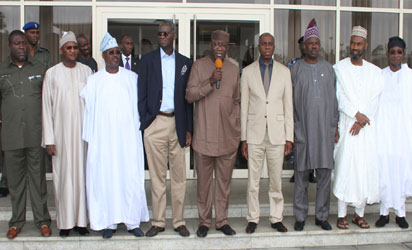
SOLIDARITY—From left: Imo State Deputy Governor; Prince Eze Madumere; Nasarawa State Deputy Governor; Dameshi Mama Luka; Governors Abiola Ajimobi (Oyo); Babatunde Fashola (Lagos); Kayode Fayemi (Ekiti); the host,Rotimi Amaechi (Rivers);Ibikunle Amosun (Ogun); Zamfara State Deputy Governor, Alhaji Muktar Anka and Osun State Governor Rauf Aregbesola, during a solidarity visit to the Rivers State Governor, yesterday, at the Rivers State Government House, Port Harcourt. Photo: Nwankpa Chijioke.

APC Governors—From left: Imo State Deputy Governor; Prince Eze Madumere; Nasarawa State Deputy Governor; Dameshi Mama Luka; Governors Abiola Ajimobi (Oyo); Babatunde Fashola (Lagos); Kayode Fayemi (Ekiti); Rotimi Amaechi (Rivers);Ibikunle Amosun (Ogun); Zamfara State Deputy Governor, Alhaji Muktar Anka and Osun State Governor Rauf Aregbesola, dPhoto: Nwankpa Chijioke.

Former President Olusegun Obasanjo is perceived another influential personality to Buhari's ascendancy to Aso Rock. President Obasanjo's behind the door counsel and patronage of Team Buhari was an open secret. He demonstrated so even in the days before the election was postponed last February when he went on an international circuit to launch his recently released book, My Watch.

He also met with market leaders in his Abeokuta office where he gave them counsel on how to vote.

However, the most strategic role President Obasanjo may have played is believed to have been in bringing international focus on Nigeria in such a way that put the defeated president in a cul de sac on allowing his subordinates to manipulate the results.

Atiku Abubakar

Former Vice President Atiku Abubakar may not have been seen regularly on the podium pushing for Buhari, but he was a main backer in terms of resources. Once he lost the ticket to Buhari, Atiku pushed his structure including his savvy media team headed by Mallam Garba Shehu to Buhari's use. The team proved to be a torn in the flesh of Candidate Goodluck Jonathan.

APC GOVERNORS

All the APC governors without exception backed the general. Though two of them, Al Makura in Nasarawa and Adams Oshiomhole in Edo were not able to deliver their states to Buhari, but the efforts they made was undeniable. Oshiomhole was especially a thorn in the flesh of Camp Jonathan in the last few days.

- See more at: http://www.vanguardngr.com/2015/04/buharis-victory-the-men-who-made-it-possible/#sthash.Jv2XYS8X.dpuf

Toyin Falola
Department of History
The University of Texas at Austin
104 Inner Campus Drive
Austin, TX 78712-0220
USA
512 475 7224
512 475 7222 (fax)

USA Africa Dialogue Series - Fwd: CEcil Rhodes


Sent from my iPhone

Begin forwarded message:

From: "Dr. Adekeye Adebajo" <adebajo@ccr.org.za>

Subject: CEcil Rhodes

Dear all: congrats seemingly to Nigerians for its historic "regime change"! for those of you interested in lively debates on the imperialist Cecil Rhodes, pls. see below. Best, Adekeye


Debating Max Price on Cecil Rhodes

Adekeye Adebajo


Being myself a former Rhodes scholar at Oxford University and given the furore by students calling for the removal of the statue of Cecil Rhodes from the front of the University of Cape Town (UCT), I was rather startled to read the views of Max Price, UCT's Vice-Chancellor, on the arch-imperialist in last week's Sunday Independent ("The Student Statue Protest Is Significant, But the Greater Debate Around this is What Really Matters", Max Price Tells Michael Morris, 22 March 2015). Price seemed to be unwittingly acting like a pyromaniac fireman.


Although he conceded that Rhodes's "values and his ruthlessness, and his willingness to take the view that imperial ends were justified by any means, were appalling", Price made the extraordinary statement: "I do believe there's a risk of simplifying Rhodes....it's important to examine why he came to be viewed as a great man. He achieved an enormous amount by the time he died....a businessman, diplomat and Prime Minister of the Cape, a military strategist, and a philanthropist very committed to education and in all these things he was successful."


Let us examine each of Price's claims in turn. First, the idea of Rhodes as a diplomat is patently absurd, unless one views "diplomacy" as flowing out of the barrel of a maxim gun. Rhodes seized, administered, and populated African land with white settlers. His genocidal "scorched earth" campaigns killed tens of thousands of people.  He dispossessed black people of their ancestral lands in modern-day Zimbabwe and Zambia through armed conquest, stealing 3.5 million square miles of black real estate in one of the most ignominious "land-grabs" in modern history. By 1890, Mashonaland had been seized, while farming claims had been staked out in Matabeleland by 1896. Rhodes's British South Africa Company gave itself the right to half of the loot, with the rest being shared out among the assorted motley crew of his settlers, freebooters, mercenaries, and adventurers. The huge herds of Ndebele cattle were divided between these armed thugs and the British South Africa Company. Rhodes's band of mercenaries raped, enslaved, and stole the land of the Shona in greedy pursuit of mineral wealth.


Perhaps the diplomacy which Price is referring to is Rhodes's use of agents to negotiate a concession with Matabele King, Lobengula, who believed that he was only ceding limited mining rights, but ended up losing his entire country. Or perhaps he is referring to Rhodes's "negotiation" of a treacherous and dishonest accord in which the Ndebele and Shona were allowed to return to their land over which all rights had been revoked? This is, surely, duplicity rather than diplomacy. Killing thousands of people with superior technology was not – in contradiction of Price's second claim - the actions of a great military strategist, but those of a pillaging plunderer. 


Price's third claim was that Rhodes was a great businessman. The imperialist, however, used his economic wealth (he controlled 90 percent of the world's diamonds) to buy political power, and used political power to protect and extend his wealth. He used shares and land to buy off politicians in Britain and South Africa, including members of the Afrikaner Bond. In cornering the diamond industry in Kimberley, he ruthlessly crushed many of the smaller businesses, and tricked many of his opponents. He manipulated the stock exchange and bought off people with company shares, outright bribes, and job offers. He had speculative shares in a shell diamond company in the early 1880s. He bought off rival entrepreneurs, politicians, and journalists to further his expansionist aims. He misled investors and the British government into believing that his British South Africa Company owned the 1888 Ruud Concession in order to secure a royal charter.


Price's fourth claim was to praise Rhodes as prime minister of the Cape colony. However, the imperialist used his rule between 1890 and 1895 to lay the foundations for apartheid, and his premiership ended in disgrace when Leander Jameson's ill-conceived raid of gold-rich Transvaal failed in 1895, helping to trigger the Anglo-Boer war four years later. Even before apartheid was passed into law in 1948, Rhodes was its forerunner, helping to disenfranchise black people through introducing new property and educational criteria in the Cape colony. He forcibly removed blacks to native reserves through the 1894 Glen Grey Act, which presaged apartheid's notorious Bantustan policies by half a century. Rhodes further pushed the Cape parliament to introduce hut and labour taxes on blacks to force them into the cash economy; packed over 11,000 black miners into inhumane, dog-patrolled, wire-protected barracks; and supported draconian labour laws (including the legal flogging of "disobedient" black labourers through the notorious "strop bill") that facilitated the continued supply of human fodder to his mines, and impoverished the black population. As premier of Cape colony, Rhodes also introduced social segregation for non-whites in schools, hospitals, theatres, prisons, sports, and public transport; forced blacks to carry passes (a precursor of apartheid's "dumb pass"); and removed thousands of members of these groups from the colony's electoral rolls. As he infamously put it: "I prefer land to niggers . . . the natives are like children. They are just emerging from barbarism [and] one should kill as many niggers as possible."


Price's fifth claim was that Rhodes was a great philanthropist. Aside from the difficulty of being generous with stolen booty, it is important to note that, though 7,688 Rhodes scholars have studied at Oxford University since 1903, the scholarship scheme excluded women until 1976 and had clearly been designed for a "heaven's breed" of largely Anglo-Saxon white males. The Rhodes trustees themselves today remain mainly white men, while most of the scholarships still go disproportionately to white Americans, Canadians, Australians, and South Africans. Contrary to Price's statement that Rhodes did not graduate from Oxford, the imperialist - not reputed to have been a particularly good student or a potential Rhodes scholar! – took eight years to achieve a "gentleman's pass" in law from Oxford. The South African scholarships – from which Price himself benefitted - have been particularly controversial, since they have effectively served as a form of white "affirmative action" for over a century, disproportionately going to schools that did not admit blacks or girls until the 1980s. Only four of the first 80 scholars were black.


One must also unequivocally reject Price's argument that "We are all, really, products of our time." Many of Rhodes's contemporaries criticised him, including writer Olive Schreiner, a friend who later wrote a devastating critique of his ruthless imperial methods in her 1897 novella, Trooper Peter Halket of Mashonaland. There were, after all, abolitionists who condemned slavery even when its practice was widely accepted. Finally, Price makes the astonishing claim that Rhodes was "in many respects…self-made, though he had the empire behind him." This is surely a contradictory and confused statement. The British government, in fact, granted Rhodes a royal charter to annex territory in Southern Africa. Rhodes was allowed by "Her Majesty's government" to dispossess the indigenous inhabitants, and offer British soldiers land-ownership in return for their military conquest. This is surely not the sort of record that the Vice-Chancellor of UCT should be defending.


Dr. Adekeye Adebajo is Executive Director of the Centre for Conflict Resolution, Cape Town.


Sunday Independent South Africa , 29 March 2015.


The Fall of Cecil Rhodes?

Adekeye Adebajo


As a former Rhodes scholar who studied at Oxford University, I have been particularly intrigued by the current student agitation at the University of Cape Town (UCT) to remove the statue of the greatest imperialist of the nineteenth century: Cecil Rhodes.  I have always justified my acceptance of the scholarship as a pragmatic decision to take a slice of the wealth plundered from Africa to pursue anti-colonial causes in order to bite the hand that fed me.


The spark that lit the fuse of protest at UCT was provided by a student, Chumani Maxwele, who threw human excrement on Rhodes's statue. Other students followed by throwing urine and pig manure at the monument. Yet more students covered the statue with a white cloth as if to hide the imperial stain. A photographer was assaulted by campus security.


Rhodes University – also named after the colonial plunderer – removed a statue of Rhodes from its main entrance two decades ago as South Africa entered a democratic era. Why has it taken so long for a debate to emerge at UCT on Rhodes's legacy?


Listening to the students, the removal of the statue appeared to be a metaphorical call for the transformation of the university's curriculum, culture, and faculty which many blacks feel are alienating and still reflect a Eurocentric heritage. Maxwele noted that he had acted on behalf of the collective pain and suffering of all black people against what he described as the "colonial dominance" still evident at UCT. He argued that black students would not want to graduate in a hall named after the imperialist Leander Jameson, wondering "where are our heroes and ancestors?"  The university's Students' Representative Council (SRC) supported calls for the removal of the statue, describing the events as a "consequence of an institutional culture that is largely exclusionary". It noted that "for too long the narrative at the university has silenced the voices of black students and black history," and asked "how can a colonizer donate land that was never his land in the first place?"


Another student, Rekgotsofetse Chikane, wrote an open letter to the chair of the university council, Archbishop Njongonkulu Ndungane, noting that he found his "silence on matters of transformation at UCT..disconcerting", and observing that UCT students often played a game of asking whether they had ever been lectured by a black academic, and citing a common saying among students that the university was "a European university stuck at the bottom of Africa." Mahmood Mamdani, the Ugandan scholar who left UCT in 1996 over a dispute about transforming the curriculum, similarly noted in this regard: "South Africa lacks an Africa-focused intelligentsia in critical numbers...the institutional apparatus of learning..continues to be hostile to Africa-focused thought." 


It was interesting to watch 500 black and white UCT students protesting together on Youtube, with most making eloquent speeches calling for the removal of Rhodes's statue. They argued "We are not black people fighting white people. We are fighting the system as youth"; chanted "Down with Rhodes, down!"; while a member of the African National Congress (ANC) Youth League, Khaled Sayed, exhorted: "Make the removal of the statue the removal of liberals at UCT." Some students made the sensible call for placing the statue in a colonial museum in which a historical context can be provided. There are no statues of Hitler to be found in Germany, or Mussolini in Italy, so why has a statue of a figure of black dispossession and oppression in Southern Africa survived for eight decades?


The university's response to the protests have been rather officious, with a questioning of the methods of some of the students; an insistence on the need to follow "procedures" for "peaceful and safe" protests; encouraging "open debate and responsible action"; and threatening to take legal steps against any "unlawful behaviour."


But even if the students are victorious in toppling the statue of Rhodes at UCT, will they go further to target other symbols of oppression on their campus? The Jameson hall is named after Rhodes's psychopathic lieutenant whose "scorched earth" policies marked the genocidal conquest of modern-day Zimbabwe in the 1890s. The grandiose Rhodes memorial can hardly be moved into a museum, but could be provided with more historical context than the brooding imperialist staring down from his Olympian heights.


Doubtless, the council of Rhodes University and the trustees of the Mandela Rhodes Foundation are watching the outcome of this fiery debate closely.


Dr. Adekeye Adebajo is Executive Director of the Centre for Conflict Resolution, Cape Town.


Businessday (South Africa), March 2015.


CCRLogo

Dr Adekeye Adebajo

CCR Executive Director

Centre for Conflict Resolution (CCR)

2 Dixton Road, Observatory 7925

Cape Town, South Africa

Tel: +27 (0)21 689 1005

Fax: +27 (0)21 689 1003

Email: adebajo@ccr.org.za 

Website: http://www.ccr.org.za   

http://www.udel.edu/giving/images/facebook%20logo.png  http://bolivarvirtual.co/sites/bolivarvirtual.co/files/default_images/YouTube-Thumbnail-Image-How-To.jpg  http://2.s.steamfeed.com/wp-content/uploads/2013/07/twitter-bird.jpg   


DISCLAIMER This e-mail, its attachments and any privileges/rights attaching hereto, are, unless the context obviously indicates otherwise, the property of the Centre for Conflict Resolution (CCR), Cape Town, South Africa. It is private, confidential, and intended solely for the addressee. If you are not the intended recipient and receive this e-mail in error, kindly notify the sender, and delete this e-mail immediately and do not disclose or use it in any manner whatsoever. Any such unauthorised use is prohibited and may be unlawful. Views and opinions contained herein are those of the sender unless unmistakably acknowledged as those of CCR. The Centre therefore does not accept liability for any claims, loss or damages of any nature whatsoever arising as a result of the use of this email or its attachments. CCR, while having taken reasonable steps to preserve the confidentiality of information transmitted electronically, does not guarantee the accuracy and integrity of this e-mail.

USA Africa Dialogue Series - Re: [develop-nigeria] APGA TO BUHARI: NO UNILATERAL POLICIES - APGA PRESS RELEASE

Boom, boom....Salvo......

I love Naija, way advanced............Not even the tea partiers could remind/inform/ demand that from Obama on very  day in 2008 or 2012 -  and not even the day or week after. 

Nigeria Wins; a proud moment for Africa's democracy that has shamed ignorant press.

Can anybody in the whole wide world tell me where my Neb is? Buhari has warned against  what he  called "wild jubilation." The guy ain't joking ooo. He was stern and abrupt.  This what Babaginda deprived us of....a Buhari....a real McCoy. I just cannot wait for the war on Boko Haram. Shekau might as well trade his fatigues for abgada right away.

Uncle Ayo, NATHIN SPOIL. I am still requesting who ever is the new anything when we need it done for Africa. Hehehe, for consolation prize, a friend called and said, MsJoe, look at the bright side: Buhari would never have voted for strikes on Libya and Gaddafi would have been alive. I laughed so hard......ou la la.....

Cheers to all. Jumping in the Jacuzzi after a historic  day. Who imagined a civilian transfer of power with the incumbent graciously conceding?

MsJoe
To Lead You Must be a Servant


-----Original Message-----
From: Okwukwe Ibiam <o.ibiam@gmail.com>
To: Igboevents@yahoogroups.com <IgboEvents@yahoogroups.com>; IgboWorldForum <IgboWorldForum@yahoogroups.com>; NIgerianWorldForum <NIgerianWorldForum@yahoogroups.com>; AnambraForum <AnambraForum@yahoogroups.com>; NaijaObserver <NaijaObserver@yahoogroups.com>; Anambra-WorldForum <Anambra-WorldForum@yahoogroups.com>; WorldIgboCongress <WorldIgboCongress@yahoogroups.com>; Apga Uk <apgauk@yahoo.co.uk>; develop-nigeria <develop-nigeria@googlegroups.com>; africanworldforum <africanworldforum@googlegroups.com>; NaijaPolitics <NaijaPolitics@yahoogroups.com>; NaijaEvent <NaijaEvent@googlegroups.com>; YanArewa <YanArewa@yahoo.com>; Joseph Nwankwo <joeabuchi@gmail.com>; ooukeh <ooukeh@yahoo.com>; Chris Oji <cojichris@yahoo.com>; isaac umunna <isumunna@yahoo.com>; newsexpressngr <newsexpressngr@gmail.com>; Elombah Elsdan <elombahperspective@gmail.com>; tatan4us <tatan4us@yahoo.co.uk>; deemyke <deemyke@gmail.com>
Sent: Tue, Mar 31, 2015 6:58 pm
Subject: [develop-nigeria] APGA TO BUHARI: NO UNILATERAL POLICIES - APGA PRESS RELEASE

                                                                          
                                             NIGERIA

                               PRESS RELEASE  31/3/15

            APGA TO PRESIDENT-ELECT BUHARI: NO UNILATERAL POLICIES.

We, at the ALL PROGRESSIVES GRAND ALLIANCE (APGA) NIGERIA, congratulate Nigerians and the Rtd.,General Muhammadu Buhari on his victory at the polls.

While acknowledging this hard-won victory, The APGA will however remind the the President-Elect that he must be a President for all Nigerians, No part of Nigeria should feel distanced because Rtd. Major General Muhammadu Buhari is President. Every part of Nigeria should feel like they have access to Aso Rock. A President Buhari should make that possible.

 The ALL PROGRESSIVES GRAND ALLIANCE (APGA) NIGERIA, will also remind the President-elect that there can be no Unilateral Government policies. None. The President-elect should strive hard to understand the sentiments of Nigerians ON ECONOMICS, TRADE, BANKING, TRANSPORTATION, HEALTHCARE, EDUCATION , HOUSING, DOMICILE SECURITY, AND PRESS FREEDOM issues. That is DEMOCRACY. A President-elect Buhari cannot wish them away. Nigeria is not a one-size-fits-all Nation State. 
 We ask the President-elect to closely study any proposed Government policies and take into account the perspective of different Nigerian Geo-political zones and socio-economic segments, before making any changes. The lives and livelihood  of Nigerians depend on any change in his administrations' policies.  We must never go back to, or feel like its  December1983, or january 1984. NO!

Globalism is in. The ALL PROGRESSIVES GRAND ALLIANCE (APGA) NIGERIA, encourages the President-elect not to ostracise Nigeria, or Nigerians from the Global village. Nigerians must have access to continue movement around the globe. This assures our exposure and acquisition of social, economic and technological developments world-wide, enabling Nigeria and Nigerians compete meaningfully world-wide. Nigeria cannot become isolationist. 

We, at the ALL PROGRESSIVES GRAND ALLIANCE (APGA) NIGERIA,  will remind the President-elect that a freedom of the press made it possible for him to campaign around the Nigerian Federation. Here, He was able to say and listen to things which probably made the present change possible. That was the beauty of democracy, and Rtd., Major-General Buhari benefitted from it.
President-Elect Rtd. Major General Muhammadu Buhari cannot deny fellow Nigerians the same access. Press freedom through the airwaves, social media and newsprint remain very important to all segment of Nigerians.

We will also like the President-Elect to assure the security of Nigerians nation-wide. Nigerians everywhere, must be assured of domicile security, to reside and engage meaningfully with other Nigerians irrespective of religious or ethnic affiliation. Nigerians must also be assured the security to trade meaningfully within Nigeria, without fear or favor. Government policies on trade must not, repeat, not be unilateral.

APGA will like the President to look into issues of population manipulation, and electoral gerrymandering in the Nigerian federation. A situation where multiple states have been created and allocated to certain Nigerian geo-political zones, allowing for predictable and favorable political outcomes during electioneering does not make for equity in the national electoral process, as certain sections of Nigeria, especially the south-east are permanently disenfranchised and do not exactly wield their political influence within the federation secondary to poor population census, and a disproportion in the allocation of states. This issue requires serious review in the interest of fairness in the existing Nigerian Federation. 

APGA will also call on the President-elect to implement the recommendations of the 2014 National conference, to aid the proper re-structuring and growth of the Nigerian federation.

Because, at the ALL PROGRESSIVES GRAND ALLIANCE (APGA) NIGERIA, we remain our brothers' and sisters' keepers, looking and speaking out on their interests. 

Once again, Congratulations.

Sgd:
Chief Okwukwe Ibiam
National Publicity Secretary 
ALL PROGRESSIVES GRAND ALLIANCE (APGA) NIGERIA.
--
DEVELOP NIGERIA NETWORK................. Building Nigeria of our Dream
---
You received this message because you are subscribed to the Google Groups "Develop Nigeria" group.
To unsubscribe from this group and stop receiving emails from it, send an email to develop-nigeria+unsubscribe@googlegroups.com.
To post to this group, send email to develop-nigeria@googlegroups.com.
To view this discussion on the web visit https://groups.google.com/d/msgid/develop-nigeria/CAHgkPQmp4U-WzmO%2BeDguuEqV4Tq%3DhOG-WoHbVKGsmBfhuTvPOw%40mail.gmail.com.
For more options, visit https://groups.google.com/d/optout.

--
Listserv moderated by Toyin Falola, University of Texas at Austin
To post to this group, send an email to USAAfricaDialogue@googlegroups.com
To subscribe to this group, send an email to USAAfricaDialogue+subscribe@googlegroups.com
Current archives at http://groups.google.com/group/USAAfricaDialogue
Early archives at http://www.utexas.edu/conferences/africa/ads/index.html
---
You received this message because you are subscribed to the Google Groups "USA Africa Dialogue Series" group.
To unsubscribe from this group and stop receiving emails from it, send an email to usaafricadialogue+unsubscribe@googlegroups.com.
For more options, visit https://groups.google.com/d/optout.
 
Vida de bombeiro Recipes Informatica Humor Jokes Mensagens Curiosity Saude Video Games Car Blog Animals Diario das Mensagens Eletronica Rei Jesus News Noticias da TV Artesanato Esportes Noticias Atuais Games Pets Career Religion Recreation Business Education Autos Academics Style Television Programming Motosport Humor News The Games Home Downs World News Internet Car Design Entertaimment Celebrities 1001 Games Doctor Pets Net Downs World Enter Jesus Variedade Mensagensr Android Rub Letras Dialogue cosmetics Genexus Car net Só Humor Curiosity Gifs Medical Female American Health Madeira Designer PPS Divertidas Estate Travel Estate Writing Computer Matilde Ocultos Matilde futebolcomnoticias girassol lettheworldturn topdigitalnet Bem amado enjohnny produceideas foodasticos cronicasdoimaginario downloadsdegraca compactandoletras newcuriosidades blogdoarmario arrozinhoii sonasol halfbakedtaters make-it-plain amatha