This is Not the End of the Book by Umberto Eco and Jean-Claude Carrière – review
A wide-ranging conversation between two European intellectuals is brimming with enthusiasm
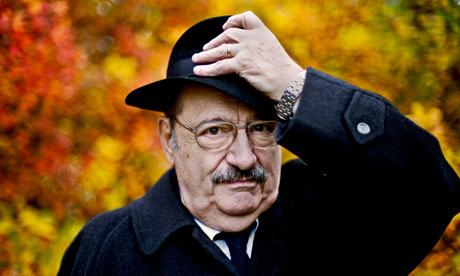
This book might have been intensely irritating. Two European intellectuals meet, and are encouraged by their "curator" Jean-Philippe de Tonnac to show off – for, if they do not put on an exhibition of erudite debate, what is the point of recording them? And show off they do, ranging in their talk from cave paintings to Italian neorealism, from hieroglyphs to computer code, from the 17th-century German Jesuit scholar Athanasius Kircher to Dan Brown, from the teachings of Jesus and Buddha to those of cultists. Reading the jacket blurb, one is inclined to give a hand gesture associated with a four-letter word beginning with "w".
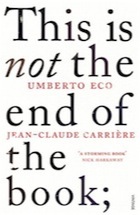
- This is Not the End of the Book: A conversation curated by Jean-Philippe de Tonnac
- by Umberto Eco, Jean-Claude Carrière
-
What redeems the book, in Polly McLean's fluent translation (from French) anyway, is the enthusiasm of the talkers. Eco and Carrière clearly fell in love with books as children, and retain their childlike enthusiasm. Eco reckons he has a library of 50,000 books, as well as of 1,200 rare titles; Carrière says he has 2,000 "ancient" books out of a total collection of some 40,000. With this enthusiasm comes intellectual curiosity. If Carrière wants to go on about the ancient language of the Americas, or French poets of the early 17th century, or the Hindu pantheon, he has earned the right to do so, one feels.
Carrière tells us that Waiting for Godot has just been translated into Nahuatl, the language of the Aztecs – "I've already ordered a first edition." Both authors relish such unusual learning. Eco has devoted a collection to wrong-headedness and stupidity, and tells us about the theorists who argued that Norwegian was the first language, that the Earth was immobile, and that Clark Gable would never get anywhere with such prominent ears. The great semiotician also reveals that he likes to spend spare moments "fighting intergalactic wars with monsters from outer space on my computer".
"The end of the book" is, as Eco and Carrière demonstrate, a misguided phrase. First, because printed books continue to be the most efficient and enduring methods of delivering texts: computer formats rapidly become redundant, and contemporary ebooks are not a good bet to outlast their printed counterparts. Second, because there is absolutely no evidence that longform texts themselves, as transmitters of knowledge and entertainment, are in any danger of diminishing in value. Certainly, they receive an excellent advertisement in Eco and Carrière's playful and learned conversations.
 Email
EmailYou received this message because you are subscribed to the "USA-Africa Dialogue Series" moderated by Toyin Falola, University of Texas at Austin.
For current archives, visit http://groups.google.com/group/USAAfricaDialogue
For previous archives, visit http://www.utexas.edu/conferences/africa/ads/index.html
To post to this group, send an email to USAAfricaDialogue@googlegroups.com
To unsubscribe from this group, send an email to USAAfricaDialogue-
unsubscribe@googlegroups.com

27 May 2012 4:26AM
I guess Emberto is the less-known youger brother of the famous Umberto
27 May 2012 8:02AM
Emberto Eco! - obviously the end of proof-readers
27 May 2012 10:19AM
This is what people forget about intellectuals. Among books and ideas, they're like kids in a sweetshop. No doubt there's pretension here; but there will also be a sweep of thinking that I miss in more technical talk.
27 May 2012 12:42PM
Passion for books is really wonderful and joyful creation.Lovers of books met accidentally their conversation is unstoppable and second to second increased joy of meeting. End of printed book is there or not it will decide in future.How new generation adopt eBooks and disdain the printed books that future will decide.After all communication with each other is never die.Books are medium of conversation medium may changed but to reading and writing will remain forever because that is inborn urge of mankind