Ayoola
The problem with the GDP is not the base. We can mess around with the base until we get the numbers we want but that will not overnight change the standard of living or well-being of the citizens. Doubling Ghana’s GDP will not provide my hometown with reliable electricity, decent education, sanitation or good drinking water overnight.
It is important to note that the creator of GDP, Dr. Simon Kutznets, argued against its use to evaluate over-all national well-being because, in his view the metric fails to distinguish “between quantity and quality of growth, between costs and returns, and between the short run and long run. Goals for growth should specify growth of what and for what”. Dr. Kuznets, like Einstein, was a sage. The many drawbacks of GDP include GDP’s focus on quantity of output often leads to policies promoting excess production and unforeseen or unanticipated negative consequences for society. This is manifest in the white elephant structures we see in Accra and Lagos that add nothing to the well-being of the citizens.
Overemphasis on financial products that increase household debt and aggregate national output without necessarily translating into real wealth increases. On a personal note, it is sad to note this a guy who bears my native name, Kwaku, just got convicted of financial fraud in London for losing $2.3 billion through fraudulent trades in fraudulent financial instruments. He is a fellow Ghanaian but no relations( he spells his name Kweku AND I AM Kwaku!!). Before the Kwekus out there start throwing bombs my way I do not want to imply that all Kwekus are crooks.
The monetary policies that increased growth but also encourage excessive risk-taking in the US housing market ultimately led to the global financial crisis. In the 1980s financial capital was barely 12 percent of GDP while manufacturing was around 22 percent. In 2008 the numbers have reversed, with financial capital contributing to around 20 percent of GDP while manufacturing was barely 13% of GDP. While GDP grew over this period inequalities and poverty increased.
Growth promoting policies in China and the emerging countries have had negative environmental implications in China and elsewhere. Anytime you produce a computer or smart phone, GDP increases, but when those products are ‘recycled’ or dumped in Agbogboshie in Accra creating the largest urban environmental hazard in the world, leading to the release of carcinogens and increased cancer rates and respiratory diseases, the cost in human terms is not reflected in GDP.
Investments in new sources of energy, for example, hydraulic fracturing in USA and Europe and soon in Africa, will increase energy production but lead to massive pollution of our water resources and agricultural lands. Witness the Nigeria Delta and see the mess for yourself. I guarantee you that Nigeria needs aver 50 billion dollars to reclaim the Delta that has been destroyed over many years of irresponsible energy production policies by foreign companies. GDP increased over those years but the Ogoni people live in a very polluted environment.
It is obvious that policies that have increased GDP have lifted many people out of poverty globally but at the cost of massive environmental deterioration, increased inequality in wealth, and general reduction in standards of living of many citizens in both developing and developed countries.
In order to correct these omissions GDP has been improved over the years to measure human well-being by introducing what we call in economics Green GDP measures, the most notable measure being the Human Development Index ( HDI). HDI, in particular, is an index of per capita income, health status and years of schooling. This captures some levels of social well-being that GDP blatantly ignores. Instead of relying on fixing, doctoring, or forging GDP it is important for African governments to use whatever money we generate from the exports and taxation on improving those measures that reflect the true development in the country such as infrastructure, schools, public health, security, governance, etc. After all, the ultimate objective of economic development should be measured by improvements in the lives of the people. ( The above represents excepts from a keynote lecture I gave at the joint session of the German Academy of Arts and Sciences ( the Leopoldina), the Ghana Academy of Arts and Sciences, and the Network of African Academy of Arts and Sciences, in Hamburg on November 2nd, 2012 in Hamburg. Proceeding from the symposium will be published soon.)
As a side comment on the picture below, how in hell does a woman carrying pawpaw on her head in the sun in Lagos constitute development? When I was a graduate student in the 70s at University of Ibadan the women sold pawpaw the same way, in Ibadan, Lagos, and elsewhere in Africa.
Kwaku Mensah
Chicago
From: usaafricadialogue@googlegroups.com [mailto:usaafricadialogue@googlegroups.com] On Behalf Of Ayoola Tokunbo
Sent: Tuesday, November 20, 2012 6:49 PM
To: usaafricadialogue@googlegroups.com
Subject: USA Africa Dialogue Series - RE: ".. how Ghana went from being one of the poorest countries in the world one day to an aspiring middle-income one the next"
Series: Guardian Africa network


Lies, damn lies and GDP
Or, how Ghana went from being one of the poorest countries in the world one day to an aspiring middle-income one the next
- Morten Jerven for African Arguments, part of the Guardian Africa Network
- guardian.co.uk, Tuesday 20 November 2012 15.14 GMT
- Jump to comments (13)
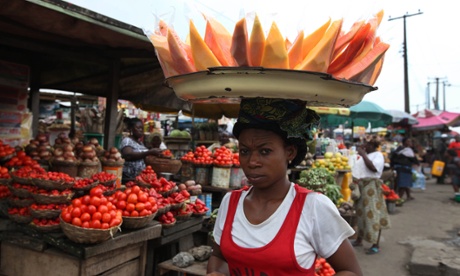
A woman carries fruit to sell in the market in Lagos, Nigeria. Photograph: Sunday Alamba/AP
Two years ago Ghana's statistical service announced it was revising its GDP estimates upwards by over 60%, suggesting that in the previous estimates about US$13bn worth's of economic activity had been missed. As a result, Ghana was suddenly upgraded from a low to lower-middle-income country. In response, Todd Moss, the development scholar and blogger at the Center of Global Development in Washington DC, exclaimed: "Boy, we really don't know anything!"
Shanta Devarajan, the World Bank's Chief Economist for Africa, struck a more dramatic tone. In an address to a conference organised by Statistics South Africa, he called the current state of affairs "Africa's statistical tragedy".
How good are these numbers?
My book – Poor Numbers: how we are misled by African development statistics and what to do about it – presents a study of the production and use of African economic development statistics. All of the central questions in development revolve around the measure of the production and consumption of goods and services. This is expressed in an aggregate composite metric called the Gross Domestic Product, which is used to rank and rate the wealth and progress of nations. It is the most widely used measure of economic activity, yet little is known about how this metric is produced and misused in debates about African economic development.
For a number of years now I have been trying to answer the question: How good are these numbers? The short answer is that they are poor. This is not just a matter of technical accuracy – the arbitrariness of the quantification process produces observations with very large errors and levels of uncertainty. This "numbers game" has taken on a dangerously misleading air of accuracy, and the resulting figures are used to make critical decisions that allocate scarce resources. International development actors are making judgments based on erroneous statistics. Governments are not able to make informed decisions because existing data are too weak or the data they need do not exist.
What happened in Ghana?
How could the country be among the poorest in the world one day, and find itself amongst aspiring middle income countries the next?
To grasp this chain of events, a basic understanding of national accounting is necessary. GDP is typically calculated as a sum of the "value added" of the production of goods and services in all sectors of the economy. In order to compare one year's value added with another, and thus get an idea of whether the economy is expanding or contracting, a new set of sums for all the sectors are computed. In order for these two amounts to be comparable, they are expressed in constant prices. The easiest way of doing this, particularly if data are sparse, which they are at most African statistical offices, is to generate "base year" estimates for future level estimates.
When picking a base year the statistical office chooses a year when it has more information on the economy than normally available; such as data from a household, agricultural or industrial survey. The information from these survey instruments is added to the normally available administrative data to form a new GDP estimate. This new total is then weighted by sectors, thereafter other indicators and proxies are used to calculate new annual estimates.
The importance of the base year
The base year is very important in three respects. Firstly, the GDP estimates will be expressed in constant prices for the base year. Second, the index number applies, so that a sector that was very economically important in the base year will continue to appear very important despite structural changes that may have occurred since the last base year.
Conversely, sectors that were unimportant or not even existing will barely have an impact on the official statistics. Finally, the data sources and the use of proxies are set in the base year. Even when new information is becoming available, national accountants may be unwilling or unable to add this data to the GDP series. Thus, when the base year is out of date, the GDP series becomes an increasingly unreliable guide to interpreting real economic change. The IMF statistical division recommends a change of base year every fifth year.
In the case of Ghana, their previous base year was made in 1993. Quite obviously, the structure of the economy has changed radically since then, partly due to the introduction of new technologies, such as the mobile phone and partly due to economic policy, such as the continued liberalisation and importance of non-state delivery of services such as in tertiary education. Through some sample surveys and availability of administrative data, such as those derived from VAT, the statistical office was increasingly aware that they were underestimating the size of the Ghanaian economy. Ghana Statistical Services therefore requested the services of the IMF as early as in 2002, which contracted a consultant to undertake the rebasing and revision of GDP estimates.
What about the comparisons with other countries? How should we compare the income and growth of Ghana with Nigeria, Kenya or other economies in the region? The lack of comparability of data and methods in national accounting practices in Sub-Saharan Africa is disturbing. According to my own survey, only 10 of these countries have a base year that is less than a decade old. When I compared statistics available from the World Bank and those published by the national statistical agencies that actually compile the GDP statistics there was an alarming level of discrepancy. A comparison of the data published in other sources further added support to the conclusion that with the current uneven application of methods and poor availability of data, any ranking of countries according to GDP is misleading.
Nigerian revision pending
Meanwhile, in Nigeria an upward revision is pending. Their base year for the national accounts, 1990, is even more outdated than that of Ghana. According to reports from the National Bureau of Statistics (NBS), Nigeria plans to change its base year to 2008. It has been boldly announced that this could lead to a "huge jump" in GDP figures.
This radically challenges our current understanding of economic development in Nigeria and in Africa. According to the World Development Indicators' most recent data, the total GDP in 2010 was above $200bn (in current US$). Nigerian GDP, before the predicted revision, already accounts for 18% of sub-Saharan Africa's total (about $1,200bn). The reports in the media, from the IMF and the NBS all indicate that Nigeria's GDP will increase at least as much as it did in Ghana.
Let us be conservative and assume that the GDP in Nigeria merely doubles following the revision. This alone will mean that the GDP for the whole region increases by more than 15%. The value of the increase amounts to nothing less than 40 economies roughly the size of Malawi's. The knowledge that currently there are 40 "Malawis" unaccounted for in the Nigerian economy should raise a few eyebrows.
It is a real tragedy that the statistical capacities of sub-Saharan African economies are in such a poor state. African development statistics tell us less than we would like to think about income, poverty and growth in the region. One of the most urgent challenges in African economic development is to devise a strategy for improving statistical capacity. This system currently causes more confusion than enlightenment. However, governments, international organisations and independent analysts need these development statistics to track and monitor efforts at improving living conditions on the African continent.
Poor numbers are too important to be dismissed as just that.
Morten Jerven is an assistant professor at the Simon Fraser University, School for International Studies, in Canada. His book, Poor Numbers: how we are misled by African development statistics and what to do about it, is published by Cornell University Press
--
You received this message because you are subscribed to the "USA-Africa Dialogue Series" moderated by Toyin Falola, University of Texas at Austin.
For current archives, visit http://groups.google.com/group/USAAfricaDialogue
For previous archives, visit http://www.utexas.edu/conferences/africa/ads/index.html
To post to this group, send an email to USAAfricaDialogue@googlegroups.com
To unsubscribe from this group, send an email to USAAfricaDialogue-
unsubscribe@googlegroups.com

No comments:
Post a Comment