---------- Forwarded message ----------
From: Pa Fru Ndeh <PaFruNdeh@yahoo.com>
Date: Wed, Apr 23, 2014 at 3:30 PM
Subject: [NaijaPolitics] Army, Boko Haram Working Together in Parts of Nigeria?
To: Cameroon Politics <cameroon_politics@yahoogroups.com>
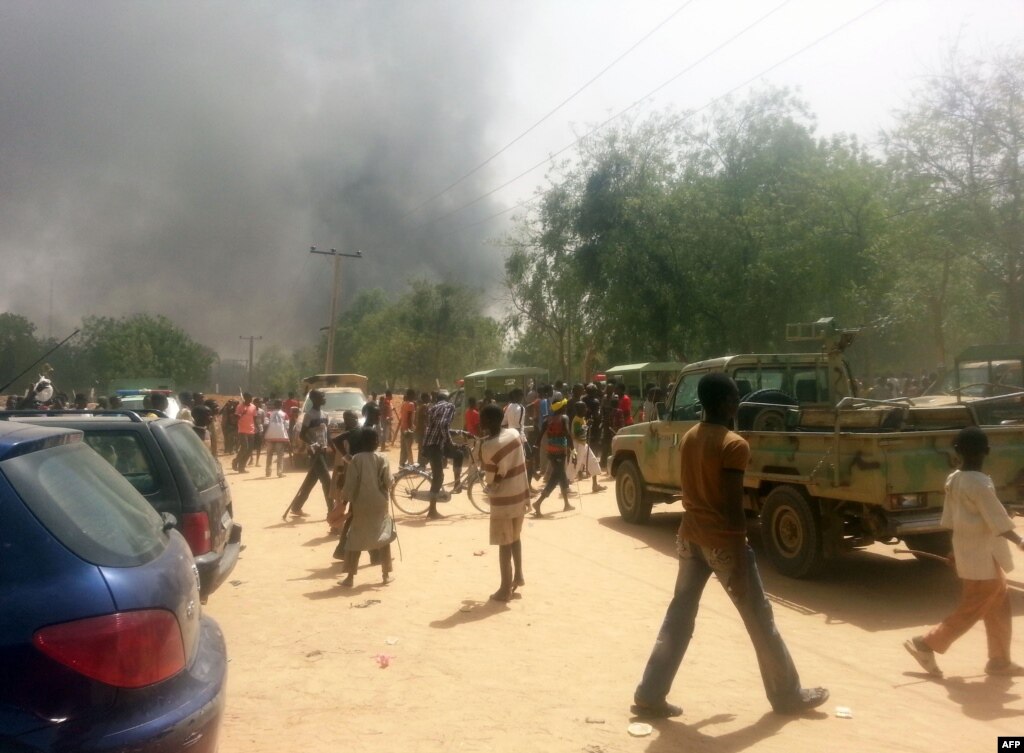
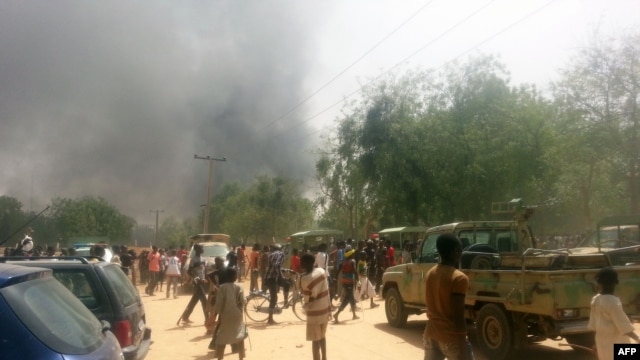 FILE - People look at smoke rising after suspected Boko Haram Islamists attack a military base in the northeast Nigerian city of Maiduguri.


From: Pa Fru Ndeh <PaFruNdeh@yahoo.com>
Date: Wed, Apr 23, 2014 at 3:30 PM
Subject: [NaijaPolitics] Army, Boko Haram Working Together in Parts of Nigeria?
To: Cameroon Politics <cameroon_politics@yahoogroups.com>
WASHINGTON — A Nigerian soldier says he has witnessed incidents that suggest some Nigerian military commanders are working with Boko Haram, an Islamist militant group blamed for thousands of deaths since 2009.
In an exclusive interview with VOA's Hausa service, he described how his military unit, based in the northeastern Borno State region, was ambushed by Boko Haram fighters.
The soldier, who did not want to be identified, said the commander of a nearby military unit, based in the town of Bama, recently sought assistance from his unit in carrying out a raid.
The soldier said when the two military units joined up, they were given different uniforms. The Bama unit commander gave his own troops green uniforms. The soldier said his unit received tan "desert camouflage" uniforms.
When the troops reached the battle area, the soldier said the commander of the better-equipped Bama unit suddenly withdrew his forces, leaving the remaining troops to fend for themselves against Boko Haram fighters.
Speaking in Hausa, he said, "We had only light arms and our men were being picked off one after the other."
The soldier also said he recognized some of the Boko Haram fighters as his former military trainers in Kontagora, a town near the capital, Abuja.
"We realized that some of them were actually mercenaries from the Nigerian army... hired to fight us," he said.
This soldier and others have said that too often, commanders have pocketed money that was supposed to be used to help equip units.
Government has no comment
VOA has made repeated attempts to get reaction from the Nigerian government for this story but no officials have been willing to speak on the record.
However, in a January 2012 speech, Nigerian President Goodluck Jonathan said Boko Haram members have infiltrated his government's executive, legislative and judicial sectors, as well as the police and armed forces.
Jonathan has declared a state of emergency in three northern regions where Boko Haram is active, and launched operations to destroy the group's camps. Despite those efforts, though, large-scale attacks have continued.
Soldier's account "credible"
Atlantic Council Africa Center Director Peter Pham said the soldier's account could have merit.
"It certainly would not surprise me that it is happening," said Pham.
Pham said the goal should be to figure out how and why collaboration between military officers and terror groups could happen.
"What's critical is to understand, if there is this collusion, to understand whether it is a collusion born of corruption, born of desperation simply to avoid combat that would result in casualties for the men under your command, or if it is born of ideological sympathy with the insurgents," he said.
Apart from some well-trained elite units, Pham said most of Nigeria's military is "woefully underfunded and under-resourced" in terms of equipment and training.
Effects of "systemic corruption"
E.J. Hogendoorn is deputy director of the International Crisis Group's Africa program. The group recently released a detailed report about the Boko Haram insurgency in Nigeria.
He said Nigeria's military disfunction is part of a broader problem of systemic corruption extending through most government sectors.
Hogendoorn says "drivers," such as bad governance and the inability of state institutions to provide basic services, help create a pool of unemployed youth "ripe for radicalization."
"We argue that even were Boko Haram to be defeated, if you don't deal with those drivers, you are not going to be able to stabilize either northern Nigeria or the entire country," he said.
Hogendoorn said in order for change to occur, the Nigerian government needs to address corruption and poor governance in a systematic and sustained way.
In an exclusive interview with VOA's Hausa service, he described how his military unit, based in the northeastern Borno State region, was ambushed by Boko Haram fighters.
The soldier, who did not want to be identified, said the commander of a nearby military unit, based in the town of Bama, recently sought assistance from his unit in carrying out a raid.
The soldier said when the two military units joined up, they were given different uniforms. The Bama unit commander gave his own troops green uniforms. The soldier said his unit received tan "desert camouflage" uniforms.
When the troops reached the battle area, the soldier said the commander of the better-equipped Bama unit suddenly withdrew his forces, leaving the remaining troops to fend for themselves against Boko Haram fighters.
Speaking in Hausa, he said, "We had only light arms and our men were being picked off one after the other."
The soldier also said he recognized some of the Boko Haram fighters as his former military trainers in Kontagora, a town near the capital, Abuja.
"We realized that some of them were actually mercenaries from the Nigerian army... hired to fight us," he said.
This soldier and others have said that too often, commanders have pocketed money that was supposed to be used to help equip units.
Government has no comment
VOA has made repeated attempts to get reaction from the Nigerian government for this story but no officials have been willing to speak on the record.
However, in a January 2012 speech, Nigerian President Goodluck Jonathan said Boko Haram members have infiltrated his government's executive, legislative and judicial sectors, as well as the police and armed forces.
Jonathan has declared a state of emergency in three northern regions where Boko Haram is active, and launched operations to destroy the group's camps. Despite those efforts, though, large-scale attacks have continued.
Soldier's account "credible"
Atlantic Council Africa Center Director Peter Pham said the soldier's account could have merit.
"It certainly would not surprise me that it is happening," said Pham.
Pham said the goal should be to figure out how and why collaboration between military officers and terror groups could happen.
"What's critical is to understand, if there is this collusion, to understand whether it is a collusion born of corruption, born of desperation simply to avoid combat that would result in casualties for the men under your command, or if it is born of ideological sympathy with the insurgents," he said.
Apart from some well-trained elite units, Pham said most of Nigeria's military is "woefully underfunded and under-resourced" in terms of equipment and training.
Effects of "systemic corruption"
E.J. Hogendoorn is deputy director of the International Crisis Group's Africa program. The group recently released a detailed report about the Boko Haram insurgency in Nigeria.
He said Nigeria's military disfunction is part of a broader problem of systemic corruption extending through most government sectors.
Hogendoorn says "drivers," such as bad governance and the inability of state institutions to provide basic services, help create a pool of unemployed youth "ripe for radicalization."
"We argue that even were Boko Haram to be defeated, if you don't deal with those drivers, you are not going to be able to stabilize either northern Nigeria or the entire country," he said.
Hogendoorn said in order for change to occur, the Nigerian government needs to address corruption and poor governance in a systematic and sustained way.
__._,_.___
| Reply via web post | Reply to sender | Reply to group | Start a New Topic | Messages in this topic (1) |
Disclaimer:
Forum members are reminded that NaijaPolitics is established to be a moderated forum for gavel-to-gavel discussion of political developments in Nigeria, Africa's largest democracy. Freedom of opinion/expression is inherent in NaijaPolitics. Views and opposing views expressed in NaijaPolitics forum are the rights of individual contributors. Mutual respect for people's views is the corner stone of our forum. Freedom of speech applied responsibly within the guiding parameters of Yahoo! Inc (our hosts) and NaijaPolitics Rules and Guidelines (broadcast monthly and accessible to all subscribers in our archives) is our guiding principle. Everyone posting to this Forum bears the sole responsibility for any legal consequences of his or her postings, and hence statements and facts must be presented responsibly. Your continued membership signifies that you agree to this disclaimer and pledge to abide by our Rules and Guidelines.
NaijaPolitics is division of Afrik Network Groups.
Latest Version of Disclaimer released (December 15, 2005)
Forum members are reminded that NaijaPolitics is established to be a moderated forum for gavel-to-gavel discussion of political developments in Nigeria, Africa's largest democracy. Freedom of opinion/expression is inherent in NaijaPolitics. Views and opposing views expressed in NaijaPolitics forum are the rights of individual contributors. Mutual respect for people's views is the corner stone of our forum. Freedom of speech applied responsibly within the guiding parameters of Yahoo! Inc (our hosts) and NaijaPolitics Rules and Guidelines (broadcast monthly and accessible to all subscribers in our archives) is our guiding principle. Everyone posting to this Forum bears the sole responsibility for any legal consequences of his or her postings, and hence statements and facts must be presented responsibly. Your continued membership signifies that you agree to this disclaimer and pledge to abide by our Rules and Guidelines.
NaijaPolitics is division of Afrik Network Groups.
Latest Version of Disclaimer released (December 15, 2005)
.
__,_._,___
You received this message because you are subscribed to the "USA-Africa Dialogue Series" moderated by Toyin Falola, University of Texas at Austin.
For current archives, visit http://groups.google.com/group/USAAfricaDialogue
For previous archives, visit http://www.utexas.edu/conferences/africa/ads/index.html
To post to this group, send an email to USAAfricaDialogue@googlegroups.com
To unsubscribe from this group, send an email to USAAfricaDialogue-
unsubscribe@googlegroups.com
---
You received this message because you are subscribed to the Google Groups "USA Africa Dialogue Series" group.
To unsubscribe from this group and stop receiving emails from it, send an email to usaafricadialogue+unsubscribe@googlegroups.com.
For more options, visit https://groups.google.com/d/optout.

No comments:
Post a Comment