Sunday, August 2, 2015

USA Africa Dialogue Series - Thanks Rev. Awasom / US or other Partisan Politics has no place in AU Diaspora Outreach


Hello Rev. Awasom, thank you. You addressed cornerstone point.

Dear all:

AU Africa Diaspora outreach is non-partisan. The dispositions or dispensations cannot be vested in the  internal politics of countries in the Diaspora. Therefore, it makes no difference who is Republican v Democrat in America;  Tory/Conservative v Labor in UK; the radical anti-immigrant parties v the various amalgamations in France; Silvio Berlusconi's Forza Italia v Democratic Party in Italy; Christian Democratic Union of Germany v Christian Social Union of Bavaria party or Social Democratic Party of Germany; Conservative Party, Liberal Party,  Le Bloc Quebecois, the Green Party or New Democratic Party in Canada; etc.

All of the above cannot be kinder and more committed to a peaceful, prosperous, and integrated Africa (PPIA)  than  to  their common wedded interests vis a vis Africa. As nature has it, a PPIA will become an equal (at minimum) to these powers. Now, it would take some maddening reasoning to think  Western nations will charitably develop Africa so that Africa will challenge the audacity they current enjoy.  As the saying goes, ultimately Africa has to do for self.

Africa Diaspora residents are encouraged to be actively involved in civic developments in their respective jurisdictions and it is understandable that stakeholders will be partisan in their localities since the politics affect local livelihoods where we live. However, and emphatically so,  the partisan affinities have no bearing when it comes to AU Diaspora outreach, participation,  and agenda, which are  pro Africa and premised on articulated vital interests aligned with the Africa We Want: peaceful, prosperous, and integrated.  Take the example of  the various Jewish  groups and political parties -  their views are as diverse as you may count but they converge on Israel's vital interests - as it is clear on the Iranian deal.

As people of African descent, it is the responsibility of each generation to pass on something that can always be perfected by subsequent generations. We can to do our part with  the benefits of many hindsight that were never in pre-independent Africa and at the eve of the independence of many African nations in the 1960s and throughout the cold war. Coming of age, Africans have to be the subjects of their own inquiry; not the objects of external determinations.

Let me underscore this point by recalling a lesson that  I loved  to engage my Mom in discussing. I am sure some on the forums  like Prince of Bessongabang the learned gentry Denis Mukefor, investor in London knew her. Some Lycée dudes used to crack me up when they asked whether I am my Mom's daughter. She taught World History.

I would listen to BBC and VOA broadcast to Africa and ask her questions. She addressed how the balance of power between NATO and Warsaw Pact played out ruinously in Africa and the views are shaped by the media. "Now, time to go to bed" she would say on a weekday when I would  show no sign of letting up with questions. Me: Please, tell me one more story....what about.  One particular discussion stood out because of its contemporary unfolding. Jonas Savimbi/UNITA  in the bush waging guerrilla warfare with US (leader of NATO) and racist South Africa providing arms to UNITA  while Russia (leader of Warsaw Pact) and Cuba supported José Eduardo dos Santos/MPLA with arms. The civil war from 1975 to 2002 plunged an endowed nation into the pit of human calamity.

Here is the point: Former Presidents Carter and Reagan were Democrat and Republican respectively when they upheld  US  interests that overshadowed any political  difference. Whether Carter was a born again Christian or Reagan was once an actor in Hollywood not known for things related to prayers made no difference. Do we need to be clearer that the internal politics and who is in power are of no benevolent difference  to Africa? 

Years later, when I interfaced with Jardo Muekalia, the UNITA representative in the US during the conflict and after the US withdrew its support, I could not help but wonder about the proverbial consequences "when two elephants fight, the grass suffers." Angola was the grass.  Jardo used to commandeer a spacious office in downtown Washington, DC in the vicinity of K Street. After the big boys stopped their proxy fight in Angola during the Clinton administration, he became a persona non grata in the Western world.  Angola, the grass, has to rebuild. The senseless loss of limbs and lives  brings home the bitter lesson in realpolitik: The super powers have no permanent friend; just permanent interest.  When I think of Angola and other neocolonial catalysts, one may understand why I have no time to discuss/debate the clash of inanities. It makes no difference. You build partnerships based on mutual interest; it should not matter whether it is Republican or Democrat.

After Gaddafi was bombed, it was apparent to watchers of how these things play out that China and Russia will veto  anything coming from the US that can mean  "no fly"  even "no pass."  Bashar al-Assad of Syria is the beneficiary. 

Fellow members of Africa Diaspora, Africa can be poorer but her people should not be stupid. The morale of  history's lessons dictate that Africa's hope is within. Let us combat ignorance, address the issues, and offer solutions to promote Africa's interests. Fighting each based on partisan politics, quarreling over  transient notions that reflect idiosyncrasies than principled African interest, is a loose-loose proposition. 

MsJoe
To Lead You Must be a Servant


-----Original Message-----
From: Jonathan Awasom jonathan_light2000@yahoo.com [Mwananchi] <Mwananchi@yahoogroups.com>
To: Mwananchi <Mwananchi@yahoogroups.com>; africanid <africanid@yahoogroups.com>; CongoVista <CongoVista@yahoogroups.com>; africa-oped <africa-oped@yahoogroups.com>; zimsite <zimsite@yahoogroups.com>; africanworldforum <africanworldforum@googlegroups.com>; voice-of-uganda <voice-of-uganda@googlegroups.com>
Cc: talknigerian <talknigerian@yahoogroups.com>; Nigerian World Forum <nigerianworldforum@yahoogroups.com>; cpcbali <cpcbali@yahoogroups.com>; camnetwork <camnetwork@yahoogroups.com>; Cameroon Forum <cameroonforum@yahoogroups.com>; KENYA ONLINE <kenyaonline@yahoogroups.com>; SDF South Africa <cameroons_sdf_party@yahoogroups.com>

 
 Msjoe  Evelyn


             This is geopolitics and international relations in action. You do not waste your precious time bashing at either democrats or republicans because it is irrelevant to the present geopolitical challenges  confronting Africa .  I will hope everyone in their right frame of mind will channel their energy to support  an initiative and vision like yours with the potential to shape a new US policy in Sub-Saharan Africa during the last tenure of President Obama and beyond. We stand to gain a lot if we explore  ways to build bridges between  liberals and conservatives because U interest in Africa does not change regardless of who is in the White House . 

            However, through  a concerted and collaborative effort like this Africans could effect meaning change as participants /stakeholders and not  as armed chair critics of  what white people doing wrong against black Africa. No matter how often we ,Africans complain about corruption and tyranny our voices can only be heard if we act responsibly by contributing to create policies here in the USA that will reverberate in Africa. I hope that every Cameroonian and Nigerian in particular who talks a lot will come on board this train of reason and commonsense to invest time , effort and talent towards achieving the goals you have set for us. 

Over to you Africans!

 Blessings

Jonathan Awasom 

This information is sent in batches to identified organizations.
 Organizations should please send their current contact numbers and email addresses.

Looking forward to the participation of professionals in the respective fields and formal representation of Diaspora organizations.
 Please study the contents and contexts. Every field is covered, except faith-based inter-faith initiative, which would be sent as a separate article. 

Note 1: Organizations should please send their  current contact numbers. 

Note 2: Please read through the agenda on the left, which includes the question on dual citizen for the 23 countries that do not have and  voting rights for African nations that have not granted it or those that have granted it, like Kenya and Nigeria,  but yet to be implemented. Both issues were derived from community-based participatory research, including surveys. But there not included in the AU Declaration of the Global Africa Diaspora Summit in South Africa in 2012. In both cases, we invited leaders to share best practices. 

Note 3:  On Africa Diaspora Representation at the Economic Social and Cultural Council of the African Union, at this there is no representation. Your participation in the caucus during the Oct. 2015 Summit will help in addressing modalities. Africa Diaspora includes everywhere outside Africa.

Have a  peaceful and productive weekend. God Bless You.

MsJoe


Welcome 
  
  
Africa Diaspora Dispatch  is  an eNewsletter that brings you information in  context of African and related developments. We  endeavor to provide links and videos for fuller appreciation of the moment and meaning.   
  
In this  edition, you can take a virtual journey, with picture and video narratives, to get the scope of  President Barack Obama's entire historic 5-day trip to Africa from July 24-28, 2015. Admits the substance and seriousness, there were lighter moods, which  include his remarkable reunion with his family, his dancing flair at the State Dinner in Nairobi ,and jokes.  He also met Lucy in Ethiopia. 
  
We also take the reader down Memory Lane with the visionary Dr. Leon Sullivan who demonstrated the possibilities in Africa and Africa Diaspora Relations. These and more are  lessons we hope to incorporate in creating sustainable solutions at the upcoming Global Africa Diaspora Summit 2015 from October 9-11, 2015.   
  

As the cradle of civilization, Africa has much to share with humanity. We  hope  readers of all backgrounds can appreciate  the times, trials, and triumphs as we draw from experiences and aim ahead in building T he Africa We Want:  Peaceful, Prosperous, Integrated.  In this pursuit, your goodwill, hand of friendship and partnership  are  mutual opportunities we cherish.
  
We wish you a productive month of August 2015. 
  
May God Bless You. 
Evelyn Joe 


 African Union
 
Global Africa Diaspora Summit 2015
 
Year of African Women Empowerment and Development
October 9-11, 2015  Washington, DC
 
Actualizing the  African Union Declaration of the Global Africa Diaspora Summit in Sandton, Johannesburg, South Africa 2012

Sensitization and Mobilizing

CITIZENS AND DIASPORA ORGANIZATIONS

 
 Make a virtual visit to the African Union to keep  informed: Enter

Notable Mentions in African Union Year of 
African Women Empowerment and Development

Congratulations to Ambassador Amina Salum Ali, African Union's Ambassador to the US for throwing her hat in the ring to become Tanzania's fifth president. Ambassador Ali indicated her priority and concern for women in the press. 

We also congratulate  Ms. Asha-Rose Mtengeti Migiro,  a former Deputy Secretary-General of the United Nations, who also contested in the primaries under the same  banner of the ruling party, Chama Cha Mapinduzi (CCM).  Both women were among the top three contestants.  

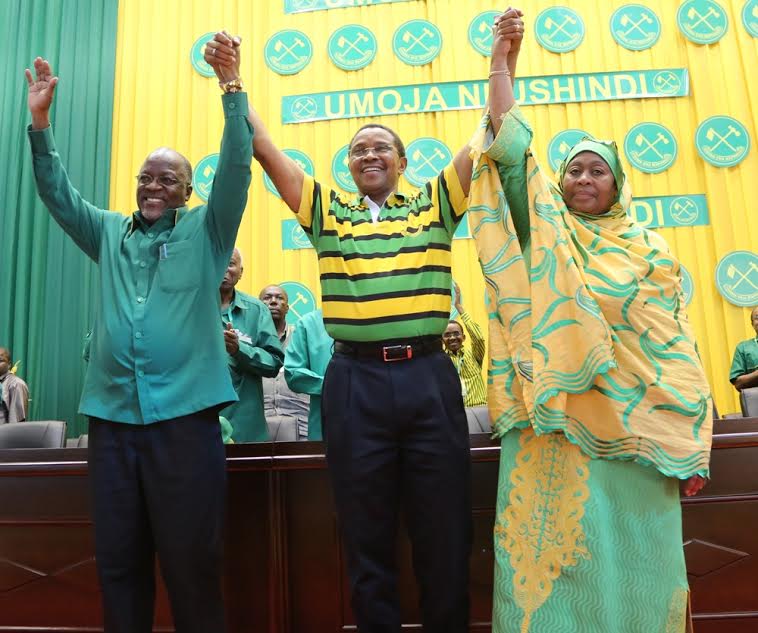
Dr. John Pombe Magufuli, the country's Minister of Works, emerged victorious. He is widely expected to best his competitors  at the Oct. 25, 2015 polls. The winner will    succeed President Jakaya Kikwete who will be stepping down after his second and final term.
From left to right:
 Presidential candidate John Magufuli, President Jakaya Kikwete, Vice presidential candidate Samia Hassan Suluhu

Hopes for the African woman was revived when the presidential standard bearer  made history by selecting a woman,  Ms. Samia Hassan Suluhu , as his running mate. From Zanzibar, Hon. Suluhu is a member of parliament and  current Minister of State in the Vice President's Office for Union Affairs.


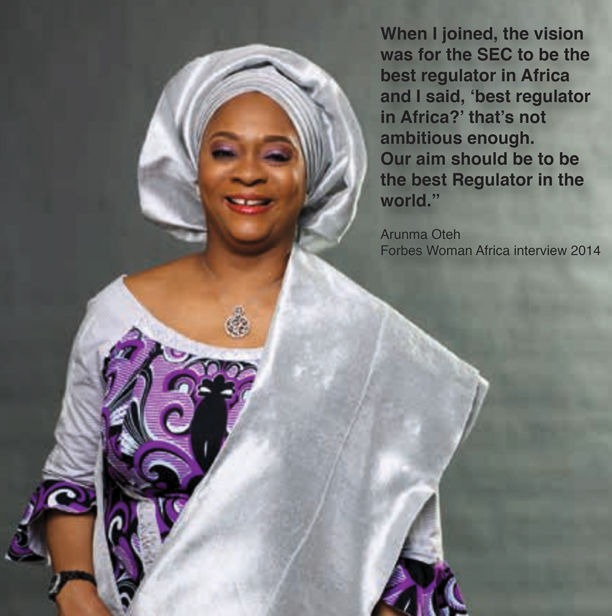
Ms. Arunma Oteh has been named the new Vice President (VP) and Treasurer at  the World Bank.  According to a statement from the World Bank, Ms. Oteh was selected through an international competitive search process. She  will  take office  on September 28, 2015.  . She will  be the first African woman to hold the position of  Treasurer. Ms Oteh was the director general for Nigeria's Stock Exchange. 

  
She  joins the league African women who have held powerful position at the World Bank. Former Nigeria's Minister of Finance Dr. Ngozi Okonjo-Iweala was one of  Bank's managing directors (October 2007-July 2011), as well as VP and Corporate Secretary of the World Bank Group.  Tanzania's Dr. Frannie Léautier  held various positions at the World Bank including  director of infrastructure and  VP  of the World Bank Institute. M s. Obiageli Ezekwesili,from Nigeria,  was the World Bank's VP for  Africa Region (May 2007-May 2012). 
  

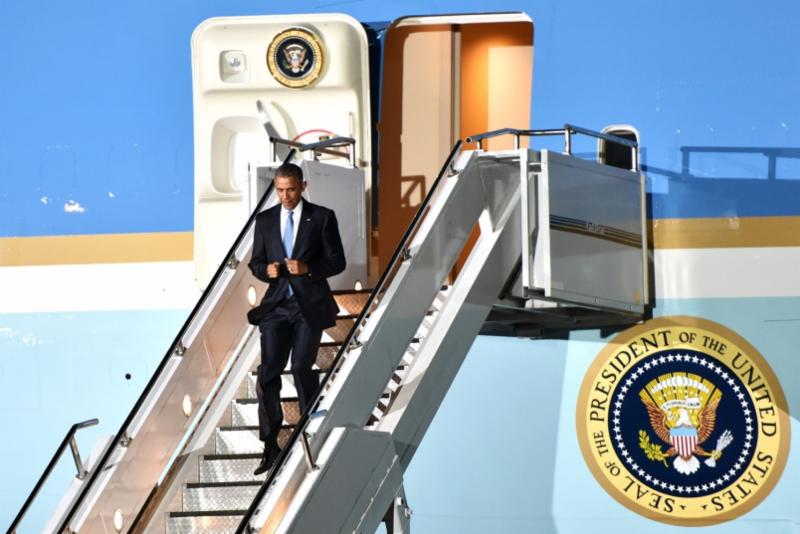
 US President Barack Obama Departs to Africa on a Historic Visit
 
Great American tradition! Obama Boarding: Take off from the USA to Africa
  Airborne  on 
 Air Force One  
Obama to Africa on July 24, 2015. 


This was President Barack Obama's fourth visit to Africa as President and first to his ancestral homeland of Kenya, where his father was born. It was the first time a sitting US President visited both Kenya and Ethiopia. It was also the first time a US President addressed the African Union at its headquarters in Addis Ababa, Ethiopia. 

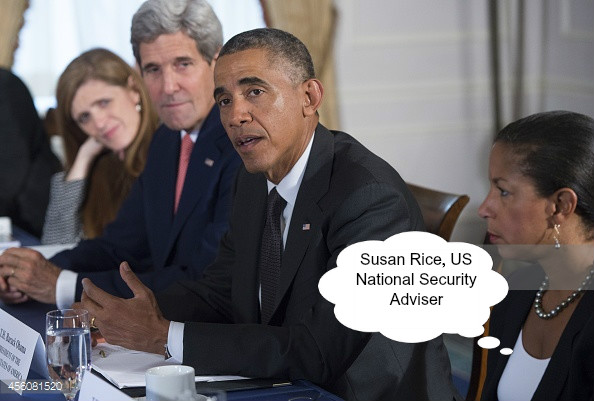
Among those who accompanied President Obama on his trip were National Security Adviser Susan Rice; Secretary of  State John Kerry;  foreign policy aide Ben Rhodes;   White House spokesman Josh Earnest;  and at least 20 members of the  US Congress:
 
  1. Sen. Chris Coons (D-Del.);
  2. Senator Jeff Flake (R-Ariz.) 
  3. Senator Ed Markey (D-Mass.)
  4. Representative Karen Bass (D-Calif.) 
  5. Representative G.K. Butterfield (D-N.C.) 
  6. Representative Eddie Bernice Johnson (D-Texas) 
  7. Representative Barbara Lee (D-Calif.) 
  8. Representative Gregory Meeks (D-N.Y.) 
  9. Representative Charlie Rangel (D-N.Y.) 
  10. Representative Terri Sewell (D-Ala.) 
  11. Representative Emanuel Cleaver (D-Mo.) 
  12. Representative John Conyers (D-Mich.)  
  13. Representative Marcia Fudge (D-Ohio) 
  14. Representative Al Green (D-Texas);
  15. Representative Sheila Jackson Lee (D-Texas);
  16. Representative Robin Kelly (D-Ill.), 
  17. Representative Gwen Moore (D-Wis.)
  18. Representative Donald Payne (D-N.J.) 
  19. Representative Cedric Richmond (D-La.) 
  20. Representative Bennie Thompson (D-Miss.)
President Obama's  focus on security, electricity democracy, and trade  resonated with the people of Africa.  In the next sections, explore the moment and meaning. 

 US President Barack Obama Arrives
Shaping Legacy
  

D
Tra
July 25, 2015: President Obama Arrives in Kenya for a 4 day African visit
July 24, 2015: President Obama arrived in Kenya for the first leg of his visit in Africa. 


Karibu (Welcome) Obama

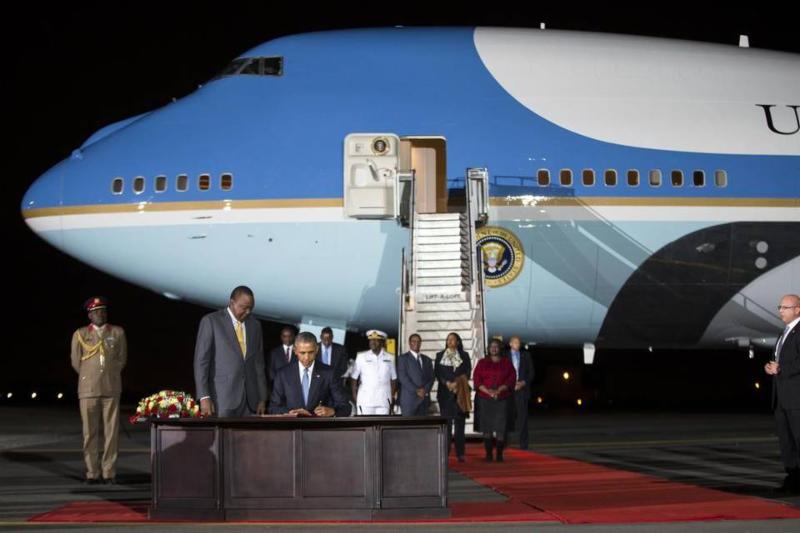
 US President Obama at the Jomo Kenyatta International Airport.


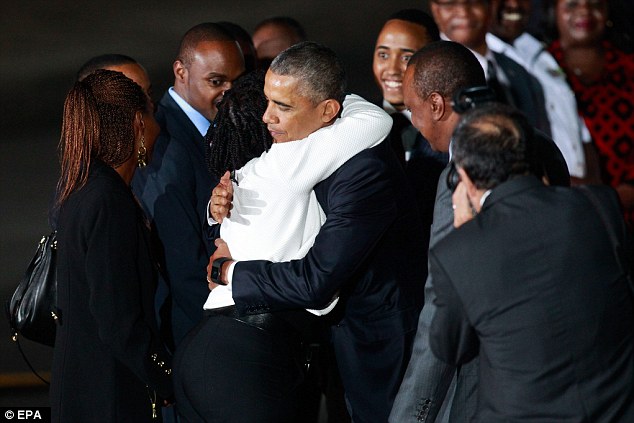
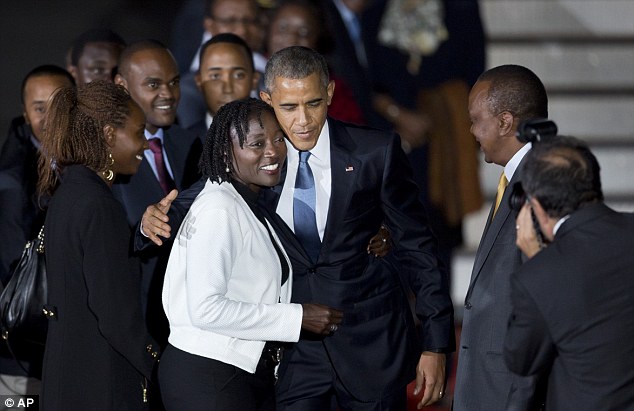
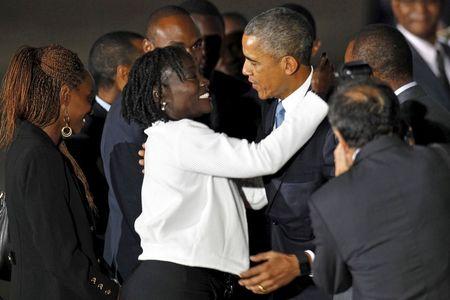
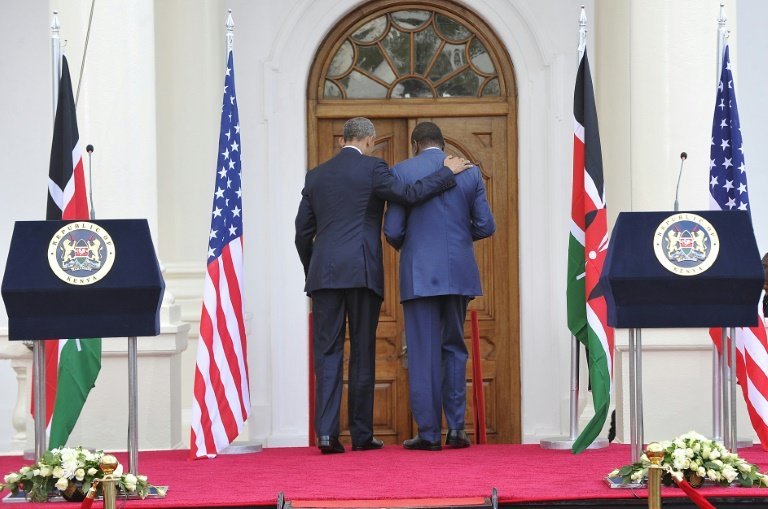
Dignitaries and personalities were at hand to welcome President Obama on his historic return to Kenya. Most captivating was his warm embrace of his older sister, Dr Auma Obama,  who was last in the greeting line. Auma later got into the president's limousine and the two rode from the airport together, embedded in a large train of security vehicles. 
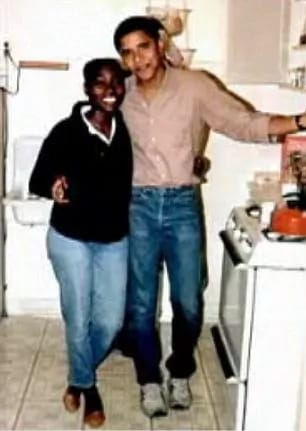
Years back: Auma and Barack Obama.


The western press has a strange habit  of referring  to  Auma Obama as Obama's half-sister and vice-versa. In Africa, children of stepmothers who share a father are actually siblings. There is nothing like half-this and half-that 
  
President Uhuru Kenyatta (right).


 Kenya's President Uhuru Kenyatta watched  as President Obama signed a guest book after arriving in Kenya.  

 
 
Dr. Auma Obama and President Obama  rode together from the airport in the presidential limousine called " The Beast," which is said to be the safest vehicle in the world.

Twenty-seven years ago, as recounted in the press, documented in President's Obama autobiography, Dreams from My Father,  and retold by both siblings, Auma picked up a 25-year-old Barack Obama at Jomo Kenyatta International Airport on his first visit to Kenya. Not long after they left the  airport, her old VW Beetle broke down. 

The story adds poignancy to the sight of the two leaving the airport in the presidential limousine in a far different circumstance. This memory was again revived when Auma joked about it two days later while introducing her brother for his speech to the nation. 
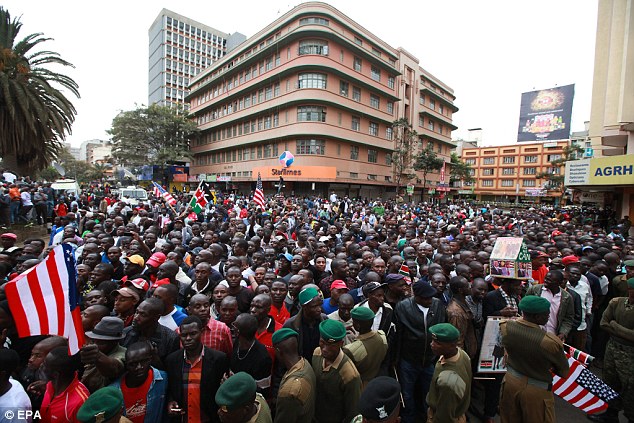
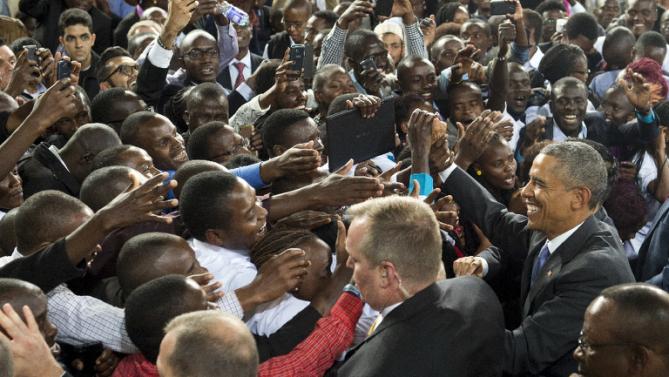
Thousands turned out for a euphoric welcome to President Obama in his ancestral home.  Obama's father, a Kenyan,  studied at Harvard University in the United States. 


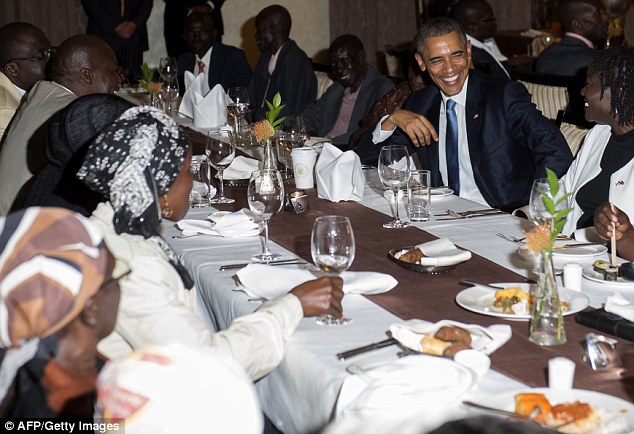
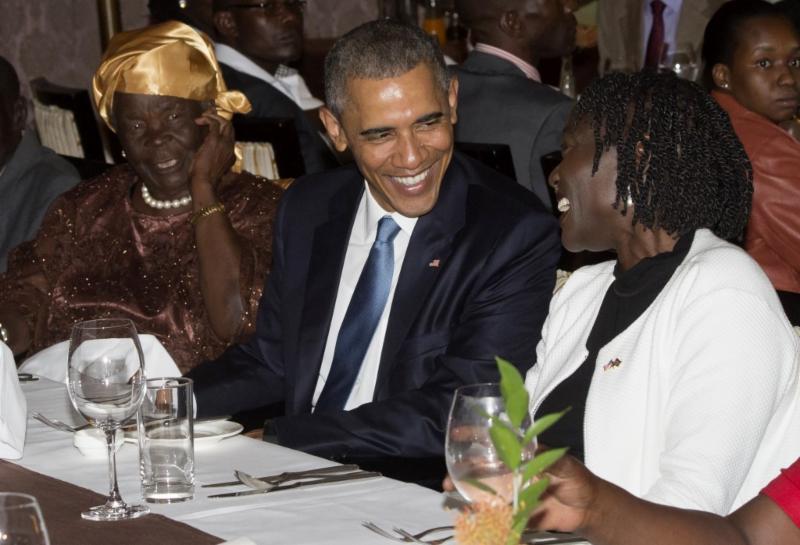
July 24, 2015: Family time: US President Barack Obama sat  alongside his step-grandmother, Mama Sarah (L) and sister Dr. Auma Obama (R), during a family reunion at  a private dinner in a restaurant at the hotel  where he stayed.   According to his uncle, Mr Saidi Obama who attended the event, they were served Kenyan/African dishes: aliya, osuga, dek, apoth, mitoo and ngenge. 
 
 Down to Business
  
President Obama inspects guard of honor with a 21 gun salute
The President of the United State received a 21 gun salute in Kenya.


On Saturday July 25, 2015, President Barack Obama was accorded the highest respect at the State House in Nairobi.   He was received by a 21 gun salute after which he inspected a guard of honor.
  
Joint Press Conference - July 25, 2015 
The Great Collaboration and Singular Class 
  
  
Joint Press Conference: Presidents Obama and Kenyatta
July 25, 2015 
Joint Press Conference:   
President Obama and  President Kenyatta. 
  
  
President Obama and President  Kenyatta echoed one another's commitment to several shared policies and nation-building initiatives, which he promoted throughout the visit.   During the press conference, Obama announced a proposed ban on the transport of ivory across U.S. state lines in a move to protect African elephants from poachers.
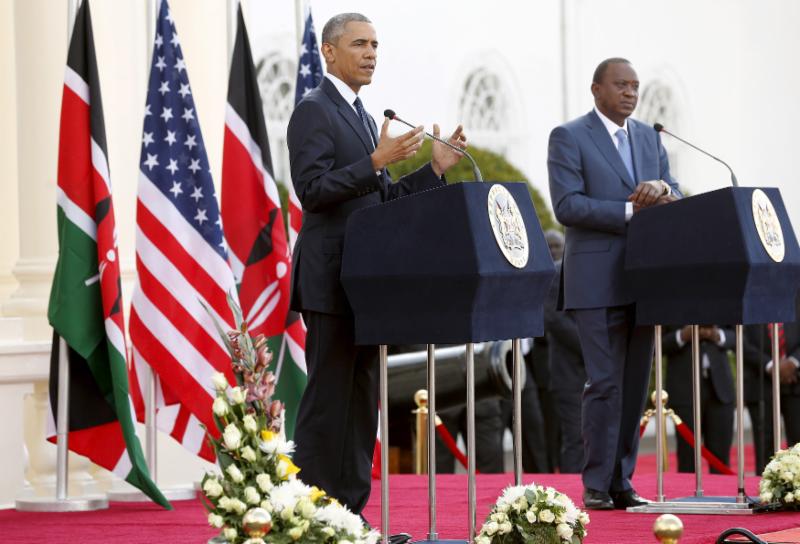
 
 When asked by a reporter about his legacy in Africa, Obama replied by highlighting his effort to bring electricity to rural Africa through a $7 billion project called Power Africa. "If we can get sub-Saharan Africa to be electrified at the same level Asia is -- that alone is going to drive economic productivity exponentially," Obama said. "It's a game-changer.   
Presidents Obama and Kenyatta disagree on gay issues
President Obama and President Kenyatta disagree on homosexuality.


On President Obama arguments  for gay  rights, a cause he has been promoting in Africa, President Kenyatta termed them  a " non-issue," citing  more pressing issues facing Kenyans.


At the end of the Joint Press Conference.
 Both Presidents agreed on much but agreed to disagree on the question of gay rights and relevance.


On July 22, 2015, during his visit to the US, Nigerian President Buhari   clearly informed United States lawmakers that Nigeria cannot shift its anti-gay stance. This clarity took place during a  joint session of U.S. Senate and House Committees on Foreign Affairs  as disclosed by the Senior Special Adviser to President Buhari on Media and Publicity, Femi Adesina. " Sodomy is against the law in Nigeria, and abhorrent to our culture," he posted on his Twitter handle.  Mr. Adesina indicated  that after the "point blank" position, the matter was not pushed.  Neither did it come up during  President Buhari's meeting with President Obama. 
  
In June 2013, at the Joint Press Conference during an official visit by President Obama, Senegalese President Macky Sall and President Obama similarly disagreed on gay rights to the jubilation of onlookers and  majority of Africans based on the commentaries, with the media penning headlines such as "Macky Resists Light Pressure from Obama and clashes with the USA," and another "Obama Makes the Case For Gays, Macky Says No!" 
  
I n February 2014, after Uganda passed a law against homosexuality with the White House registering strong displeasures, Ugandan President Museveni   told CNN that the West should not force its beliefs onto Ugandans.   "Respect African societies and their values," he said. "If you don't agree, just keep quiet. Let us manage our society, then we will see. If we are wrong, we shall find out by ourselves, just the way we don't interfere with yours."


ON TRADE: NO DAYLIGHT DIFFERENCE 


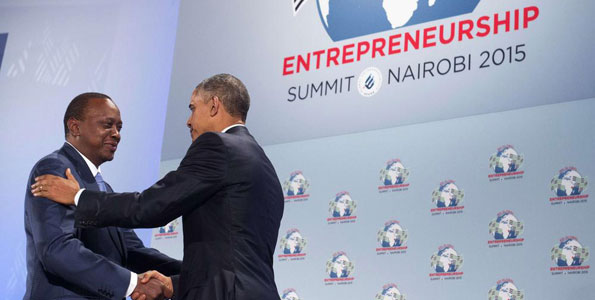
President Uhuru Kenyatta and President Barack Obama.
Their fathers knew each other.

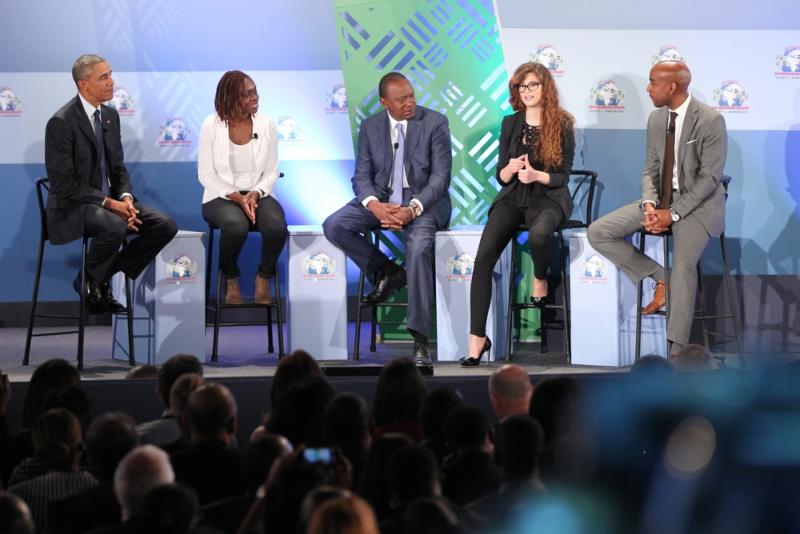
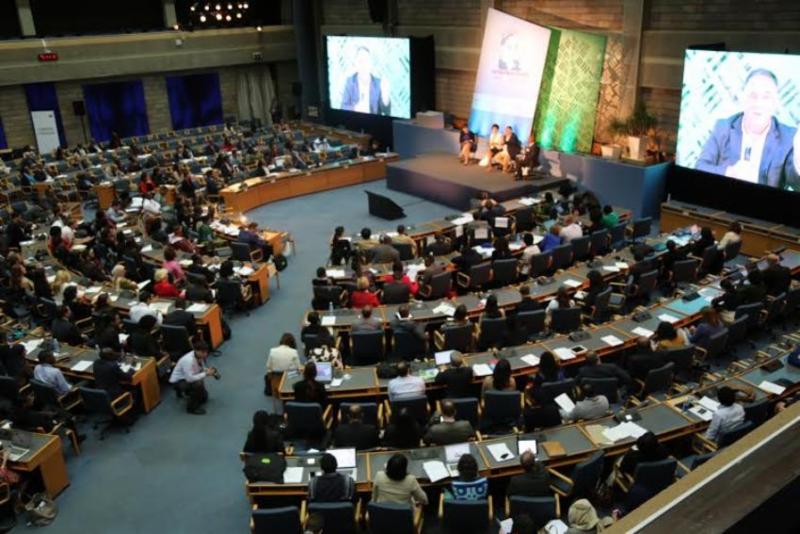
The  sixth annual  Global Entrepreneurship Summi t (GES) was  a two-day program, which took place on July 25 and July 26 at the sprawling United Nations campus on the outskirts of Nairobi. The Summit was  co-hosted by President Obama and President Kenyatta.  

This year's  Summit  focused on youth and women entrepreneurs.  It  brought together business owners, policymakers, educators and investors to a region that  has seen enormous  economic growth in recent years but still suffers from severe  poverty and unemployment. GES  is particularly  relevant in Africa with a youthful population where between 10-12 million youth enter the labor market every year, and youths remain almost twice as likely to be unemployed as their elders.   

The program was launched in Cairo, Egypt  in 2009. Thereafter, Obama has  pushed entrepreneurship to the forefront of United States' engagement with Africa. Since the U.S. hosted the first GES  in Washington, D.C., in 201o,   it  has expanded to a global event, subsequently hosted by the governments of Turkey, the United Arab Emirates, Malaysia, and Morocco.

President Uhuru Kenyatta spoke for Africa: Insightful
President Uhuru Kenyatta spoke for Africa  in addressing the 6th Global Entrepreneurship Summit.


"Africa is Open and Ready for Business."  
President Kenyatta 

  Based on documented reports in 2014, African countries have experienced unprecedented growth rates, with seven of the top ten fastest growing economies in the world being those of key African countries.  Ethiopia, Tanzania, Mozambique, Kenya, Ghana, Republic of the Congo, Zambia and Nigeria, have recently  seen levels of economic growths  that have forced foreign investors to turn away from their traditional investments, and looking toward opportunities in Africa.

Address to African Entrepreneurs who came from various regions.
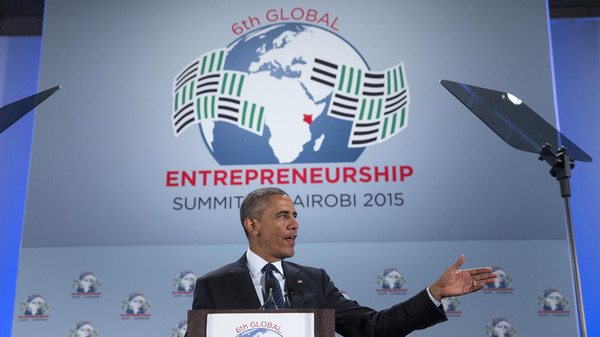
President Obama addressed the 6th Global Entrepreneurship Summit. 


"Africa is on the Move."
 President Obama declared at the 6th Global Enterpreneurship Summit in Nairobi, Kenya.

  President Obama  praised the spirit of entrepreneurship indicating, "I wanted to be here, because Africa is on the move, Africa is one of the fastest growing regions in the world," which drew cheers and applause from delegates.  
  
One of President Obama's main and consistent themes throughout his visit was his insistence that  Africa and its nations can aspire to a bigger role in the global economy, and the United States was ready to be a partner with a continent where China now does more trade than America. "This continent needs to be a future hub of global growth, not just African growth," he told African entrepreneurs at the start of his trip.
  
President Kenyatta's insight on  Africa's great potentials and strides  elicited  ethusiastic and acknowledging  applause. At one point he requested that the American president tell Americans what he has seen in Africa.  This line appealed to the fact that Africa's success stories are under-reported in mainstream media while sensational woes make more news. 
  
In the course of two days, entrepreneurs from across Africa and  attendees from more than 100 countries used the opportunity to network with each other, interfaced   with U.S. start-up executives from companies such as Airbnb and Uber, and heard from venture capitalists, including  from Silicon Valley. Participants also shared success stories, engaged in skills training, and pitched ideas.
   
  
Transforming Talk Into Action 
President Obama has undoubtedly  played a major organizing role in the annual summit and stressed the  importance of building and strengthening ties between American business leaders and African entrepreneurs as a crucial investment in the region's development. In May of this year at a  White House event after announcing this visit, Obama said,. "
Entrepreneurship empowers people to no longer be subject to aid agencies, but to be part of something to pursue their dreams. Entrepreneurs like you can change the world one idea at a tim e."
  
The Obama Administration has delivered on this commitment, greatly expanding support for entrepreneurship and economic opportunity around the world.  Signature achievements in the past five years include:
*The United States has played a prominent role in organizing five Global Entrepreneurship Summits (GES) that have elevated entrepreneurship on the global agenda and inspired new generations of innovators to choose entrepreneurship as a profession.  These Summits have opened up new markets for products and encouraged policymakers to break down barriers to business, such as the draft law currently being developed by the Moroccan Government to create a legal status for startups. 
  
*The Administration has invested in over 1000 initiatives and programs promoting entrepreneurship around the world, many of which are focused on generating opportunities for women and youth and increasing access to capital for entrepreneurs. 
  
*The Unites States sends some of America's top entrepreneurs abroad through the Presidential Ambassadors for Global Entrepreneurship.  Begun earlier this year, the Ambassadors have already met with entrepreneurs and promoted entrepreneurship on four continents.  
  
*The United States' Global Innovation through Science and Technology (GIST) Initiative has helped young scientists from throughout the Muslim world generate more than $80 million in revenue for their companies.  
  
*The Administration has committed roughly $3.2 billion to support micro, small, and medium sized enterprises and mobilized $80 million in private capital for startup accelerators in the developing world through development financing institutions and programs. 
  
Source:Fact Sheet: Global Entrepreneurship Summit, White House.

Translated Dreams
Among the numerous shared  stories:  
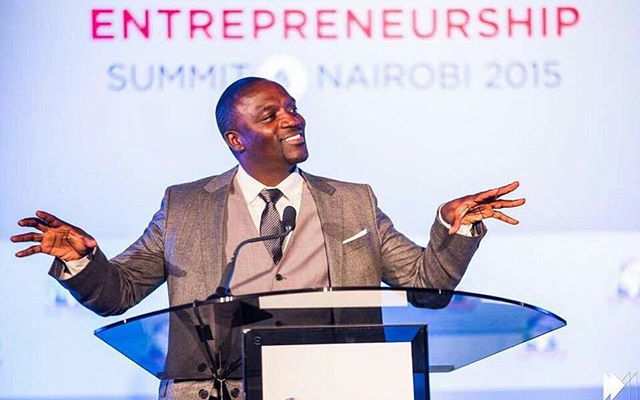
Akon at the Global Entrepreneurship Summit. 
Senegalese born and popular recording artists, businessman and record producer 42-year-old Aliaune 'Akon' Thiam addressed participants and guests. He inspired on  how he rose from humble beginnings as an African immigrant in the US, getting into crime and becoming a convict, to building an empire. Akon founded the  Akon Light Africa project, an initiative to bring solar power to streets and households across 14 African countries.  
  
In search for job security, Ali-shah Jivraj, a third-generation Ugandan entrepreneur has built a $15 million business in less than 10 years. As a student, Jivraj said he did whatever he could to make extra pocket money. After finishing high school in 2006, he started a company called Royal Electronics, which assembles and distributes electronics. Jivraj has expanded into the trade and commodity, manufacturing, property, and real estate sectors with four other businesses, all of which fall under his parent company called East Africa Industry. Based in Ugandan capital Kampala, he was named one of Forbes' "30 Most Promising Young Entrepreneurs in Africa" for 2015. 
Congolese    entrepreneur Ange Bukasa dreamed of owning her own business since she was a young girl growing up in Central Africa, where she witnessed political instability, deadly conflict and rampant poverty. Years later in 2007, she translated her dream into a reality when she founded ChezAnge Connect,  an organization aimed at facilitating African entrepreneurship and investment, out of a need to make a sustainable income and also a desire to help her community.
You grow up seeing the many, many areas of need," said Bukasa, now 38. "It clearly drove me to start thinking from the time I was very young that something needs to be done 
A single mom  currently living in Cape Town, South Africa, Ange mentors her teenage daughter who  joins her mom  on business trips. She says  encourages the 15-year-old, who loves music and singing, to track her songs and to start her own record label one day.   
Western and African entrepreneurs face different challenges
  
As reported by the Brookings Institution and writer Whitney Scheindman, " the principal theme that emerged from numerous conversations and panels was the difference in scale and experience between entrepreneurs in the U.S. and Africa. Entrepreneurs in the U.S. want to "disrupt" existing platforms to enhance their impact and value. Entrepreneurs in Africa share the desire to impact their communities and generate income, but they largely have to create systems and platforms that do not exist."
  
Reportedly, a venture capitalist from Silicon Valley shared further light. Capital is  usually invested in start-ups that already have products and have identified employees for key functions.  However, start-ups in Africa are frequently self-funded, less reliable and dependent on finding a commercial niche that enables entrepreneurs to be sustainable.  The approach apparently presents  barriers  to accessing  venture capital and finding skilled employees.  
  
Based on the Brookings Institution report, Western entrepreneurs think about their businesses as being part of an eco-system. On the other hand, entrepreneurs tend to be focused "on being part of a value chain and finding a market for their products." 
  
One thing that African entrepreneurs and experts agree on is that  the lack of opportunities on the continent has driven youths to become self-employed. Nevertheless,  success is often hindered by a lack of resources and partnerships. Redressing the barriers is vital  in order to spur and nurture the spirit of entrepreneurship in Africa. 

Along with  partners,  Obama also has a responsibility to ensure that the plan of action formed at the conference makes headway within the next month, according to Raoul Davis, CEO of Ascendant Group Branding, which helps Chinese, African, European and American business leaders increase their visibility in the United States. He said he hopes "rhetoric turns into timelines, milestones and sequencing." 
AN AFRICAN ANSWER WITH SOLUTION  
Ms Parmider Vir,   Chief Executive Officer of the Tony Elumelu Foundation presented the report on challenges facing African entrepreneurs at the 6th Global Entrepreneurship Summit as as well as solution  by the Africapitalism Institu te.
 
The Tony Elumelu Entrepreneurship Program was launched in December 2014 with  a $100 million initiative to discover and support 10,000 African entrepreneurs over the next decade with a target of creating one million new jobs to contribute an additional $10billion to Africa's GDP.   The program is the first initiative of its kind to be launched by an African philanthropic organization and is the largest African sourced philanthropic gift targeting entrepreneurs. The multi-year program, which includes training, funding, networking and mentoring,  is designed to empower the next generation of African entrepreneurs. 
  

Africapitalism is the research and policy arm of the Tony Elumelu Foundation, the Africapitalism Institute, which released a groundbreaking study on Africa's entrepreneurial ecosystem at the sixth Global Entrepreneurship Summit in Kenya.   
  
Africapitalism is based on the philosophical vision that the African private sector has the power to transform the continent through sustainable long-term investments that create both economic prosperity and social wealth, thus creating  value within Africa. It is also a  call-to-action for Africans to take primary responsibility for Africa's development and for non-Africans to evolve their thinking about how best to channel their efforts and investments in the region. 
  
  
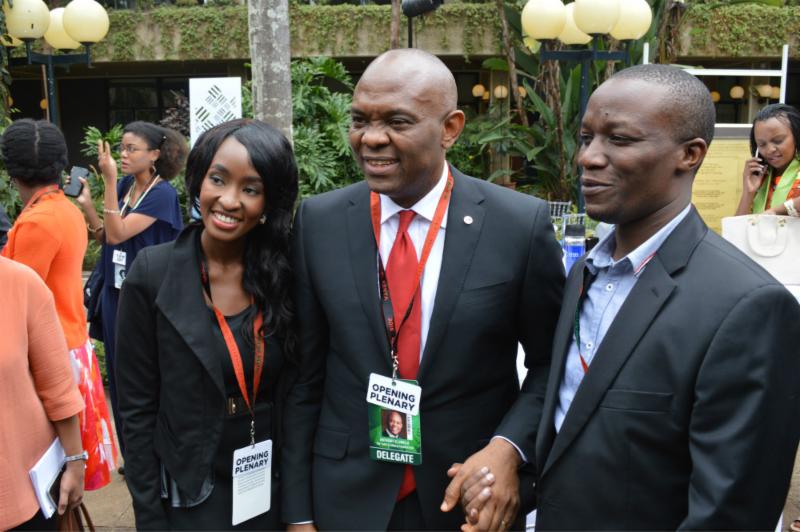
 Tony Elumelu,  founder of the Tony Elumelu Foundation in the middle with  two of the Kenyan Tony Elumelu Entrepreneurs.
he Africapitalism Institute released  its report on the sidelines of the 2015 Global Entrepreneurship Summit. The report is  based on results from a series of surveys completed by African entrepreneurs in the Tony Elumelu Entrepreneurship Program Network, which includes more than 20,000 members from all 54 countries in Africa. The results of the surveys were presented to various experts in banking, SME finance, business development, and economic policy, and further discussed in focus groups comprised of more than 100 entrepreneurs who participated in the surveys.
  
The executives indicated that  the initial findings from the surveys, expert consultations, and focus groups mirror previous insights gained from similar efforts. They also pointed to its  uniqueness in that the data is drawn from more than 5,000 surveys completed by small and emerging entrepreneurs from nearly every country in Africa.  
  
The  proposed solutions in the report are derived primarily from entrepreneurs themselves with additional suggestions from experts on African entrepreneurship, investment, and business. Another unique aspect of this research is the way in which it will be used to effect tangible, positive changes with  enabling  business environment for  Africa's entrepreneurs. 
At last year's Global Entrepreneurship Summit in Morocco, a question was raised by a participant on why  more is not  done to promote artisan businesses.  Notably, artisan activity is often the second largest employer in developing countries, and the artisan market generates around $34 billion a year. This arts sector not only create livelihoods for communities globally; it  preserves a society's cultural heritage and uniqueness that the people cherish. Yet the artisan sector's potential is often ignored or overlooked. 
  
At the 2015 Global Entrepreneurship Summit,  Catherine Russell, who serves as the U.S. Ambassador-at-Large for Global Women's Issues at the U.S. Department of State,  launched the   Artisan Enterprise Multimedia Competition . The purpose is to  engage artisans, artists, and supporters to tell the story of artisans.  The campaign is sponsored by  the  Alliance for Artisan Enterprise, a global partnership between more than 60 organizations, corporations, and individuals, including the State Department and the Aspen Institute to promote and connect artists, and expand opportunities in the artisan sector.  
  
  
TIME FOR SOME PLEASURES 
  
  
Full Speech at State Dinner: Full of Life!
President Obama Speaks at State Dinner in Kenya with Wits. 

 
At  the toast concluding the State Dinner for President Obama, Kenyan President Kenyatta described Obama as a president of historic consequence, an "engine to propel and transform the African continent." Obama joked that some of his critics probably believe he went back to Kenya "to look for my  birth certificate," adding, "That is not the case." Obama noted  that his father and Kenyatta's father knew each other. " It would have been hard for them to imagine how their sons might be sitting here today," Obama said. 
  
President Obama takes to the Floor at State Dinner on July 26, 2015
President Obama takes to the Floor at State Dinner on July 26, 2015. 
  
President Obama displayed some dancing know-how at a State Dinner held in his honour in Nairobi on Saturday.  He joined  joined in the traditional Lipala dance made popular by the Kenyan afro pop group Sauti Sol.  The state dinner event was hosted by Kenyan President Uhuru Kenyatta and his wife Margaret. President Kenyatta and Dr. Auma Obama, amomg others, were not to be outdone. There were on the floor moving to the hit. 
  
President Obama Speaks to the Nation and Africa, and Closes Out Historic Mission in the First Leg of his Visit 
  
Auma Obama introducing  her brother Barack Obama
Auma Obama introducing her brother Barack Obama at Safaricom Indoor Arena. 

On Sunday, July 26, Dr. Auma Obama was the only speaker before President Barack Obama, addressed a packed Safaricom Arena with an audience that included President Uhuru Kenyatta, Former Prime Minister Raila Odinga,  school children, and the elderly.   

Dr. Obama introduced her brother.  "We are very grateful to Americans for allowing and electing our brother as the most powerful leader in the globe," she said amidst applause from an empathetic and appreciative audience.  She delighted the audience on how her  brother is truly down a  earth person who loves  Kenyan cuisine including  Nyama Choma, Nyoyo, Ugali, and Omena. 

"He is not lost as Luo say, ilal, he is here with us and we keep communicating regularly," she disclosed. She narrated how a couple of years ago, she picked him at the airport in her battered VW Beetle, and on his arrival in Kenya as president her brother returned the favour. "He gave me a ride in what Americans call The Beast. But do I say," drawing thunderous applause amid laugher. 

 President Obama  hugged his sister before delivering his address.  
I am proud to be the first Kenyan America to become president of the US
I am proud to be the first Kenyan America to become president of the US. 


To an overflowing crowd, President Obama  noted the  progress Kenya has made as well as the challenges. He said the country is at crossroads, urging them to "choose the path to progress" by continuing to root out corruption, confront terrorism, and be more inclusive of women and girls.  Obama concluded that Kenya has come so far in just his lifetime, but can go even further.  "You can choose the path to progress, but it requires making some important choices." 


President Obama's Conversation with the  Civil Society
  
   
President Speaks to the Civil Society
President  interfaced with  the Civil Society. 


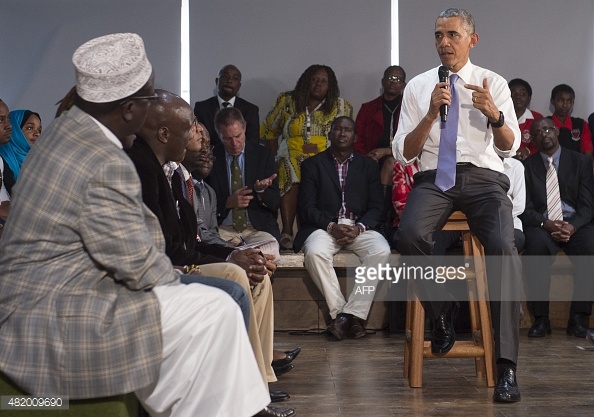
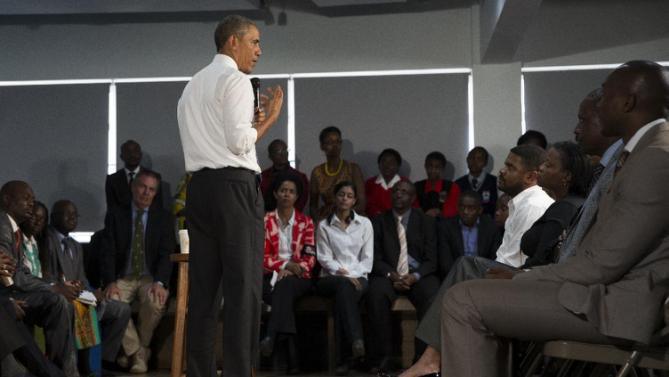
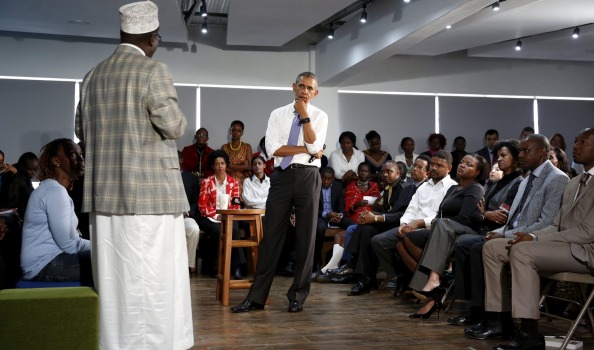
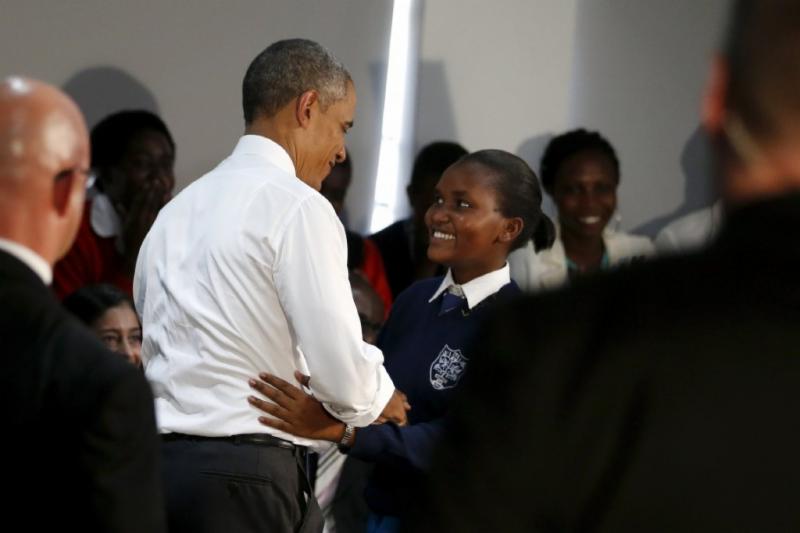
On Sunday July 26, 2015 at the YALI Regional Leadership Center, Kenyatta University in Nairobi, President Barack Obama had an interactive dialogue with about 75 civil society leaders. 
  
"This is a very good-looking group. (Laughter.) So it's wonderful to be with all of you. My name is Barack Obama. (Laughter.) In case you didn't know. I want to, first of all, begin by thanking Kenyatta University for hosting us here today. We are very grateful. And the Vice Chancellor is here -- Madam Vice Chancellor, thank you. 
 
 
With a roving microphone in hand, it was a reminder of his days  in South Side Chicago as a community organizer finding common cause and he dialogued with civil society leaders on African on promoting civil society initiatives in Kenya and Africa.
 
President Obama had faced some of those challenges in South Side Chicago, which parallel the experience organizing to help young people find hope in urban slums.  He found commonalities in the big picture, telling the  leaders that "bottom-up civic participation" was the key to making societies work better.  
  
Quoting Alexis de Tocqueville, the former college professor gave a mini history lesson on the early days of American democracy and the hard-fought gains of the civil rights movement and other democratic advances.  

Reflecting on his work  as a community organizer, he said the experience "taught me the importance of ordinary people when they come together to create a better vision for the future." He said. If Kenya can continue to cultivate those habits of participation and freedom the country is going to be better off.  
 
President Obama reminded participants "Democracy does not stop on election day." He continued, "Part of the reason why it's important for me to be here today is to send a message that we in the United States believe civil society is important." 
  
   
Several activists took turns speaking on a range of issues from wildlife trafficking, particularly elephants;  girls' education  as opposed to marrying them off to old men; to tolerance  for religious minorities.   
  
Among the civil society leaders, Paula Kahumbu of Wildlife Direct, sported an armband that said "Hands Off Our Elephants," noted that 30,000 elephants are killed each year in Africa for their ivory.   "I love elephants. I want the whole world to fall in love with elephants," Kahumbu said. "Tell the American people, 'Don't buy ivory.' It's the simplest way to save elephants." President Obama apparently agreed as he had addressed the issue   earlier in his visist.
  
The US President called  16-year-old Linet Nenkoitoi Momposhi, a boarding school student who spoke about on what she could accomplish after she finishes  school. President Obama replied "I'm sure you're going to be an excellent cardiologist." 


July 26, 2015: Obama Leave for  Ethiopia 
  
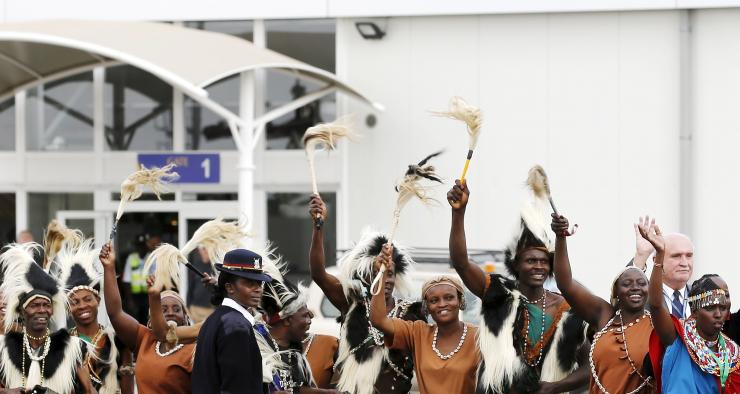
 Traditionally attired, they came to bid President Obama farewell.


July 27, 2015. President Obama departs to Ethiopia.
July 26, 2015.  
 President Obama departs to Ethiopia. 
Broadcast  alternated between English and Swahili 

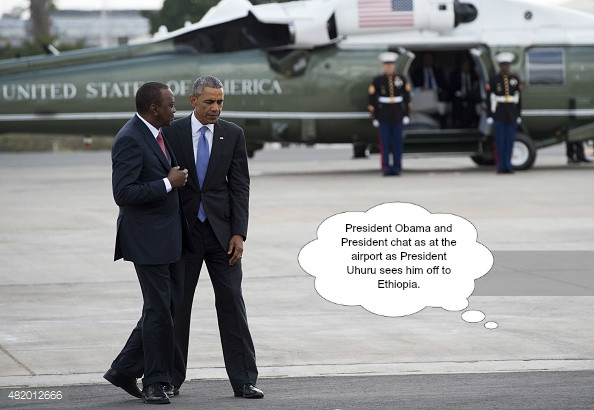
The President of the US concluded a truly historic and remarkable visit and began the second and last leg in Addis Ababa, Ethiopia.  On hand at the airport to bid him  farewell was President Kenyatta. 


 US President Obama arrived  at Bole International Airport in Addis Ababa, Ethiopia on  July 26, 2015


Presidents Obama Arrives in Ethiopia
July 26, 2015 
Another historic visit in Ethiopia. 

 
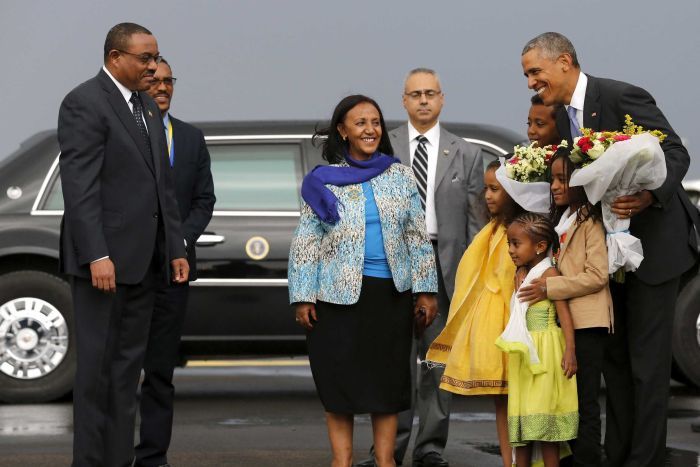
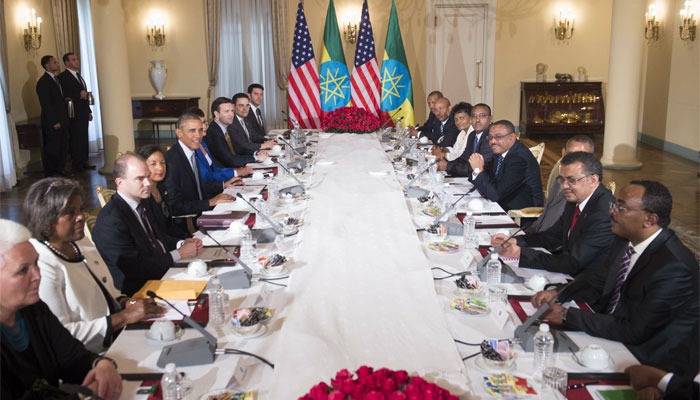
This is the last stop in a 2-day  stay in Addis Ababa, capital of Ethiopia, headquarters of the African Union and its political capital. President Obama w as greeted at the tarmac by Ethiopian Prime Minister Hailemariam Desalegn and   received a bouquet of flowers from  a little Ethiopian girl.
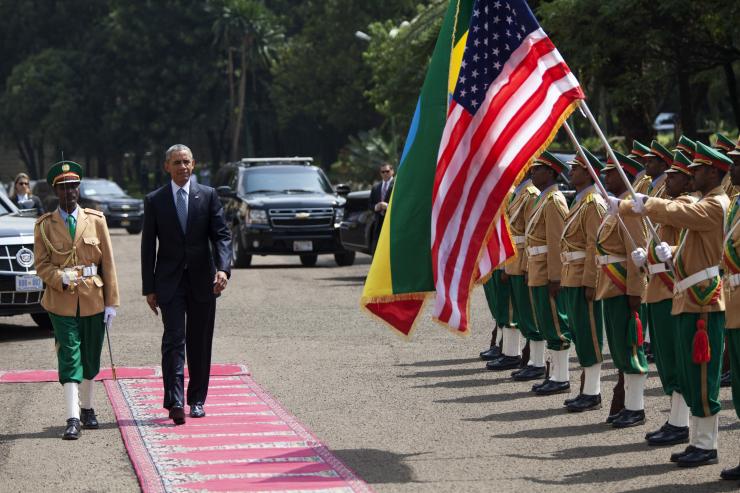
History Again: Ethiopia Welcomed President Obama with a 21 Gun Salute
July 27, 2015: 
 President Obama received a 21 Gun Salute. 

 
President Obama inspecting the Ethiopian guard of honor.
This was the first time Ethiopia honored a visiting head of state with a 21-gun salute.


Joint Press Conference: President Obama and  Ethiopian Prime Minister Haile
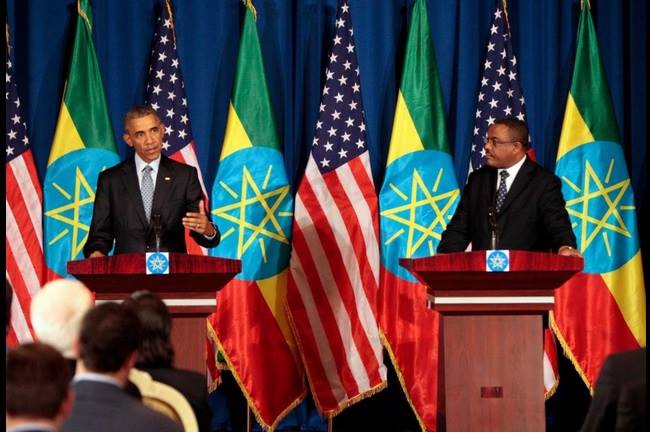
July 27, 205:  Joint Press Conference:  
 President Obama and Ethiopian Prime Minister Hailemarian Desalegn. 


At the Joint Press Conference, Prime Minister Hailemarian Desaltegn highlighted the historic nature of Obama's visit as the first trip to Ethiopia by a U.S. president.  
  
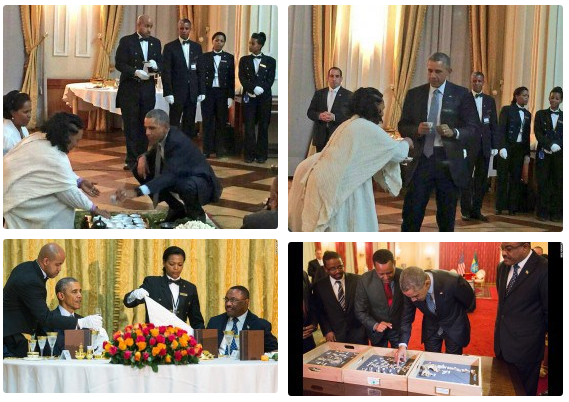
On a lighter note, he  said Ethiopia already has a number of firsts,  including one that is dear to the hearts of world-wide caffeine lovers worldwide with Ethiopia as  "the birthplace of coffee."  Later, at a state dinner in his honor, Obama paid tribute to Ethiopia's coffee contribution.  He  said Americans are thankful that Ethiopians discovered "something that sustains people around the world, day and night, and many people in the White House, and that is coffee."
  
President Barack Obama said the United States and Ethiopia are "strong partners" on many issues. He praised Ethiopia's economic record, noting the country has lifted millions out of dire poverty and for leading role  Ethiopia has played in fighting the Somali terrorist group Al-Shabab.  
  
President Obama  said  he also held "frank discussions" with the prime minister on opening space for journalists and opposition voices, indicating it  "will strengthen rather than inhibit" the ruling party's agenda.  He said w hen all voices are being heard, when people know they are being included in the political process, that makes a country more successful.  The Ethiopian prime minister defended his country, saying its commitment to democracy is "real, not skin deep."


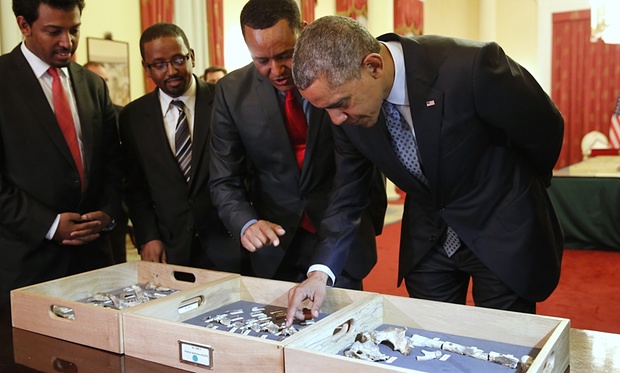
President Obama met Lucy, the "Grandmother of Humanity." 


But Lucy  had never heard of anyone called Barack Obama,   or the United States for that matter. She did not utter a single word when the meeting happened  before   the  state dinner in Ethiopia.
Lucy is a 3.2 million years member of Australopithecus afarensis,  the most complete skeleton of an early human ancestor ever discovered. Paleoanthropologist Donand Johanson  made the find in 1974 and  played a Beatles cassette at his campsite that night along with the song "Lucy in the Sky with Diamonds," which accounts for her name. 
The fossil is normally housed in Ethiopia's national museum.  The s cientists present could not recall a time when the bones of Lucy were displayed uncovered. The last time they were displayed outside the museum was two years ago, during the 50th anniversary and celebration of the African Union in 2013. However, it was  brought to the national palace on Monday for Obama's visit and helped put everything in perspectives, including the politics of humans.
Encouraged by Dr Zeresenay Alemseged, senior curator of anthropology at the California Academy of Sciences,  President Obama even  touched a vertebra from Lucy's torso Dr. Alemseged said Lucy demonstrated how all human beings are connected, joking: "Every single person, even Donald Trump."   Obama  commented : "That's amazing. So Lucy was on the chain to homo sapiens." He asked "how many jumps" there were between Lucy and homo sapiens.
L ucy had a very small brain, primitive wrists, feet and teeth and was only one metre tall, but was still declared "the grandmother of humanity" after her discovery in Ethiopia's Afar region. 

During the state dinner  with   Ethiopian prime minister, Hailemariam Desalegn, and other guests, President Obama told them that   Lucy is a reminder that the world's people are part of the same human family.  "You know Ethiopians are an ancient people in an ancient land," he said. "We honor Ethiopia  as the birthplace of humankind. In fact, I just met Lucy, our oldest ancestor. As your great poet laureate wrote, "Here is the land where the first harmony in the rainbow was born ... Here is the root of the Genesis of Life; the human family was first planted here.''

At State Dinner in Ethiopia 


Peace and Security in the Region


Secretary of State John Kerry is at this leg of the visit in Africa
Pictured on the   right after President Obama.
   
  
On  July 27,  2015,  President Barack Obama met with East African   leaders and the African Union  on clear strategies to redress the crises in South Sudan, including  sanctions and a "regional intervention force"  if South Sudan's warring parties do not agree on a power-sharing peace deal by August 17, 2015.

African nations, led by Ethiopia, have been trying to broker a peace in South Sudan through the Intergovernmental Authority on Development (IGAD), a regional body, and are almost ready to present a possible compromise to the warring parties. The two sides will have until Aug. 17 to respond to the proposal.

" The possibilities of renewed conflict in a region that has been torn by conflict for so long, and has resulted in so many deaths, is something that requires urgent attention from all of us," Obama said. "We don't have a lot of time to wait."

The group agreed on the urgency of the crises but did not arrive at a consensus on the strategic approach if a peace deal is not reached.

Obama praised the regional leaders for showing "extraordinary leadership in trying to address the continuing situation in South Sudan." The group included Ethiopian Prime Minister Hailemariam Desalegn, Ugandan President Yoweri Museveni, Kenyan President Uhuru Kenyatta, African Union Chairperson Dlamini Zuma  and Sudan's minister of foreign affairs, Ibrahim Ghandour.  

"This gives me and the U.S. delegation an opportunity to learn from them what progress has been made, where there appears to be continued roadblocks and how we can partner with them to make progress," Obama said. "Our hope is that we can actually bring about the kind of peace that the people of South Sudan so desperately need."


 Back to Economics  and Trade 
  
  
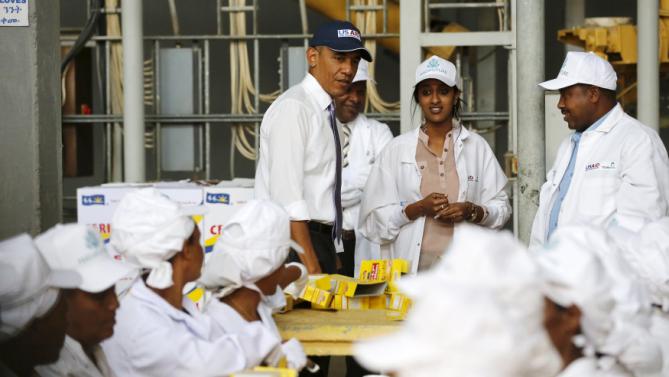
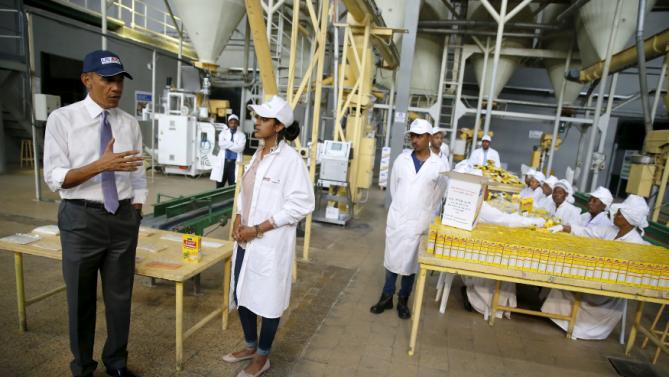
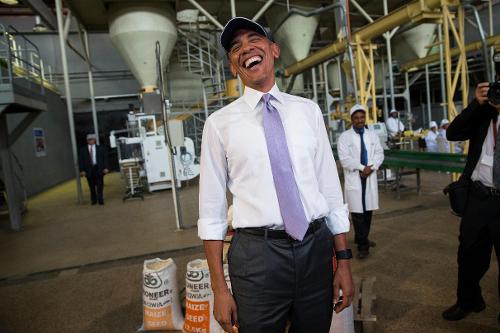
On Tuesday July 28, 2015,  President Obama made the case on why his signature policy initiatives are making a difference in Africa during his tour of the Faffa Food Factor. He highlighted the   Feed the Future program, an initiative that pairs federal funding with money from other nations and the private sector to boost the agricultural productivity of small farmers in developing nations.  
  
Faffa Food produces supplemental foods such as fortified baby food, flours and barley mixes. A local farmer and one of the factory workers explained how they've been able to boost agricultural productivity and overall. 
 
On the  same day, the Obama administration released a report indicating that the program played a part in several measurable advances. They include a more than 25 percent reduction in height stunting in two provinces in Kenya between 2009 and 2014, and a 16 percent cut in rural poverty across Uganda in recent years.  
    
  
President Obama visits food factory in Ethiopia to underscore economic developments in Africa.
President Obama visits food factory in Ethiopia and underscore economic initiatives. 


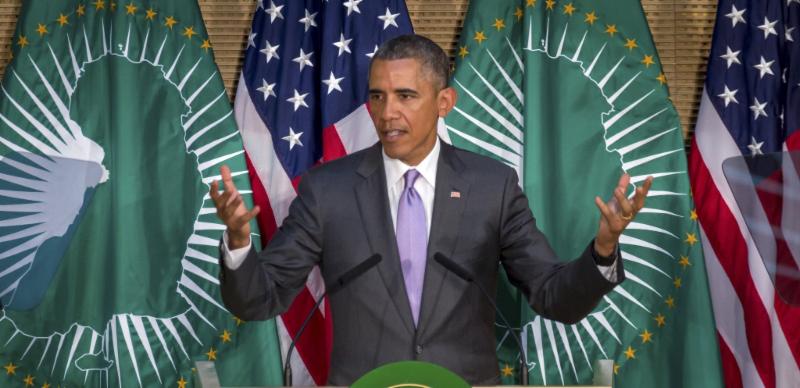
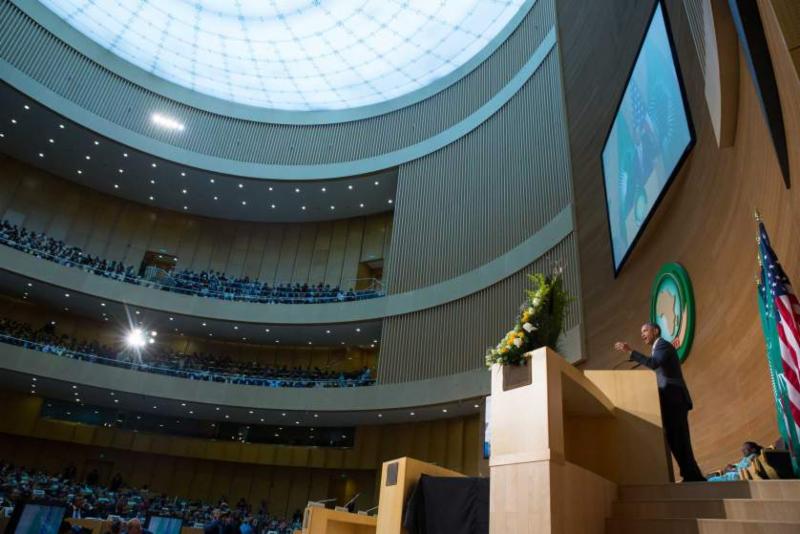
President Barack Obama at the African Union.  
The first US President to address the African Union  
its  headquarters in  Addis Ababa, Ethiopia 
Tuesday July 28, 2015 


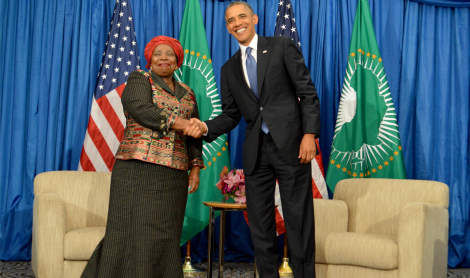
The Chairperson of the African Union Commission: Dr.  Nkosazana   Dlamini Zzuma and the President of the United States: Barack Obama. 
  
No America without African - Her Excellency Nkosazana Dlamini-Zuma

Her Excellency Nkosazana Dlamini Zuma, brilliantly captured Africa's aspirations and inspirations in her remarks and welcome.  

The  continent is in a unique position to chart its development and industrialization." 
Her Excellency Nkosozana Dlamini Zuma
  
In a rousing and poignant welcome, H.E. Dlamini Zuma said," although we welcome you as the President of the United States of America, we also claim you as our own." Those remarks captured both the substance and symbolism the historic visit.  
  
She also reached back to history to capture the indelible contributions of African Americans in the development of America- albeit through the scourge of slavery. She thanked the visiting Congressional delegation and noted   their bipartisan steadfast stance and the support of ordinary Americans against colonialism and apartheid.
  
A frica's accomplishments and promising future are  seldom told. While acknowledging the challenges and calls for partnership, H.E. Dlamini Zuma listed an array of progress and vision embodied in Africa's Agenda 2063 and role of women, which is integral to Africa's overall development.

 
For more on H.E. Dlamini Zuma's remarks, you can watch the video and also go to the AU website: Enter


President Obama delivered a resonating address to the People of Africa.  


Marking the first time a US President addressed the African Union, President Obama  said he had come to the African Union to   pay tribute to Africa's huge potential, the vibrancy of its youth and the impressive rates of economic growth in some countries. 

Susan Rice, Obama's national security adviser, said the African Union (AU) takes the lead on an array of global issues, including peace and security, health and agriculture. Obama wanted to address the continent through the AU because the U.S. has come to work closely with the AU on many of these issues.

 
 P resident Obama addressed  democracy, pointing on the need to  abide by the constitution. He indicated that those who hang on to power outside the constitution imperil democracy. He used a self-deprecating humor:  Who would want to stay in office for longer? He knows a thing or two about such things. 
 
He continued:   "It has been an extraordinary privilege for me to serve as the President of the United States. I cannot imagine a greater honor or a more interesting job. I love my work. But under our Constitution, I cannot run again," the president said. "I actually think I'm a pretty good president. I think if I ran I could win, but I can't under our constitution, I cannot run again," he said to laughter and applause.

 
To read the address  entitled " Remarks by President Obama to the People of Africa, "visit the White House's website: Click
  
  
Thank you, we  have come to the end of President Barack Obama's historic time-line visit to Africa from July 24-28, 2015. 


Massive Recruitment Drive by the World Bank for 80 Africans. 
The deadline is August 31, 2015. 
Interested persons, please go to the link: 


SAVE THE DATE 
Saturday August 29, 2015. 
ECOSOCC Roundtable African Coffee 
 
 Strategic Assessments and Approach on the Program of Action.  
9:00-am to 12 noon. 


Africa Diaspora Civil Society and Diplomatic Corps  Dinner Dialogue 
Cocktail: 
5:30pm to 6:00pm 
Dinner Presentations 
6:00pm to 9:00pm 

Connect with the African Union (AU) Missions:   
 United States 

There are AU Missions Missions to  European Union and ACP in Brussels;  
 the United Nations in New York, USA; and Office in Geneva, Switzerland. 


Learn about the origin of the African Union.  
  
From OAU to AU and  African Liberation Day. 
Memories with Pictures. 
  
  
Sensitizing and Implementing Agenda 2063 


 Economic Social and Cultural Council of the African Union 
ECOSOCC SECRETARIAT 
African Union Headquarters
P.O Box 3243  
Roosevelt Street
(Old Airport Area) 
W21K19 
Addis Ababa, Ethiopia 

Dr. Joseph Chilengi 
Presiding Officer


Special Advisers of the ECOSOCC of the African Union. 

1) Adviser on Regional and International Partnerships: Professor Dipo Kolawole
  
2) Adviser on Governance and intergovernmental Relations:   Mr. Chukuemeka Eze
  
3) Adviser on Interfaith, interreligious and Intercultural Issues:  Ambassador Mussie Hailu
  
4) Adviser Private Sector and Economic Relations:  
 Mr. Michael Sudarkasa, Esq. 
  
5) Adviser on Diaspora Relations:  
 Ms Evelyn Joe 


ECOSOCC is a unique organ of the African Union that reports to the  
and  
 which is composed of  Heads of State and Government or their duly  accredited representatives. The Assembly of Heads of State and Government is  the supreme organ of the Union.


C itizens and Diaspora Organizations of the African Union.
Dr. Jinmi Adisa, Director

Head of Diaspora Division: 
Mr. Ahmed El-Basheer

Ms. Eiman Kheir
Desk O fficer,  in charge of the Middle East, Asia and Oceania regions.

Mr. Kyeretwie Osei: 
Desk Officer in charge of the Americas and the Caribbean, with interim
responsibility for the Europe Region. 
oseik@africa-union.


GLOBAL AFRICA DIASPORA SUMMIT 2015
October 9-11, 2015


Program of Action:

Participants  are encouraged to read through the African Union Declaration of  the Global Africa Diaspora Summit in 2012 and invited to concentrate on a program of choice, which is further delineated by  target goals.


POLITICAL COOPERATION 

Intergovernmental Cooperation 

Mobilization of Support 


11: 
ECONOMIC COOPERATION
 
Government Action to Foster Increased Economic Partnership  
 
Mobilization of Capital 
   
Partnership in Business 
 
Science and Technology 
  
 
Knowledge Transfer and Skills Mobilization  
 
Infrastructural Development 
 
 
Climate Change 


111: 
SOCIAL COOPERATION 

K nowledge and Education 

Arts and Culture 

Knowledge and Education 

Media and Image Building 

Immigration and implications such as brain drain, retaining the citizenship of country of origin  (dual citizenship) voting rights, and AU leadership on the welfare of African immigrants in the Diaspora. 

 
 22  African countries currently allow dual citizenship: Angola, Benin,  Burundi, Cote d'Ivoire, Djibouti, Egypt, Eritrea, Gabon, Gambia, Ghana, Kenya, Lesotho, Morocco, Mozambique, Namibia, Nigeria, Rwanda, Sao Tome & Principe, Sierra Leone, South Africa, Togo, Togo, Tunisia and Uganda.  Egypt and Eritrea have 
restrictions while allowing it.

Human and People's Rights 

Social and Cultural Issues

 
*SPECIAL FOCUS*
Diaspora Representation at the ECOSOCC 

LEGACY PROJECTS

 
1)T he production of a Skills Database of  
African Professionals in the Diaspora;

 
 2) The establishment of the African Diaspora Volunteers Corps; 

 
3)  The African Diaspora Investment Fund; 

 
4)  A program on the Development Marketplace for the Diaspora, as a framework for facilitating innovation and entrepreneurship among African and Diaspora; 
and 
5) The African Remittances Institute. 

 
Special Forum:
Calling on African Women for Advancement and Empowerment  and the  Girl Child.

  
You can take a virtual visit with  some of  the organs:


CONNECTING THE DIASPORA AND AFRICA.


FESTAC 77
Reviving FESTAC 77

Get an English language video narrative from  UNESCO

Wofford, Tobias. " African Roots and Diasporic Returns in FESTAC'77 and Jeff Donaldson's Majority"  

Abstract of  Paper presentation at the annual meeting of the American Studies Association Annual Meeting, Hilton Baltimore, Baltimore, Md. 


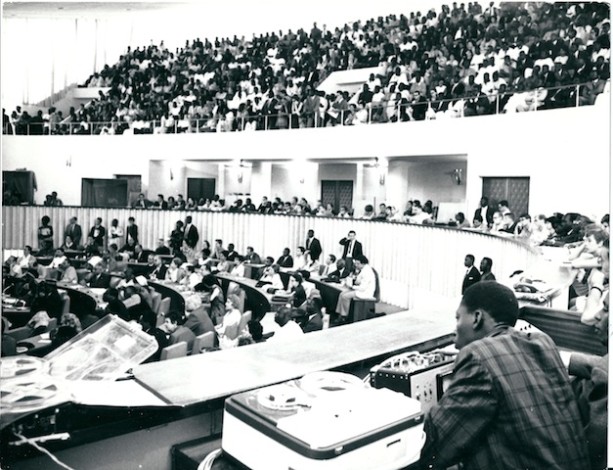
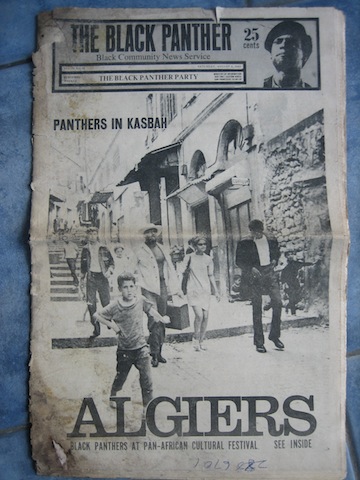
From January 15 to February 12 of 1977, thousands of artists, writers, and musicians from throughout Africa and its diaspora descended on Lagos, Nigeria for the Second World Black and African Festival of Arts and Culture (FESTAC'77).  

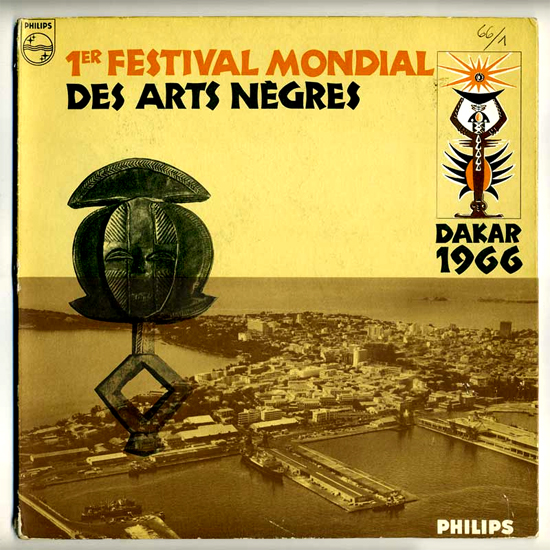
FESTAC'77 was held eleven years after the 1966 First World Festival of Negro Arts in Dakar Senegal. Yet FESTAC'77 dwarfed its predecessor in size and scope. 

It was attended by a reported 17,000 participants from around the world, with the United States Zone sending 482 delegates. The event coincided with the airing of the miniseries Roots, adapted from Alex Haley's famous chronicle of slavery and survival. 

Certainly, the notion of roots and the possibility of correcting the violent rupture of slavery through return seemed to dominate many accounts of the festival. In an article for the popular black magazine, Ebony, Alex Poinsett described the event as "the biggest family reunion in human history."

In this respect, FESTAC'77 provided black artists in the United States with an opportunity to reassess their cultural and political connections to Africa at a time when African retentions were central to the African-American cultural imaginary. Yet what did the possibility of return offer for artists in the diaspora?


 Further, what political and cultural barriers had to be transcended in order for an event like FESTAC'77 to be meaningful for its participants? 

In response to the festival, artist and FESTAC'77 organizer Jeff Donaldson created Majority, a mixed-media collage that presented a treatise on the Pan-African political imperatives of the festival and visualized what Donaldson increasingly referred to as a "TransAfrican" artistic style. 

The paper examines Majority in light of FESTAC'77, exploring how both the work and festival mediated the tensions between independence-era Africa and U.S. foreign policy, African American cultural discourses about Africa, and debates over Pan-African unity in the late 1970s.


At the end of this e-Newsletter, we went back to the beginning in 1966. 


Greetings: 
  
We welcome you to another  moment. Yes, Africa is on the move and Africa Diaspora is essential to the transformations. 

  
The Global Africa Diaspora Summit 2015 is a sequel to the Global Africa Diaspora Summit in Sandton, Johannesburg, South Africa, 2012, which resulted in the African Union Declaration of the Global Africa Diaspora Summit under three programs of action: Political, Economic and Social Cooperations.  
  
The Summit will take place from October 9-11, 2015 in Washington, DC  Metropolitan Area. 


his convening of a civil society of leaders aspires to to sensitize and inspire stakeholders as catalysts and drivers of people-driven developments. While global partnerships can be essential, in the final analysis, Africans are ultimately responsible for African development. 
     
he range of participants will included specialized sectors such as media and technology experts; grassroots activists and advocacy networks; faith-based groups; transnational home-based, professional, and alumni associations; arts and culture collectives;  multination NGOs led by people of African descent; the academia and think thanks; entrepreneurs; women and youth organizations; and policy makers.
  
The array of voices from Africa Diaspora and the Continent in a marquee Summit is taking place at a pivotal moment with a  triple need  to develop Africa's self-reliant capacities; forge empathetic connection among people of African descent; and to build participatory partnerships that  address Agenda 2063: 
The Africa We Want: Peaceful, Prosperous, and Integrated
.  
  
The Summit will, therefore,  provide shared platforms for to exchange ideas and  develop frameworks to implement goals and assess measurable outcomes.  
  
The weekend of interrelated activities would center on the respective  programs of action, including meet-ups hosted specific committees and  designed as signature events that reflect both the spirit and goals of the  Summit. 
  
2015 is dedication to the African Union Year of African Women Empowerment and Development. 37% of African nations  have achieved gender parity at primary level education and maternal and child mortality rates have seen a 47% and 44% drop. How can we ensure these indicators are contributing and improving  to enable  sustainable social transformation for women and girls across Africa? This is a conversation we invite you to have 
  
Exhibitions and a  Saturday evening Gala will honor the brilliance and resilience of African women on all frontiers of Africa's great past and bright future.  
  
We look forward to your goodwill and  support in this critically important conversation.  
  
For more information, inquiries, and participation, please call 240-706-6885 or respond by email: africanservices@aol.com.  


A  Model for Africa Diaspora and Africa Cooperation.  
  
Rev. Dr. Leon Sullivan  (1922-2001), who helped in raising American sensitivity and galvanized actions to end apartheid in South Africa, set standards with the biennial African and African American Summit. Although styled African and African American Summit, it brought together people of African descent from North America, South America, the Caribbean, and Europe. 
   
  
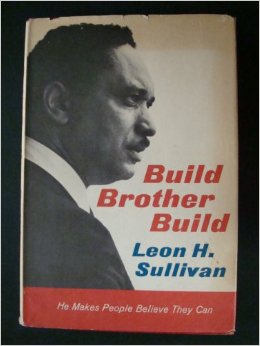
In his book  Build Brother Build,  Rev. Sullivan recorded his thoughts on his African heritage in direct, poetic and metaphoric terms:    
 
" When I plan for the future, my thoughts turn eventually to Africa. Somehow, I believe, slavery will be turned to the advantage of our future. The day will come when the continent from which my forefathers came will blossom into a paradise. I have a feeling that my ultimate freedom and my ultimate security are tied to the development of Africa. 

 
Of course I have no intention of forsaking America, for America is my home and I have helped to build her and shape her. But like the Jews and others who came to make this country what it is, I need an anchor in the past, a place my children can proudly call their ancestral home. My citizenship is here, but a part of my spirit is in Africa, also.
 
I envision a bridge from America to Africa over which one day my children and my black brothers and black sisters will move freely from one side to the other and back again. 

 
The bible has said, "The day will come when Ethiopia shall stretch forth her hands again," and I know that day is coming, though I shall not live to see it. The time is not far off when black technicians, artisans and craftsmen by the thousands and tens of thousands will visit a flourishing Africa, helping to mold that continent into a new greatness glorious to see.  "
     
Summarily, the African and African American Summit was conceived for concerted efforts that give birth to Africa's economic and socio-cultural strategic developments, strengthen ties and forge political links with Africa Diaspora for mutual empowerment. These goals mirror the political, economic, and social determinants in the Declaration of the Africa Diaspora Summit in  Sandton, Johannesburg, South Africa in 2012.
 
The biennial Summit grew in attendance in the successive years, attracting the largest gathering of African heads of state and representatives outside state events, and was championed by Africa Diaspora elected officials; civic, business, religious, and academic leaders; cultural and entertainment icons, youth and student groups, and NGOs from the Diaspora and also official representatives from the White House, United Nations.
 
 
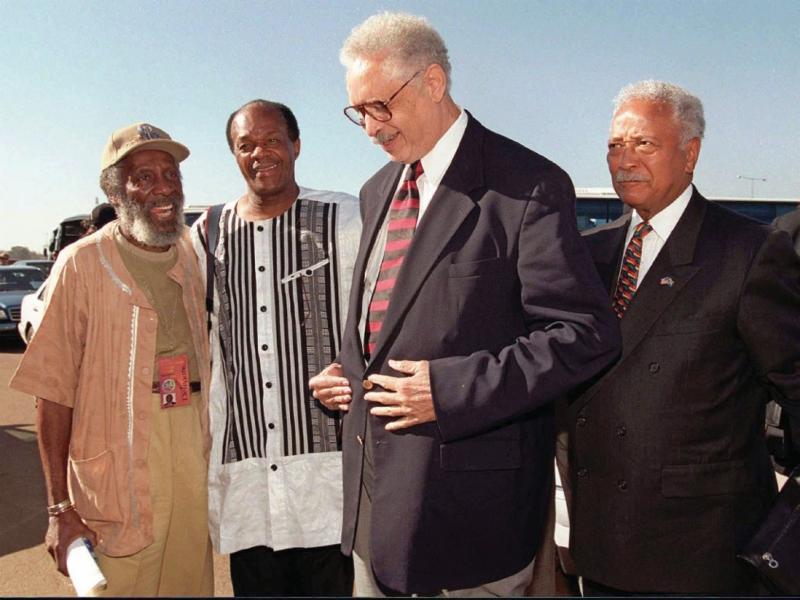
From left to right: Comedian Dick Gregory,left, Washington D.C. Mayor Marion Barry, the Rev. Leon Sullivan,second from right, and former mayor of New York David Dinkins.
  
  
Among the pioneering organizers were Rev. Jesse Jackson Sr; the first African American Governor Doug Wilder of Virginia; Coretta Scott King, wife of Dr. Martin Luther King;  Dr. Calvin Rolark of United Black Fund, and other civil rights icon such as Joseph Lowery who helped in the formation of the Southern Christian Leadership Conference;  Dr Dorothy Heights, the founder of the National Council of Negro Women; Kwesi Mfume while the  President/CEO of the National Association for the Advancement of Colored People, with entertainment industry such as Dick Gregory  and Cicely Tyson.  
  
Rev.  Leon Sullivan died after a battle with leukemia in 2001 as preparation  for the Sixth Summit was underway in Abuja, Nigeria.   
  
The Summit was renamed  the Leon H. Sullivan Summit and managed by the Leon H. Sullivan Foundation after his death. With the change of name came a change in focus; it was no longer premised on the leadership and management by people of African descent. The Sullivan ceased operations ceased operations in 2011. Currently, no organizing entity has fills  the gap. 
  
Below are briefs on the  first five Summits during the visionary's lifetime. It also captures the spirit of why the African is reaching out to the Diaspora.  Given the demonstrated model, there is modern precedent to actualize  the  Declaration of the Global Africa Diaspora Summit in 2012.
  
With much hope and abiding optimism for  the Africa We Want, we look forward to a peaceful, prosperous and integrated Africa.
  
We appreciate your time. Please read on.  
  
T he First African and African American Summit, Abidjan, Ivory Coast, 1991.
  
  
Over 1,000 delegates, which included 300 African American leaders from the civic, political, religious, and business class,  30 heads of state or foreign ministers, responded to the  challenge to craft a pragmatic approach to improve Africa's  economic, technical  and educational advantages in order to make the continent competitive in the 21st century global market.  
  
In an interviewed, Rev. Sullivan  stated that the " First African and African-American Summit is designed to forge economic and political links between the two groups to each group's mutual benefit."  He called the concept  of the Summit "building of a bridge from America for the future of Africa.
  
The Second  African and African American Summit, Libreville , Ivory Coast, 1993
 
The four-day Summit in July 1993 was attended by 1,000 Americans and about 3,500 Africans.   "Africa is open for business," the then Mauritanian Ambassador to the United States told a group of African Americans meeting in May 1993. He continued  "and the first people we're going to seek business from are you."

  
Mr. Ainina's remarks summed up a vital goal of the Summit to encourage business between people of African descent within and across continents. Increasingly, sponsors of the conference indicated that African Americans began competing with businesses from Africa's  former colonial powers. Some notable examples were cited, which were previously difficult to imagine. 

The Third   African and African American Summit, Dakar, Senegal  1995

 
Never be separated again! Never, never, never....thundered the Lion of Zion
Never be separated again! Never, never, never....thundered Dr. Leon Sullivan

 
 Excerpts of the speech by Dr. Leon Sullivan


In 1995, the African and African Summit expanded with over 5000 participants in Dakar, Senegal. US President Bill Clinton's  Commerce Secretary, the late Ron Brown led a substantial U.S. private and public sector delegation. While in Dakar,  he summarily pronounced that the United States would no longer concede the African market to former colonial powers, and launched a new strategy and approach to the United States' economic relationship with Africa based on commercial interests through an invigorated emphasis on trade and investment. 
 
Secretary Brown's attendance was a historic moment and signaled, in clearest and new terms,  the Clinton Administration's resolve to redefine the U.S. relationship with Africa as a mutually beneficial partnership based not only on common interests but mutual respect (also new).

The Fourth  African and African American Summit, Harare, Zimbabwe  1997


The Fourth African and African American Summit took place in Harare, Zimbabwe in 1997. The US.  More more than 40 representatives of African nations attended with dozens of CEOs from multinational companies and the US Agency for International Development. 
Find below excerpts from the host President Robert Mugabe of Zimbabwe and current  Chairperson of the Authority of Heads of States and Government of the African Union.

President Mugabe Pays Tribute to PanAfricanism at the Fourth African and African American Summit in 1997


" This summit takes place against the background of a world of growing globalization. It is therefore most imperative that we get to know one another even better than before - in order to fully appreciate the various circumstances under which we live. Africans and African-Americans need each other. There are well known historical and sentimental reasons why Africans and African-Americans must cooperate. These must form a basis for strengthening and deepening linkages between us - of a more substantial nature."

The US presidential delegation of 40 persons was led by Secretary of Transportation Rodney Slater in the Clinton administration.Mr. Slater 
repeated the clarion call  made by former  Commerce Secretary Ron Brown (who died in a plane crash in 1996) for closer business ties between the  United States Africa.  "Africa is a great continent and the U.S. desires it as a full trade and business partner," Slater told the summit's closing plenary session.  

Referring  to Brown, who like himself was an African-American lawyer, Slater said, "We are building our dreams" of greater cooperation and prosperity "on the shoulders" of men like "the late Ron Brown." And he added, "I take a solemn pledge...to help build our common future."


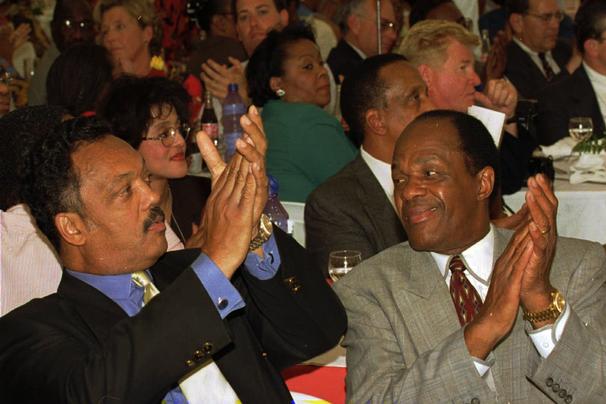
The Rev. Jesse Jackson (left) and the late Mayor Barry, Washington, DC at the  fourth African-African American Summit in Harare, Zimbawbe 1997

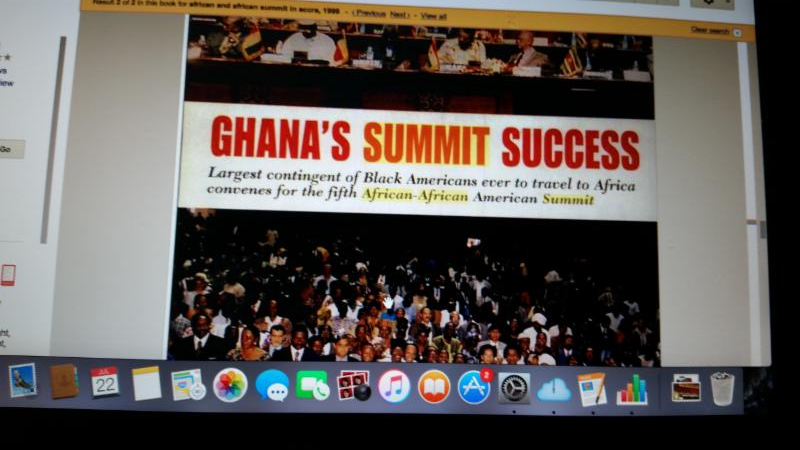
The Fifth African and African American Summit, Accra,  Ghana 1999


T he theme of the Fifth African and African American Summit in Accra, Ghana was "Business, Trade and Investment: Africa Can Compete"  attracted nearly 5,000 participants and over 2,000 observers, including Heads of State and official delegations from more than 40 African nations, prominent African Americans, government officials, executives and professionals from all around the world. 

Rev. Dr. Sullivan and host President J.J. Rawlings implored participants with a well received call:  
'Less talk, more action!'  as the gathering was focused on applying  innovations and resources on Africa's economic and social development. 


Today the Atlantic is a highway," President Rawlings continued, referring to the metaphorical "bridge" between the continents envisioned by the Rev. Sullivan in his call for this meeting. "It can be crossed in a few hours, or in seconds with the use of modern technology. On both sides, our people are free and ready to embark on an exciting new adventure of development together," Mr. Rawlings said.

The official U.S. delegation was led by Secretary of Labor Alexis Herman, 1996 Republican Vice Presidential nominee and former HUD Secretary Jack Kemp, and by Rainbow-PUSH Coalition president Rev. Jesse Jackson, President Clinton's special envoy to Africa for Democracy. 

 
The message of the then Secretary General of the UN, Mr. Kofi Anan to the fifth  African and African-American Summit, read: "in the era of global change, time to bring about Africa that Africans deserve. His remarks were delivered on his behalf by the Assistant Secretary-General for Political Affairs, Ibrahima Fall.

  
The Summits have become a "rallying place" for Africans, the Rev. Sullivan told the plenary session and have already been responsible for hundreds of millions of dollars in badly needed new investments in the continent and in billions of dollars in forgiveness of the crippling debts African countries owe to their former colonial masters.  


Other representatives from the United States included Mrs. Coretta Scott King,  Dr. Dorothy Height, president emeritus of the National Council of Negro Women (NCNW); and Denver Mayor Wellington Webb, president of the National Council of Mayors, led an inter-racial delegation of two-dozen mayors to the Fifth Summit. 

The Hon. Andrew Young, former U.S. Ambassador to the U.N.; NAACP President Kweisi Mfume; National Urban League President Hugh Price; Dr. Andrew Brimmer, former Federal Reserve Board Member were also delegates from the United States.  C. Payne Lucas, president of Africare; and Melvin Foote, president of the Constituency for Africa; and activist Dick Gregory.


Staying Current  
  
  
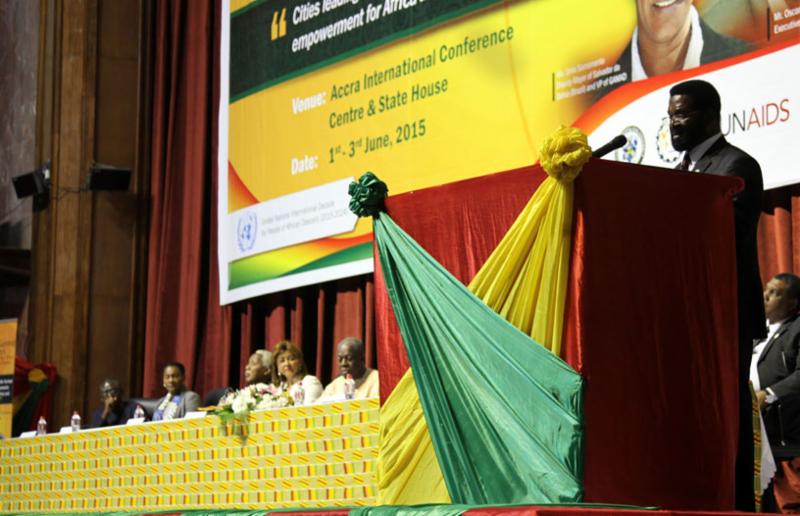
From June 1-3,  2015,  African mayors and mayors of African descent from more than 30 countries participating in a global conference in Accra, Ghana, explored how cities can accelerate the AIDS response and deliver specific results in HIV prevention, testing and treatment in the next five years.The summit was convened within the framework of the International Decade for People of African Descent (2015-2024). It featured other thematic pillars, including gender equality and women's empowerment, youth entrepreneurship and employment.
During the summit, participants committed to the goal of ending the AIDS epidemic and discussed how to increase HIV testing, access to antiretroviral therapy and stopping new HIV infections among children.Following a series of regional consultations, 18 mayors from Africa, Latin America and the United States of America signed the Paris Declaration on Fast-Track Cities, which calls for ending the AIDS epidemic in cities by 2030. The mayors agreed that by putting people at the centre of the response and addressing underlying issues, such as poverty, discrimination and violence against women and girls, their societies can be transformed.
The was the Fourth World Summit of Mayors and Leaders from Africa and of African Descent, hosted by the Lord Mayor of Accra, Alfred Vanderpuije, and co-organized by the Global Alliance of Mayors and Leaders from Africa and of African Descent, the African Renaissance and Diaspora Network, Inc., in partnership with the City of Accra, la Asociación Nacional de Alcaldes de Municipios con Población Afrodescendiente and UNAIDS.
Source: 


Antionette Eyombo Bella 
Antionette Eyombo Bella welcomes you to the  Youth Literacy Project: I AM AN AFRICAN. 
I was born in the United States where I live. I hope you can join me and my friends to support our adopted Literacy Project: I AM AN AFRICAN. 
    

Youth Literacy Project: I AM AFRICAN
 I AM AFRICAN

Usa River Tanzania read the poem. Upendo Middle Primary recently received 60 Kindle E-readers as Worldreader's first e-reader project in Tanzania. 
     

I AM AFRICAN
I AM AFRICAN
Reading by the Author 

Words of the poem, set to music by Hans Zimmer from The Power of One 


I Am An African by Wayne Visser

I am an African
Not because I was born there
But because my heart beats with Africa's
I am an African
Not because my skin is black
But because my mind is engaged by Africa
I am an African
Not because I live on its soil
But because my soul is at home in Africa
 
When Africa weeps for her children
My cheeks are stained with tears
When Africa honours her elders
My head is bowed in respect
When Africa mourns for her victims
My hands are joined in prayer
When Africa celebrates her triumphs
My feet are alive with dancing
 
I am an African
For her blue skies take my breath away
And my hope for the future is bright
I am an African
For her people greet me as family
And teach me the meaning of community
I am an African
For her wildness quenches my spirit
And brings me closer to the source of life
 
When the music of Africa beats in the wind
My blood pulses to its rhythm
And I become the essence of sound
When the colours of Africa dazzle in the sun
My senses drink in its rainbow
And I become the palette of nature
When the stories of Africa echo round the fire
My feet walk in its pathways
And I become the footprints of history
 
I am an African
Because she is the cradle of our birth
And nurtures an ancient wisdom
I am an African
Because she lives in the world's shadow
And bursts with a radiant luminosity
I am an African
Because she is the land of tomorrow
And I recognise her gifts as sacred


I AM AFRICAN SPEECH by former President Thabo Mbeki


You may have a virtual visit and learn more: Enter 
  

Related Archived Newsletter 
  
  
Topics: AU's Diplomat Tarek Ben Youssef closes "Mutuality Gap" at milestone Africa Diaspora Stakeholder Exchange; Africa Diaspora Moving Forward Forum on July 18; 25th AU Summit Rocks!; Inter-Africa Mega Trade Block To Boost Africa's Commerce; Dashing President Kikweti of Tanzania looking forward to Dashing Out and Ambassador Mulamula Has a New Job; Jews honored Proud African Diasporan Muslim at the prestigious AJC Annual Global Forum; New Captain Steering the AfDB; African Joint Force to Defeat Boko Haram;  Africa Diaspora Readying for ECOSOCC; AGOA Reauthorization Breezes through US House of Reps.  
  
  
Happy Eid Mubarak to our Muslim brothers and sisters !  
  
  
In Step with President Léopold Sédar Senghor
Léopold Sédar Senghor (1906-2001)
 Senghor at at Musée Dynamique, Dakar, in 1966. 
One of the preeminent African intellectuals of the twentieth century, Senegalese poet and statesman Léopold Sédar Senghor is hailed as a powerful voice of postwar black cultural pride and self-determination. He was the first president of Senegal from 1960 to 1980. 

A leading proponent of negritude, a literary movement based on the repudiation of Western imperialism and the reclamation of Pan-African heritage, Senghor was instrumental in the cultivation of postcolonial aesthetics and black racial consciousness. His acclaimed verse in  Chants d'ombre (1945)    Hosties noires ( 1948);  Ethiopiques (1956 and   Nocturnes ( 1962)

Négritude is a literary and ideological philosophy, developed by francophone African intellectuals, writers, and politicians in France during the 1930s. Its initiators included Martinican poet Aimé Césaire, Léopold Sédar Senghor (a future President of Senegal), and Léon Damas of French Guiana. Négritude intellectuals disfavored French colonialism and claimed that the best strategy to oppose it was to encourage a common racial identity for black Africans worldwide. 

Senghor celebrated the cultural legacy of Africa while attempting to reconcile his affinity for European civilization with the devastating effects of its colonial policies. The recipient of numerous international honors and the first black person to be elected to the prestigious French Academy, Senghor was the first president of modern Senegal, a political position he served with distinction from 1960 to 1980.


The establishment of Dakar as a global centre for modern and contemporary arts on the African continent can be traced back to Senegal's independence in 1960 and the particular interventions of Senegal's first president  Léopold Sédar Senghor. By setting up a number of major national art institutions, and hosting large-scale international arts events in the capital city during the first decade of post-colonial independence, Senghor signalled that artistic modernism was to be one of the most prominent demonstrators of Senegal's arrival as a 'new' nation-state on the world stage. 
  
  
Reviving  Festival of African Arts and Culture by understanding its beginnings at FESTAC 66 
  
  
A CALL TO HISTORY 
Cédric Vincent writes about the importance of remembering, focusing on four groundbreaking African festivals 
By  Cédric Vincent 
 
 
Independence gave rise in Africa to a proliferation of festivals of art and culture, symposia, and gatherings on musical and later cinematic themes. This emerging scene felt the lasting imprint of a number of massive pan-African events held in various countries. Four in particular were radically new phenomena for their time and deserve sp ecial attention:
The first World Festival of Negro Arts (Dakar, 1966) 
The first Pan-African Cultural Festival (Algiers, 1969) 
The Zaire 74 Festival, accompanying the world boxing championship between Mohammed Ali and George Foreman (Kinshasa, 1974) 
The Second World Black and African Festival of Arts and Culture, a.k.a. FESTAC (Lagos, 1977) 
  
  
Symposium during the World Festival of Negro Arts, Dakar, 1966 (courtesy of Panafest Archive research project) 
  
The First World Festival of Black Arts or World Festival of Negro Arts was held in Dakar, Senegal, 1-24 April 1966.  The festival was held under the auspices of the United Nations Educational, Scientific and Cultural Organization (UNESCO), the government of Senegal and the Society of African Culture. It was initiated   by former President Leopold Senghor with the participation of 45 African, European, Caribbean, and North and South African countries, and featuring black African literature, music, theater, visual arts, film and dance.
  
Those four (aformentioned) festivals followed fairly similar models. They featured delegations from around the world and were attended by tens of thousands of visitors. The festivities created encounters between music and fine art, theater and cinema, dance and literature, and in one case even included one of the most ambitious sporting events ever organized on the continent.  
  
There were panels and round-table discussions by the score. Grand avenues were added to the map and imposing structures built (such as the Dynamique Museum in Dakar and the National Theater in Lagos). Even entire neighborhoods were erected (e.g. Festac Town in Lagos), profoundly transforming the fabric of the host cities. The budgets were dizzying and the infrastructure was a complex financial undertaking. 
  
  
The festivals of Dakar, Algiers, Kinshasa, and Lagos left their marks on the pan-African cultural landscape, on the continent both north and south of the Sahara, and even further afield, inspiring people in the US, Latin America, the Caribbean, and the islands of the Indian Ocean. Strangely enough, however, they have not received much attention from academics and have never been the subject of a collective study to date. This is a crucial oversight that essentially consigned an entire chapter of cultural and political history in the postcolonial period to the dustbin. The team of the Panafest Archive research project (EHESS-CNRS, Paris) is now working to fill that gap. 
  
  
As shown above, the grand events in question had a global impact and continue to be remembered as symbols of a cultural Golden Age. They owe this memory to their political character. It would be inaccurate to think of these four festivals as "mere" cultural and artistic events. Rather, they were central nodes in a network of relations and representations, situated at the very heart of movements that had fundamental global effects on the structuring of the nation-state and the incipient political imaginary.  
  
As sites of coordination and mediation between artistic creators and decision-makers on one side and widely disparate audiences on the other, they served as sounding boards for the public dissemination of ideas that had previously been confined to the elite. As showcases for the states that organized and participated in them, they served as entranceways - via the artists' work - for diplomacy around various issues at various scales: among young African nations, between culturally Arab North Africa and sub-Saharan Africa, between independent countries and liberation movements in the remaining colonies and apartheid regimes, between the Americas and Africa, between former metropolises and former colonies, and between international organizations and bilateral cooperation structures. 
  
  
Apart from ideological rivalries (notably over the notion of Négritude) among the events, which greatly contributed to shaping their contours, it is fitting to think of the festivals in Dakar, Algiers, Kinshasa, and Lagos as collectively opening a space for interchange and encounter. The delegations' artists and cultural players engaged with one another, made each other's acquaintance, exchanged ideas. It is important to situate them in connection with one another and with a view to the transfer (that is, recycling) of ideas, practices, and images as well as the flow of people, objects, and symbols. 


T he Black Panther newspaper, 1969 (courtesy of Panafest Archive research project)
This stream of memory took form in different kinds of artistic events via the rediscovery and reuse of intellectual and artistic productions linked to the agitated years of anti-colonial struggle and the attainment of independence. Moreover, these events' affinity for commemoration has been expressed through explicit references to historical festivals, notably through the anniversaries of independence.  
  
The Second Pan-African Festival, for example, was held in Algiers in July 2009. Then, in 2010, the third World Festival of Black Arts was organized in Dakar, not without difficulty. The theme was African Renaissance, a buzzword coined by the former president of South Africa Thabo Mbeki in a bid to redefine the international image of the continent. Prior, the various organizers of the Dakar Biennale had made recurrent references to the 1966 festival in order to raise the profile of their own event. Finally, in South Africa, an abortive project intending to resurrect the FESTAC was developed in the late 1990s after the abandonment of the Johannesburg Biennale. These projects all demonstrate the extent to which the memory of those festivals permeates the world of art and culture in Africa. 
  
  
At the same time, the references to festivals in the 1960s and '70s are often stereotyped and billed as canonical, pioneering points of departure. The images and discourses they have produced are recycled, but always draw on the same sources (catalogues, memorial books, etc.). In cases where the stereotypes could be contested, the dearth of documentation frequently leads to a kind of amnesia-fueled nostalgia.  
  
It bears pointing out that festivals do not generally keep good records of their history and tend to neglect their archives. This might make the historian's job harder, but it also has the benefit that the history is not wrapped in the artifice of institutionalized memory. 


Monument of the African Renaissance


The African Renaissance Monument (French: Le Monument de la Renaissance Africaine) is the tallest statute in Africa standing at 49m tall. The bronze statue located on top of one of the twin hills known as Collines des Mamelles, outside of Dakar, Senegal. Built overlooking the Atlantic Ocean in the Ouakam suburb, the statue was designed by the Senegalese architect Pierre Goudiaby  The site preparation on top of the 100-meter high hill began in 2006, and construction of the bronze statue began 3 April 2008. It was formally dedicated  on formal April  4, 2010, Senegal's "National Day" by President Wade Abdoulaye  commemorating the 50th anniversary of the 18 African country's including Senegal.  


Forward this email


Global Africa Diaspora Summit 11: Operationalizing the Declaration of the Global Diaspora Africa Summit in South Africa 2012 7915 24th Place Hyattsvile MD 20783 

--
Listserv moderated by Toyin Falola, University of Texas at Austin
To post to this group, send an email to USAAfricaDialogue@googlegroups.com
To subscribe to this group, send an email to USAAfricaDialogue+subscribe@googlegroups.com
Current archives at http://groups.google.com/group/USAAfricaDialogue
Early archives at http://www.utexas.edu/conferences/africa/ads/index.html
---
You received this message because you are subscribed to the Google Groups "USA Africa Dialogue Series" group.
To unsubscribe from this group and stop receiving emails from it, send an email to usaafricadialogue+unsubscribe@googlegroups.com.
For more options, visit https://groups.google.com/d/optout.

No comments:

Post a Comment

 
Vida de bombeiro Recipes Informatica Humor Jokes Mensagens Curiosity Saude Video Games Car Blog Animals Diario das Mensagens Eletronica Rei Jesus News Noticias da TV Artesanato Esportes Noticias Atuais Games Pets Career Religion Recreation Business Education Autos Academics Style Television Programming Motosport Humor News The Games Home Downs World News Internet Car Design Entertaimment Celebrities 1001 Games Doctor Pets Net Downs World Enter Jesus Variedade Mensagensr Android Rub Letras Dialogue cosmetics Genexus Car net Só Humor Curiosity Gifs Medical Female American Health Madeira Designer PPS Divertidas Estate Travel Estate Writing Computer Matilde Ocultos Matilde futebolcomnoticias girassol lettheworldturn topdigitalnet Bem amado enjohnny produceideas foodasticos cronicasdoimaginario downloadsdegraca compactandoletras newcuriosidades blogdoarmario arrozinhoii sonasol halfbakedtaters make-it-plain amatha