Starting in 2011, Wells Fargo employees opened more than 1.5 million sham checking accounts and applied for more than 565,000 credit cards using customer names and money without those customers ever knowing. The fraudulent accounts helped employees meet punishingly aggressive sales quotas and helped the bank tout its ability to "cross-sell" financial products to its customers. The bank's stated goal was for every customer to have eight accounts with Wells. Low-paid retail bank employees who didn't meet short-term sales quotas could lose their jobs. (The Department of Labor announced Tuesday that it is investigating the bank for its treatment of workers.)
Wells Fargo's CEO Is Actually Getting Punished, Thanks To Elizabeth Warren
It's a start.
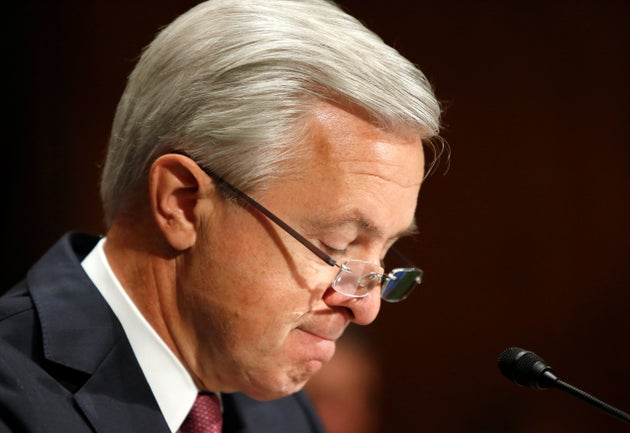
For the first time since the financial crisis, a big bank is publicly forcing its CEO to give up a small part of his millions in salary and stock ― making him take at least some symbolic, personal responsibility for misconduct.
Wells Fargo CEO and chairman John Stumpf will forfeit $41 million in unvested stock, give up his $2.8 million annual salary (for a time) and get no bonus this year, the bank announced Tuesday in the wake of a massive scandal. Stumpf is hardly at risk of homelessness, though: he still has his job ― much to the consternation of critics ― and another $247 million in Wells Fargo stock he's accumulated.
The bank also fired 5,300 low-paid workers over the past five years in connection with the scandal, none of whom, presumably, had as comfortable a safety net.
For the unusual fact that a bank CEO is facing any kind of penalty, you can thank Sen. Elizabeth Warren (D-Mass.) who has tirelessly gone after the banking industry since the financial crisis devastated the country in 2008.
Warren, who excoriated Stumpf last week in a blistering and pinpointed series ofquestions and non-answers at the Senate hearing over the scandal, is largely responsible for the creation of the Consumer Financial Protection Bureau. The new post-crisis regulator finally held the bank to account for defrauding millions of customers. The CFPB and the city of Los Angeles fined the bank a combined $185 million earlier this month.
In a series of tweets on Wednesday, Warren called Wells Fargo's announcement "a step in the right direction," but said more must be done.
On Tuesday, Wells Fargo's board also said that Carrie Tolstedt, the executive responsible for the banking unit that had been ripping off customers, was leaving effective immediately, pushing up her retirement date from the end of this year. She will also get no severance pay or bonus for this year, give up $19 million in stock and won't receive some "retirement enhancements."
In a blandly worded press release, the bank's lead independent board member, Stephen Sanger, hinted Stumpf's future was far from secure. After announcing the board would retain an outside law firm to investigate the scam, Sanger said it would "take all appropriate actions" to address misconduct.
No bank in the wake of the financial crisis has forced a clawback of compensation from its chief executive. JPMorgan came closest during its London Whale scandal a few years ago. After the bank lost $6 billion on a credit derivatives trade, chairman and CEO Jamie Dimon had his 2012 pay cut from $23.1 million the year before the scandal to a mere $11.5 million.
Industry critics treated Wells Fargo's move fairly skeptically.
"Our biggest concern is that too many people are focused just on the CEO," Dennis Kelleher, the president and CEO of the nonprofit Better Markets, told The Huffington Post. "This was a breakdown of the entire corporate chain of command."
Starting in 2011, Wells Fargo employees opened more than 1.5 million sham checking accounts and applied for more than 565,000 credit cards using customer names and money without those customers ever knowing. The fraudulent accounts helped employees meet punishingly aggressive sales quotas and helped the bank tout its ability to "cross-sell" financial products to its customers.
The bank's stated goal was for every customer to have eight accounts with Wells. Low-paid retail bank employees who didn't meet short-term sales quotas could lose their jobs. (The Department of Labor announced Tuesday that it is investigating the bank for its treatment of workers.)
Stumpf, who was blasted at a Senate finance committee hearing over the scam last week, faces a similar grilling by a House committee on Thursday.
QUOTEThe core of the entire financial system is trust. Customers trust banks with their money. Banks trust that consumers will repay loans. Investors trust broker-dealers that they will provide them advice in their best interest and get the best price, not the brokers' highest commission. Without trust, the entire financial system collapses. Financial crises occur, in part, because trust is suddenly lost. Fundamentally the private sector has to build and maintain trust, while the government can serve to enhance it. The government works to enforce this trust through a series of explicit government guarantees such as deposit insurance, laws and regulations to require proper action, and enforcement and oversight to ensure punishment and remuneration when laws and contracts are violated.........It also raises the logical question: who else was doing this? Every American may be wondering: are there accounts that were opened in my name that I don't know about? If so, how can I find out?UNQUOTEThat is right - lack of trust in government, in banks, in law enforcement, etcheram, ad nauseum is a cancer in society, brought on by government, banks and law enforcement etc. themselves. It is the restoration of that trust, not necessarily through new laws, but the enforcement of old laws, with exemplary punishment (both to redeem losses and to sanction), that must be the task to be done.Bolaji AlukoWhy the Wells scandal matters so much
Aaron KleinScandals in banking, finance, and housing rocked the world, causing a global financial meltdown and the Great Recession. While the economy and the financial sector eventually recovered, the fallout from the financial crisis kept the papers full of misdeeds and improper actions within finance. A certain numbness must have come over large sections of the public who could hardly muster shock anymore when this latest new scandal was uncovered at Wells Fargo.
Yet yesterday's hearing before the Senate Banking, Housing and Urban Affairs Committee achieved something that prior scandals had not. AsSenator John Tester (D-MT) noted, Wells Fargo's practices had "done something I've never seen in 10 years: You have united this committee — and not in a good way."
Why is this scandal different and why should we be more concerned about it? Because this improper action gets at the heart of the entire financial system: trust between consumers and banks.
The core of the entire financial system is trust. Customers trust banks with their money. Banks trust that consumers will repay loans. Investors trust broker-dealers that they will provide them advice in their best interest and get the best price, not the brokers' highest commission. Without trust, the entire financial system collapses. Financial crises occur, in part, because trust is suddenly lost. Fundamentally the private sector has to build and maintain trust, while the government can serve to enhance it. The government works to enforce this trust through a series of explicit government guarantees such as deposit insurance, laws and regulations to require proper action, and enforcement and oversight to ensure punishment and remuneration when laws and contracts are violated.
The actions that Wells Fargo undertook violated this trust on the most basic levels. What Wells, America's largest commercial bank by domestic assets, did was to open unauthorized bank, credit card, and other accounts for their customers on a massive scale. These accounts, which consumers did not authorize or even know about, then triggered various fees, which were charged to consumers. More than 5,000 Wells Fargo employees were involved in the operation, which was incentivized by offering bonuses and other pressure to Wells employees to create accounts. These activities went on for several years from 2011-2013, when they were first detected. It is unclear how long they continued, and even after yesterday's hearing, it is unclear exactly when Wells CEO John Stumpf first knew about them, despite his having frequent direct access with the executive in charge of this program Carrie Tolstedt. When asked directly by Senator Sherrod Brown (D-OH) whether Stumpf knew about the activities before they were reported in the L.A. Times in 2013, Stumpf said, "I don't remember the exact timeframe. I can get back to you." A low point in a hearing full of low points for the CEO.
It is easier to understand what Wells Fargo did as compared to what was going on during the financial crisis with synthetic collateralized debt obligations, credit default swaps, and the tri-party repo system. That is one reason why members of Congress and the press are likely to continue pounding on this issue. It also raises the logical question: who else was doing this? Every American may be wondering: are there accounts that were opened in my name that I don't know about? If so, how can I find out? You can start by requesting your free credit report through a provision that Congress required in the Fair and Accurate Credit Transactions Act of 2003, but be prepared for a shock as it is estimated that 1 in every 4 Americans have incorrect information on their credit report (I found out about several other 'Aaron Klein's in mine).
This post-financial crisis scandal also raises the question, has anything really changed in banking and finance? One reason why it was important for financial regulation to be enacted into law after the financial crisis was to restore public trust and confidence in our markets. The Dodd-Frank Wall Street Reform and Consumer Protection Act of 2010 was designed to do just that and included new legal authority allowing financial regulators to 'claw-back' ill-gotten gains by executives. Yet the executive compensation rules implementing this authority have still not yet been finalized by the regulators, six years after the law was passed and more than five years after they were first proposed. Financial regulators could start by enforcing the law, finalizing those rules ASAP, and acting upon them aggressively. Criminal prosecutors also have a role to play in enforcing their legal authority, which is separate from the job of bank regulators. Enforcement of the full range of law is important as it relates to public trust.
But beyond government action, the industry needs to act to restore trust. The fact that Wells Fargo has fired over 5,000 junior employees — but not a single senior manager — will not sit well with the American public, nor should it. It is simply untenable that Wells Fargo told investors that it has "strong recoupment and claw-back policies" in place, yet they have not publicly announced a single dollar of claw back from the over $100 million that Carrie Tolstedt is poised to receive as part of her retirement (yes she is still a Wells Fargo employee, not fired and poised to retire with full benefits). The financial services industry needs to convince the American public with deeds, not words, that they should be trusted. Trust is at the core of the financial system. To truly move beyond the financial crisis, that trust must be restored.
Author
On Tue, Sep 20, 2016 at 9:04 PM, Mobolaji Aluko <alukome@gmail.com> wrote:------------------------------------------------------------ ------------------------------ -------------------- My People:Is this "cross-selling" false-account-opening scam happening in the Nigerian banking system? I would not be surprised if it was, particularly with public accounts during the pre-TSA period. Individuals could also be similarly victimized, if banks have an internal mechanism for linking balances in multiple bank accounts, while at the same time ensuring multiple maintenance charges in the various accounts, etc.It is worth investigating in our country.....I really don't trust our banks: too many sharp practices. Even without trust, I would love to verifyBolaji AlukoElizabeth Warren Hammers Wells Fargo CEO: 'You Should Be Criminally Investigated'
John Stumpf admitted no senior bank executives have been held accountable in the scam.
09/20/2016 12:29 pm ET | Updated 2 hours agoEmily Peck Executive Editor, Business and Technology, The Huffington PostZach Carter Senior Political Economy Reporter, TheMassachusetts Sen. Elizabeth Warren grilled Wells Fargo CEO John Stumpf on Tuesday for his role in a widespread scheme in which thousands of bankers opened more than 2 million accounts for customers without them knowing over at least five years.
"You should resign. You should give back the money you took while this scam was going on and you should be criminally investigated," Warren told Stumpf, after he admitted under Warren's grilling he hadn't yet been held personally accountable for the actions of his employees.
The Democratic senator also forced Stumpf, who was under questioning from the Senate banking committee over his bank's handling of the scam, to admit that no senior executives have been held accountable for the actions of the low-level bankers.
Some forged signatures and committed identify theft to open fraudulent bank accounts, while under pressure to meet sales targets or be fired. These employees, Stumpf explained earlier in the committee hearing, were "well-paid," making between $30,000 and $60,000 a year. Stumpf made $19.3 million in 2015.
"This just isn't right," Warren said. "You squeezed employees to the breaking point" to drive up the stock price and your compensation, she said, referencing the bank's fierce drive to "cross-sell" or make customers open up multiple accounts. "You went on television to blame thousands of $12-an-hour" workers.
"It's gutless leadership," Warren said.
Last week Stumpf in a televised interview appeared to blame low-level workers for this behavior, which was widespread throughout the bank ― 5,300 employees were fired for their involvement.
A cashier who "steals a handful of $20s" is held accountable, Warren said. Bank executives aren't.
"The only way Wall Street will change will be if executives face jail time" for criminal behavior, she said.
In the Wells Fargo scandal, people were mistakenly charged fees, saw their credit ratings fall, got credit cards in the mail they never asked for or just were confused.
The bank said that it had fired the thousands of employees from 2011 to 2016 for engaging in the practice. Stumpf tried on Tuesday to make the case that this was a few bad apples, explaining the firings amounted to 1 percent of the bank's 100,000 retail bankers every year.
The incentive to open fake accounts was strong: Wells Fargo bankers received quarterly bonuses for cross-selling. Stumpf said on Tuesday that the lowest-paid bank workers make $12 an hour in low-cost regions and have salaries that touch $16.50 an hour in the highest-cost areas. Those who lost their jobs were making on average $35,000 to $60,000 a year ― and that included some regional bank managers. Bonuses for bankers were $500 to $2,000 every three months, The Wall Street Journal reports. District managers could get $10,000 to $20,000 a year.
Wells Fargo just this month announced it would get rid of these incentives, beginning in January 2017.
Earlier this month, Wells Fargo was fined $185 million, including a record $100 million penalty imposed by the Consumer Financial Protection Bureau, for scamming its customers. The CFPB was Warren's brainchild and was created as part of the 2010 Dodd-Frank financial regulations.
Last week, Republicans on the House Financial Services Committee approved a bill designed to hamstring the CFPB. Senate Majority Leader Mitch McConnell (R-Ky.), who is married to Wells Fargo board member Elaine Chao, is attempting to push a bill with similar terms through the Senate.
Senator after senator from both sides of the aisle joined Warren in the pile-on Tuesday. Stumpf's repeated emphasis that only 1 percent of the bank's sales force had been involved with what multiple lawmakers called "fraud" lead Sens. Jon Tester (D-Mont.) and David Vitter (R-La.) to invoke the prospect of breaking up the bank.
"Every time you say that," Tester said, referring the the 1 percent excuse, "you give ammunition to the people who want to break up the big banks."
"Why isn't this crystal clear proof that an entity as big as Wells is too big to fail, too big to manage, too big to regulate?" Vitter demanded.
Cross-selling was a significant aspect of Wells Fargo's retail banking strategy, which the bank detailed in Securities and Exchange Commission filings. Sens. Jeff Merkley (D-Ore.), Sherrod Brown (D-Ohio) and Robert Menendez (D-N.J.) all suggested that those claims could be grounds for a securities fraud case against Stumpf himself.
"You say you 'accept responsibility, and it was the fault of those 5,000 people,'" Merkley said. "That's not accepting responsibility ... you are scapegoating the people at the very bottom."
In a statement issued Tuesday morning, presidential nominee Hillary Clinton was more circumspect than her fellow Democrats on the banking committee. Though she called Wells Fargo's behavior "outrageous" and called for compensation to be "clawed back" for responsible executives, Clinton restricted comments about breaking up big banks to the realm of hypothetical future scenarios.
"If any bank can't be managed effectively, it should be broken up."

Listserv moderated by Toyin Falola, University of Texas at Austin
To post to this group, send an email to USAAfricaDialogue@googlegroups.com
To subscribe to this group, send an email to USAAfricaDialogue+subscribe@googlegroups.com
Current archives at http://groups.google.com/group/USAAfricaDialogue
Early archives at http://www.utexas.edu/conferences/africa/ads/index.html
---
You received this message because you are subscribed to the Google Groups "USA Africa Dialogue Series" group.
To unsubscribe from this group and stop receiving emails from it, send an email to usaafricadialogue+unsubscribe@googlegroups.com.
For more options, visit https://groups.google.com/d/optout.

No comments:
Post a Comment