Wednesday, December 6, 2017

USA Africa Dialogue Series - With kin of Slave Revolt Leader in Amistad: Press Release by African Diaspora Organizations and African Traditional Authorities: Concrete Actions for African migrants in Libya and African Integration


Subject: Updated with kin of Slave Revolt Leader in Amistad: Press Release by African Diaspora Organizations and African Traditional Authorities: Concrete Actions for African migrants in Libya and African Integration

The Keynote Speaker: First Concerted Action
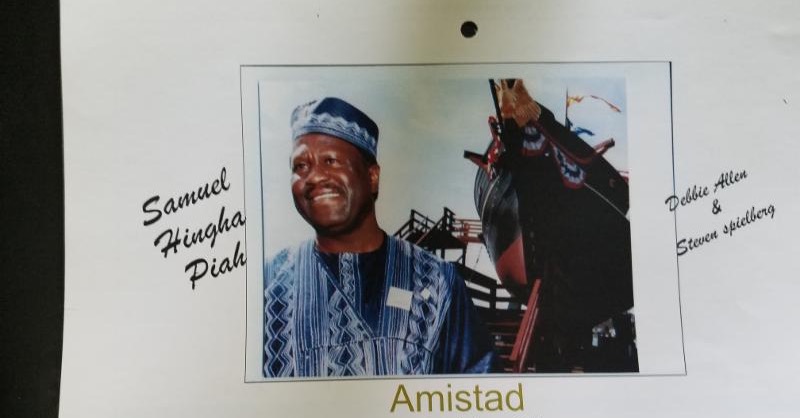
Samuel Hingha Pieh
 December 22, 2017 at the University of Maryland, USA
Nyumburu Cultural Center.
7:30pm

Featuring the historic point at the African Gastronomy Dinner with the Final Call by Langston Hughes, presented by Sankofa Youths to exemplify AU Agenda 2063 Goal 18: Engaged and Empowered Youth and Children. 

One of the strategic indicators in the Agenda 2063  targets is to develop and implement programs that address the welfare of youths in the Diaspora from Member States.


Samuel Hingha Pieh is a descendant of the leader in the Amistad Saga of 1839. His great- great- grand father Sengbeh was one of the captured and enslaved Africans from Sierra Leone, West Africa who were later sold to Spanish Enslavers in Puerto Rico to cultivate their farms for agricultural profits.
Sengbeh Pieh, also known as Joseph Cinque in American history books, led the historic revolt aboard the Spanish slave ship-La Amistad in 1839. After the Ship was captured along the Eastern coast of the USA- off the New England coast, Sengbeh and his companions became the scene of Anti-Slavery Abolitionist's Campaign to end Slavery.
With help and support from diverse groups of people and organizations, The Amistad Africans were tried and freed in the US Supreme Court after being exemplarily represented by former President and Lawyer John Quincy Adams. 
This historical event inspired Debbie Allen and Steven Spielberg to produce the movie Amistad in 1997 and Samuel Pieh was casted as Language Coach and Screen Actor-representing Suuleh who was one of the Elders among the enslaved Africans.
Full Credits for the Amistad Film: READ
Mr. Pieh descendants were among freed slaves who moved backed to Africa, mainly to Liberia and Sierra Leone.  A dynamic speaker, Mr. Pieh will be coming from Africa where he lives and works on research and development.

Cotonou, Benin
Email address: social@pactna.com
Tel : 00 229 97 34 10 89

Pan African Council of Traditional and Customary Authorities

Media Contacts

Diakite Boubacar, Harvard University, Advisor, Pan African Council of Traditional and Customary Authorities

Adeyemi Coker, Communication Director, Global Synergy, LLC

Concerned African Citizens in the Diaspora and Organizations 

Email addresses: 
Americas: 240-706-6885

Europe:
Roger Alain Pagou, Central African Chamber of Commerce, Sweden

African Union Agenda 2063 Aspiration 5 is based on "An Africa with a strong cultural identity, common heritage, shared values and ethics."

Cotonou, Benin, December 6, 2017 


For Immediate Distribution

Joint Press Release

 Concerned African Citizens in the Diaspora  and Organizations
and 
Pan African Traditional and Customary Authorities 


After the initial shock and furor, the crisis is sooner forgotten or relegated to yesterday news and complacency sets in.

Urgent relief for African immigrants in Libya, some of whom are sold as slaves, should be on the front burner of agendas. It should not be piecemeal, neither should each country be left entirely on its own to fetch and repatriate its nationals. 

Xenophobic attacks meted against Africans on African soil is a plight that tests the sight of the African Union (AU) vision towards an integrated Africa. It is a collective duty to redress. 

Therefore, while external parties may help mostly from their own vantage points, ultimately, it is an African responsibility. Citizens in the civil society should work with the public sector to stamp out the vicious cycle, stereotypes, and ignorance and to advance sustainable solutions. 

Concerned African Citizens in the Diaspora and Organizations and the Pan African Traditional and Customary Authorities will co-organize concerted and concrete actions to promote public-private partnerships in addressing migrant crisis and successful integration in African societies, public education, and the welfare of young people living outside their Member States within and outside Africa.

The results are intended to serve as practical solutions that can be replicated and recommended to the AU and Member States, and institutionalized. 

Inviolable Value

"At the root of society, enabling heritage values serve as moral anchors that endure the test of time and rise above sectional interests" His Majesty Tanyi Robinson, the Secretary General of the Pan African Council of Traditional and Customary Authorities, said in calling for concerted response to the inhumane treatment of African immigrants in Libya and to address xenophobia in Africa, which unravels the social fabric of the African society.

Pan African Council of Traditional and Customary Authorities takes the unwavering position that no civilized person or reasonable government can rationalize policies or practices that subjugate people to a dehumanized status as constructive migration deterrent.

Concerned African Citizens in the Diaspora and Organizations, consisting of individuals, Home Town and Professional Associations, National and Regional Economic Community and Africa-wide organizations based in the Diaspora, believes that what is happening in Libya is a dire humanitarian emergency beyond the debates on the cause and cost.

The world, and particularly Europe, is facing the largest refugee crisis since the end of World War II. This ought to be assessed  and addressed in the broader context of violent conflict, terrorism, climate change, and other co-factors to destabilization in parts of the world and specifically in Africa where women, men and children are forced to flee their homeland for the chance to just stay alive.

People scrambling for basic security and voluntary migration in search for better life are not synonymous. When this is seen as a false division of categories, the non-distinction leads to orienting policies and mobilizing action instruments  that create more humanitarian crises.

Whatever the factors and circumstances, auctioning people as slaves for commercial purposes or placing them in conditions that are detrimental to normal human functioning should be, as it has been, appropriately decried as a "crime against humanity." 

 Intra-African Challenge

Compounding this modern day horror, devaluing Africans as aliens who are targeted for xenophobic attacks on African soil in Libya and elsewhere in Africa contradicts the expected progress of the AU vision toward integration. In fact, these manifestations are obstacles to the milestones. 

In 2016, President Yoweri Museveni of Uganda and Leader on Africa's Political Integration sensitized the point of welcoming other Africans. On assumption of the Chairmanship of the African Union Commission in 2017, Mr. Faki Moussa Mahamat said no African should be made to feel like a foreigner in any African country.

The position is foundational to the Union.

Immediacy of Redress

While the CNN report sparked the recent international outrage, this degradation of human life had been articulated. The International Office for Migration confirmed the same findings in March 2017 READ.

In early November 2017, United Nations High Commissioner for Human Rights, Zeid Ra'ad Al Hussein, accused the international community of turning a "blind eye to the unimaginable horrors endured by migrants in Libya" and called the European Union's policy "inhuman". 

The Chairperson of the African Union and Authority of the African Heads of State, H.E. Alpha Condé of Guinea, also criticized Europe's co-operation with the Libyan authorities. "The refugees are living in extremely bad conditions," he said. "Our European friends were not right to ask Libya to keep immigrants (in detention)" in reference to the European Union (EU) co-operation with the UN-backed government in Tripoli. 

The policies include aiding the Libyan coastguard as the EU increases efforts to intercept migrant boats. 

On November 22, 2017, at the European Parliament in Brussel,  Mali placed the  blame on  "external intervention" for the societal breakdown in Libya since the NATO-led bombing campaign in 2011 that helped to topple the government of Muammar Gaddaffi and plunged the country into chaos from which it has not emerged. 

Malian Minister of Foreign Affairs, Abdoulaye Diop, said the raids were "carried out without a strategic vision, without a plan, and without the ability to manage the consequences." 

African Union Chairperson, Faki Moussa Mahamat, said at the moment, "there is no state, there are no rights, there are no laws in Libya."  

Both spoke alongside Federica Mogherini, EU High Representative for Foreign Affairs and Security Policy, at a joint press conference between the AU and EU officials on the security situation in the Sahel region of West Africa, which is battling an Islamist insurgency.

Libya is now home to about 1,500 armed militia groups. The mayhem allows individuals and groups to abuse the human rights of migrants with impunity, including trading in them in open slave auctions. Nigerian President Muhammadu Buhari commented  that he was appalled by the recent footage of migrants being sold "like goats for few dollars in Libya."


Current calls for investigations, discussions on various platforms, and recommendations, including those jointly agreed on at the European Union-African Union Summit  on November 29-30, 2017, attended by  55 African and 28 European leaders in Abidjan, Ivory Coast, are commendable.

Deterring irregular and dangerous migration where some die in the Mediterranean sea and arid deserts, stopping human trafficking, investments in youths and creating economic opportunities in Africa and Member States should be earnestly pursued. 

However, relief for African migrants experiencing daily mental anguish and physical torments in abhorrent conditions is an urgent moral obligation. Some of the nationals who have returned to their homes lived to tell the traumatic experiences.  Others are eager to return. 

Holistic Action.

Based on reports, there is an estimated 500,000-700,000 Africans in Libya. From the AU-EU Summit  in Abidjan, the only concrete plan is to evacuate 3,800 African migrants stranded in Libya.

President Alpha Condé said he was "in contact with all leaders," adding: "We are trying to find a solution, even if it means bringing all of our citizens home." 

Various efforts are made by individual countries to return nationals to their home countries and the International Office for Migration has been asked for assistance. 

The efforts should not be isolated and piecemeal. Concrete and concerted solutions should simultaneously demonstrate African sensibility, hospitality and unity with functional cooperation and commitment to results and more humane policies from Africa's external friends and partners. 

Leading with Indigenous African Solution and Commendation

Assistance is complementary. 

It is a collective humiliation to conscientious African citizens if the AU, Regional Economic Communities, and Member States must now depend on EU, the UN, international organizations to address the inhumane treatment of African citizens in other African countries.

Pan African Council of Traditional and Customary Authorities  and Concerned African Citizens in the Diaspora and Organizations strongly commend the Rwandan government and President Paul Kagame for offering to transport  over 30,000 African immigrants out of Libya, as well as providing them sanctuary if they choose to relocate to Rwanda.
The chairperson of the African Union Commission has called on all Member states of the AU, the private sector and citizens of Africa to make financial contributions to help alleviate the suffering of these migrants and facilitate the evacuation of those who wish to leave.
High Level Panels have characterized approaches on migration discussions. While the method is useful, it is most often disconnected from the population, especially grassroots and transnational organizations. The  translocal links between Diaspora organizations and their localities, which are essential for successful implementations of policy actions, are missing. 

Toward this end, Pan African Council of Traditional and Customary Authorities and Concerned African Citizens in the Diaspora and Organizations will co-organize action-oriented and out-come-based efforts that promote public-private partnerships to achieve practical results, which can be replicated and institutionalized as best practices.

About the Pan African Council of Traditional and Customary Authorities


The organization is made of legally installed African traditional authorities that are officially recognized by governments. Members serve in administrative capacities in their jurisdictions. 

The organization is dedicated to creating conditions that sensitizes and promote the African Heritage by preserving African patrimonies and integration of African cultures in systems, including in formal education and in sustainable developments; promotes the African Renaissance by applied knowledge, including science and technology; and fosters peaceable communities that enable intra-African collaboration on multidimensional levels.


The President is Professor Octave Cossi Houdégbé. He is Senator in the Benin Parliament, former Minister of Mines in Central African Republic,  Founder and Chancellor of the Houdegbe North American University, Cotonou, in the Republic of Benin.


His Majesty Tanyi Robinson

Secretary General, Pan African Council of Traditional and Customary Authorities, His Majesty Tanyi Robinson

PAN AFRICAN COUNCIL OF TRADITIONAL RULERS AND CUSTOMARY AUTHORITIES  
 Département de l'Ouémé, Commune de Sèmè-Kpodji, Arrondissement de Sèmè-Kpodji, Quartier Houdégbé, Cotonou, Benin


--
Listserv moderated by Toyin Falola, University of Texas at Austin
To post to this group, send an email to USAAfricaDialogue@googlegroups.com
To subscribe to this group, send an email to USAAfricaDialogue+subscribe@googlegroups.com
Current archives at http://groups.google.com/group/USAAfricaDialogue
Early archives at http://www.utexas.edu/conferences/africa/ads/index.html
---
You received this message because you are subscribed to the Google Groups "USA Africa Dialogue Series" group.
To unsubscribe from this group and stop receiving emails from it, send an email to usaafricadialogue+unsubscribe@googlegroups.com.
For more options, visit https://groups.google.com/d/optout.

No comments:

Post a Comment

 
Vida de bombeiro Recipes Informatica Humor Jokes Mensagens Curiosity Saude Video Games Car Blog Animals Diario das Mensagens Eletronica Rei Jesus News Noticias da TV Artesanato Esportes Noticias Atuais Games Pets Career Religion Recreation Business Education Autos Academics Style Television Programming Motosport Humor News The Games Home Downs World News Internet Car Design Entertaimment Celebrities 1001 Games Doctor Pets Net Downs World Enter Jesus Variedade Mensagensr Android Rub Letras Dialogue cosmetics Genexus Car net Só Humor Curiosity Gifs Medical Female American Health Madeira Designer PPS Divertidas Estate Travel Estate Writing Computer Matilde Ocultos Matilde futebolcomnoticias girassol lettheworldturn topdigitalnet Bem amado enjohnny produceideas foodasticos cronicasdoimaginario downloadsdegraca compactandoletras newcuriosidades blogdoarmario arrozinhoii sonasol halfbakedtaters make-it-plain amatha