| |
| Editor's note | | The Conversation, a global publishing platform, exists to ensure public access to independent, high quality and explanatory journalism. Under normal circumstances such journalism underpins a functioning democracy. But in times like these, when people around the world are bracing for a very tough battle against the COVID-19 pandemic, articles that are written by experts and yet are relatively accessible become even more important. They can help the public make sense of the pandemic and better prepare themselves for the battle ahead. It's our hope that as The Conversation Africa we have stepped up and made a contribution in the fight against COVID-19, recognising that our contribution pales into insignificance compared with the risks that healthcare workers face in the frontline of this battle. Since news of the spread of COVID-19 broke, academics from across the continent have reached deep into their knowledge banks to shed light on the pandemic. As a result, we have published 21 articles that have reached nearly a million reads. The Conversation's seven sister sites have also seen a massive rise in demand for the 500 plus stories they have published in four languages. There has also been a spike in republishing interest, with Africa articles taken up by a host of publications. The global titles have included Quartz, The Africa Report and Newsweek. Local interest has also increased. The uptake across the continent has been extensive, with articles appearing in the Daily Nation in Kenya, The Punch, Premium Times and the Guardian in Nigeria, Ghana's Modern Ghana and South Africa's News24 and Eye Witness News. We are proud to have built a news site that can offer trustworthy, evidence-based articles. And that we are part of a collective effort to provide knowledge, insight and guidance in these extraordinary times. That means featuring the specialist academics who can unpack the science that's providing guidance on how to manage the pandemic. It also means giving prominence to the academics who can reflect on the social, economic and cultural aspects of a disease that's forced a freeze on day-to-day activities. We are enormously grateful to all the academics who have continued to write for us despite the disruptions they face as institutions get shut down. We are also grateful to our newsletter subscribers and readers. We believe that the articles we're publishing are important in a world overwhelmed by disinformation and misinformation. So we'd ask that you encourage others to support The Conversation Africa by: signing up to our newsletter; sharing articles we've published; using stories as source material. This morning James Lappeman unpacks panic buying in times of extreme uncertainty. However irrational it might appear to be, this is neither new nor an unexpected phenomenon. But in a society characterised by high levels of income and wealth inequality, as South Africa is, panic buying is a luxury the majority of households can't afford. For his part, Steven Friedman sets out why the pandemic won't heal societies' divisions, or lead to problems like inequality and poverty being addressed more seriously. And Njeri Kinyanjui answers questions about what can be done in Kenya to support informal workers affected by COVID-19. | Jabulani Sikhakhane Deputy Editor and Business & Economy Editor |  | | Top Stories |  South Africa's Alexandra township in the foreground, where the majority live in squalor, and Sandton in the background, representing the most privileged Shutterstock James Lappeman, University of Cape Town Most consumers in South Africa aren't able to fill up a trolley of groceries for their daily needs, let alone join the panic buying induced by the COVID-19 pandemic. |
| 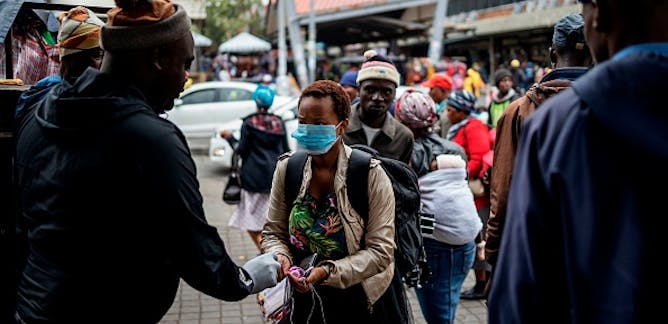 Steven Friedman, University of Johannesburg Reactions in South Africa give little reason for hope that the virus will bring people closer together or trigger more energetic action against poverty. |
| 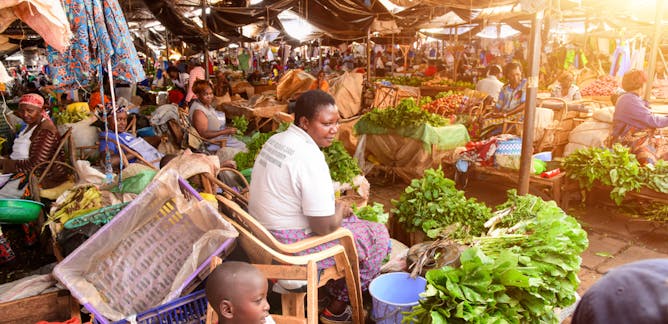 Njeri Kinyanjui, University of Nairobi Many informal workers will not be able to take the precautions that health authorities suggest. | | | Arts, Culture and Society |  Françoise Ugochukwu, The Open University Viewing Nigerian movies is seen as a trip down memory lane, a virtual journey back home and group therapy for Africans in the diaspora. |
|  Johan Swart, University of Pretoria Built by Tamil immigrants almost 100 years ago, the temple has survived apartheid and urban decay to remain at the heart of its community. | | | Politics |  Andrew Edward Yaw Tchie, King's College London Africa's youngest state has a long way to go before it can put conflict behind it for good. |
|  Zakeera Docrat, Rhodes University; Russell H. Kaschula, Rhodes University Forensic linguists are called as expert witnesses in court cases to provide linguistic analysis of legal documents and other forms of oral and documentary evidence -- including emojis. | | | From our international editions |  Joseph Eisenberg, University of Michigan Epidemiologists want to quickly identify any emerging disease's potential to spread far and wide. Dependent on a number of factors, this R0 number helps them figure that out and plan accordingly. |
|  Claudia Abreu Lopes, United Nations University; Sanae Okamoto, United Nations University Travel bans, social distancing and testing can all be effective against COVID-19. |  Simone Abram, Durham University And why COVID-19 has launched a response that the climate crisis couldn't. |
|  Dale Fisher, National University of Singapore The keys to success in Singapore: being prepared, keeping those infected with coronavirus out of the community and communicating effectively with the public. | | | En français |  Cheikh Sokhna, Institut de recherche pour le développement (IRD) Le lavage des mains est un geste simple et efficace pour sauver des vies contre le Covid-19. Des études au Sénégal et ailleurs le prouvent amplement. |
|  Alice Desclaux, Institut de recherche pour le développement (IRD) Reprises, amplifiées, déformées, mal comprises…Les informations qui quittent les laboratoires pour le vaste espace incontrôlé des médias et réseaux numériques peuvent avoir des conséquences graves. | | | | | | | | | | | Would you like to republish any of these articles? | | It's free to republish, here are the guidelines. Contact us on africa-republish@theconversation.com in case you need assistance. | | | | | | | | | | | |
|
| |

--
Listserv moderated by Toyin Falola, University of Texas at Austin
To post to this group, send an email to USAAfricaDialogue@googlegroups.com
To subscribe to this group, send an email to USAAfricaDialogue+subscribe@googlegroups.com
Current archives at
http://groups.google.com/group/USAAfricaDialogue Early archives at
http://www.utexas.edu/conferences/africa/ads/index.html ---
You received this message because you are subscribed to the Google Groups "USA Africa Dialogue Series" group.
To unsubscribe from this group and stop receiving emails from it, send an email to
usaafricadialogue+unsubscribe@googlegroups.com.
To view this discussion on the web visit
https://groups.google.com/d/msgid/usaafricadialogue/CALUsqTS2SyjB82F8gzTvoFKXbqhG0bhsvfDgHOMwa-9%3D06m18Q%40mail.gmail.com.


No comments:
Post a Comment