| 24 August 2025 Issue No: 843
UNITED STATES Nathan M Greenfield  United States President Donald J Trump's latest Executive Order, which replaces the peer-reviewed granting process with political appointees who will approve federally funded research grants, including international sub-grants, has led to widespread criticism from scientists, politicians and academics both at home and abroad. United States President Donald J Trump's latest Executive Order, which replaces the peer-reviewed granting process with political appointees who will approve federally funded research grants, including international sub-grants, has led to widespread criticism from scientists, politicians and academics both at home and abroad.
PALESTINE 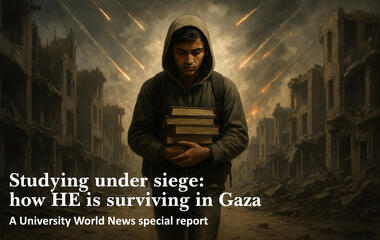 University World News publishes a special report this week, leading with exclusive interviews with the presidents of Gaza's three main universities. We report on the response to their call for practical support from global higher education, while Ahmed Kamal Junina outlines how education has survived. University World News publishes a special report this week, leading with exclusive interviews with the presidents of Gaza's three main universities. We report on the response to their call for practical support from global higher education, while Ahmed Kamal Junina outlines how education has survived.
PAKISTAN Ameen Amjad Khan  The number of international students from countries previously considered a major source of international students is no longer growing at the same pace. With student numbers either stabilising or declining, educational institutions are looking to new populations like Pakistani students to diversify campuses. The number of international students from countries previously considered a major source of international students is no longer growing at the same pace. With student numbers either stabilising or declining, educational institutions are looking to new populations like Pakistani students to diversify campuses.
GLOBAL Min Bahadur Bista  The current era is characterised by rapid technological advancements and significant geopolitical shifts. The future of liberal education depends on its ability to convey that cultivating well-rounded, adaptable and lifelong learners is humanity's most significant asset for both personal growth and collective progress. The current era is characterised by rapid technological advancements and significant geopolitical shifts. The future of liberal education depends on its ability to convey that cultivating well-rounded, adaptable and lifelong learners is humanity's most significant asset for both personal growth and collective progress.
GLOBAL Louise Nicol  Governments in many countries are questioning the value of international education, so universities need to do more to link academic study with the world of work and to demonstrate that preparation for the labour market of today and tomorrow is not palmed off onto industry. Governments in many countries are questioning the value of international education, so universities need to do more to link academic study with the world of work and to demonstrate that preparation for the labour market of today and tomorrow is not palmed off onto industry.
SOUTH AFRICA Desmond Thompson  University World News talks to Professor Deresh Ramjugernath, the new rector and vice-chancellor of Stellenbosch University in South Africa, about the evolving role of African universities and the importance of leadership that emphasises service and social impact. University World News talks to Professor Deresh Ramjugernath, the new rector and vice-chancellor of Stellenbosch University in South Africa, about the evolving role of African universities and the importance of leadership that emphasises service and social impact.
LATIN AMERICA Mariana Ceci de França e Silva, Neri de Barros Almeida and Marcelo Knobel  Although Latin America accounts for roughly 11% of global greenhouse gas emissions, it is among the regions that are most vulnerable to the effects of global warming. Universities have the unique capacity to tackle climate change, but this requires more than isolated initiatives. Although Latin America accounts for roughly 11% of global greenhouse gas emissions, it is among the regions that are most vulnerable to the effects of global warming. Universities have the unique capacity to tackle climate change, but this requires more than isolated initiatives.
UNITED STATES Nathan M Greenfield  The Bureau of Indian Education's request to the United States Congress to drastically cut funding support for Tribal Colleges and Universities will result in dozens of tertiary education schools losing programmes and students, and having to close their doors, fear the leaders of these institutions. The Bureau of Indian Education's request to the United States Congress to drastically cut funding support for Tribal Colleges and Universities will result in dozens of tertiary education schools losing programmes and students, and having to close their doors, fear the leaders of these institutions.
AFRICA The Education Collaborative team
UNITED KINGDOM UNITED KINGDOM UNITED KINGDOM UNITED KINGDOM UNITED STATES UNITED STATES UNITED STATES UNITED STATES UNITED KINGDOM UNITED KINGDOM UNITED KINGDOM UNITED KINGDOM UNITED STATES UNITED STATES |
| Global | Africa | Asia | SDGs | Edtech/AI Commentary | World Blog | Special Reports Terms & Conditions | Newsletter Subscription Advertise | Sponsorship | Facebook | Contact |
| Update | Unsubscribe | Sent to: toyin.adepoju@gmail.com |
| Contact Address: 4th Floor, 18 St Cross Street, London, EC1N 8UN, United Kingdom |
| Copyright 2025 University World News |
Listserv moderated by Toyin Falola, University of Texas at Austin
To post to this group, send an email to USAAfricaDialogue@googlegroups.com
To subscribe to this group, send an email to USAAfricaDialogue+subscribe@googlegroups.com
Current archives at http://groups.google.com/group/USAAfricaDialogue
Early archives at http://www.utexas.edu/conferences/africa/ads/index.html
---
You received this message because you are subscribed to the Google Groups "USA Africa Dialogue Series" group.
To unsubscribe from this group and stop receiving emails from it, send an email to usaafricadialogue+unsubscribe@googlegroups.com.
To view this discussion visit https://groups.google.com/d/msgid/usaafricadialogue/CALUsqTTWsBXZifT_k6fZUEK1cF3RkKqPaBNJv5LX-6M0LG-e6w%40mail.gmail.com.

No comments:
Post a Comment